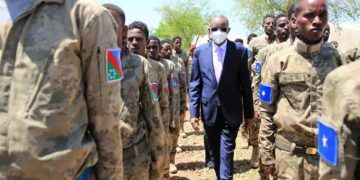
Mogadishu, SOMALIA – Heavy fighting has erupted between the Garre and Jidde clans, both part of the larger Digil clan family, in the town of Qoryoley, located in the Lower Shabelle region of Somalia. The clashes, which began two days ago after four Garre clansmen were reportedly killed, have once again highlighted the fragility of the security situation in the country and the unintended consequences of President Hassan Sheikh Mohamud’s strategy of encouraging clans to raise their own armies to assist in the fight against Al-Shabab.

The renewed clan infighting in Qoryoley is part of a broader pattern of clan conflict that has been flaring up across Somalia in recent months. From Galmudug to Hirshabelle, and now in the Lower Shabelle region, clans have been taking up arms against each other, often in response to perceived grievances or as part of long-standing disputes over resources, power, and political influence.
The Unintended Consequences of Clan Mobilization
President Hassan Sheikh Mohamud’s decision to encourage clans to raise their own armies to assist in the fight against Al-Shabab has been a controversial and risky strategy from the outset. While the president’s intention may have been to mobilize additional forces to support the overstretched and underequipped Somali National Army (SNA) in its battle against the terrorist group, the unintended consequences of this approach are now becoming all too apparent.
The mobilization of clan militias has not only failed to significantly weaken Al-Shabab’s operational capabilities but has also created a dangerous parallel security structure that operates outside the formal chain of command and control of the SNA and the Somali government. These clan militias, often loyal to their own clan elders and political leaders rather than to the state, have become a source of instability and insecurity in their own right, frequently clashing with each other and with government forces.
Moreover, the president’s strategy has had the effect of exacerbating existing clan tensions and rivalries, as clans compete for resources, territory, and political influence in the guise of fighting Al-Shabab. This has created a permissive environment for clan conflict to flourish, as evidenced by the recent outbreak of violence in Qoryoley and other parts of the country.
The renewed clan infighting in Qoryoley, in particular, demonstrates the risks of relying on clan-based militias to provide security in the absence of a strong and cohesive national security apparatus. The fact that the fighting began after the killing of four Garre clansmen suggests that the violence was triggered by a specific incident rather than a broader campaign against Al-Shabab. This highlights the danger of clan militias being used to do the job of the legitimate forces of government.
The Weakness of the Somali National Army
The clan mobilization strategy adopted by President Hassan Sheikh Mohamud is, in part, a reflection of the weakness and limitations of the SNA in its fight against Al-Shabab. Despite years of training and support from international partners, including the United States and the African Union Transition Mission in Somalia (ATMIS), the SNA remains ill-equipped, understaffed, and poorly coordinated to effectively counter the threat posed by the terrorist group.
The recent setbacks suffered by the SNA in its battle against Al-Shabab, including the loss of several key towns and strategic locations in central and southern Somalia, have underscored the urgent need for a more comprehensive and sustainable approach to building the capacity and effectiveness of the national security forces. The fact that the president felt compelled to resort to clan mobilization as a means of bolstering the SNA’s capabilities is a damning indictment of the failure of the government and its international partners to create a professional and self-sufficient military that can protect the country and its citizens.
The clan infighting in Qoryoley and other parts of Somalia also highlights the risks of relying on external actors, such as ATMIS, to provide security in the absence of a strong and effective national security apparatus. While ATMIS has played a crucial role in supporting the SNA and pushing back against Al-Shabab over the past decade, the mission is now in the process of drawing down and handing over responsibility for security to the Somali government. This transition, if not carefully managed and supported, risks creating a dangerous security vacuum that could be exploited by Al-Shabab and other armed groups, including clan militias