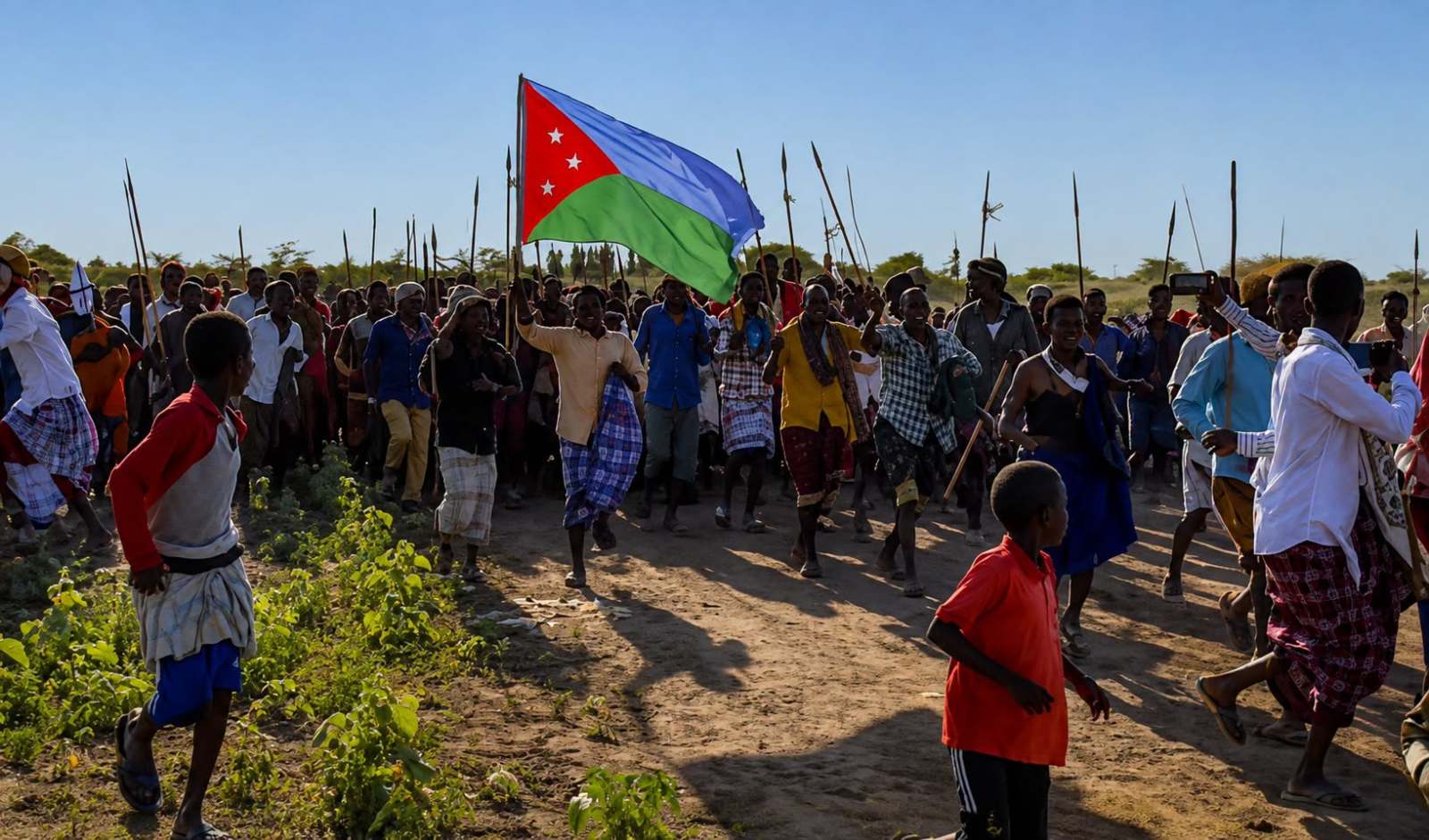
MARKA, SOMALIA – Armed men supporting the administration that calls itself Koonfur Bari entered Marka on Sunday and raised their flag over the district administration building, the district police station and the headquarters of the Lower Shabelle regional administration, taking down the flag of Southwest State at several of those sites. Crowds came into the streets to welcome them, armed men remain posted at the buildings, and no formal recognition of the new administration has come from the federal government or from Baidoa. Marka has been the seat of Lower Shabelle for as long as the region has had one, and the question the morning has left behind is who now holds a town that Somali commandos took from al-Shabaab only months ago.

The Flag Over the Marka Headquarters
The buildings that changed hands are the ones that matter administratively. A district headquarters, a police station and a regional administration office are where land titles are registered, disputes are heard and taxes are assessed, and whoever holds them holds the paperwork of Lower Shabelle whatever any capital says. Lowering the Southwest State flag at those addresses was the substantive act of the day, and the fact that it was accomplished without a reported battle says a good deal about how thinly the previous administration was holding them.
Neither Villa Somalia nor Baidoa had responded publicly by Sunday evening, and neither had recognised Koonfur Bari at any point, a silence that is now several weeks old and has survived every earlier warning of what was coming. In the first week of August a Southwest delegation carrying the justice minister, the deputy security minister, the deputy interior minister and the governor of Lower Shabelle got as far as Ceel Jaalle on Marka’s edge and spent four days sheltering inside an AUSSOM base while residents demonstrated against letting it in. A federal delegation led by Cabdullahi Cumar Abshirow, deputy speaker of a parliament whose term has expired, had turned back from Gendershe days before that.
Read in sequence those episodes describe an eviction carried out in stages. First the ministers were kept outside the town, then the governor could not reach the office he had been appointed to, and on Sunday the flag above that office came down. In Baidoa the installed Southwest president has meanwhile told his own ministers he cannot travel the city’s outskirts without promising to strike the camps beyond them, which leaves his government holding one contested city and no longer holding the other. The road between the two runs through country where al-Shabaab still moves at will, so Baidoa cannot reach Marka by force even if it decides to try.
What the Koonfur Bari Militias Are
The armed men now in Marka are drawn from the Biyomaal, a Dir clan long established along the Lower Shabelle coast and across the farmland behind it. Their mobilisation runs through elders, professionals and diaspora committees as much as through fighters, and it has been assembled in the open, without the concealment that usually attends the raising of a Somali militia. Meetings have been held inside the country and abroad, diaspora associations from Lower Shabelle, Middle Juba and Jamaame have publicly endorsed the project, and reporting from the region puts the sum raised abroad at up to one million dollars.
Geographically the effort covers the coastal strip at Marka, Jilib Marka and Lambar 60, together with the irrigated farmland of Shalaambood and Janaale. That arc holds the best agricultural land in southern Somalia and the shortest sea approach to Mogadishu, which is why every armed actor in the region has spent thirty years trying to hold it. Ranged against the Biyomaal are sections of the Hiraab, principally the Abgaal and Habar Gidir, whose elders have said they will defend what they describe as their own territory against any attempt to alter the balance of control.
The fighting that accompanies the political project has been attributed to named men. A militia reportedly organised by a figure called Cumareey and assembled at Ismaan Quule was accused of burning a commercial farm at Janaale and destroying property valued at more than two hundred thousand dollars, in what local accounts described as an attempt to frighten other clans off the land. The owner, Xasan Maxamed Fiidoow, appealed to Mogadishu and Baidoa to intervene before a full clan war began. Each side accuses the other of targeting farmers and civilians, and no independent account has established who moved first, which is the ordinary condition of a district where no authority is trusted enough to investigate anything.
Three Decades of Land Behind the Guns
Koonfur Bari was not improvised on Sunday. Its organisers declared the administration in Marka on 14 May and named the town its capital, and they have asked to be recognised as a federal member state of Somalia on the grounds that the process reflects the will of the people who live there. The claim underneath it is a grievance about dispossession. Its spokesmen argue that thirty years of war transferred their farmland and their political weight to armed newcomers, that every administration since 1991 ratified the transfer by declining to reverse it, and that the withdrawal of al-Shabaab is the opening to undo it.
The land dispute beneath the constitutional language is concrete and documented. Biyomaal elders allege coordinated seizures along the corridor between Marka, KM50 and the coastal settlements of Jasiira and Gendershe, and in July their fighters detained a survey team and displayed its equipment, saying it had been mapping the Deexda strip for an acquisition they linked to a major Somali telecommunications company. No evidence for that allegation has been published and the company has never answered it. The claim nonetheless travels widely through Lower Shabelle, and it explains why the sight of a surveyor’s tripod now provokes the reaction a rifle would.
Violence followed the argument within days. Fighting broke out around Janaale on 4 July and ran for three days, spreading on the sixth to the road linking Janaale to Marka, fought with small arms and with pickup trucks mounting heavy machine guns, and the banana plantations that give the district its livelihood burned as the fighting moved through them. A ceasefire signed later in July has largely held, which indicates that the elders on both sides retain real authority over the fighters, and that such authority now rests with clan structures and with nothing belonging to the Somali state.
The Order Al-Shabaab Keeps and the State Cannot
Marka and Jilib Marka were taken by Gorgor commandos and intelligence units, Daarusalaam and Mubarak fell to the national army, and a number of al-Shabaab commanders surrendered around Mubarak, Buulomareer and Jilib Marka after President Hassan Sheikh Mohamud renewed his amnesty offer and announced a final offensive against the group. Those were real operations against a real enemy, executed by the best units the country has. What followed them into the vacated districts was a competition over who would inherit them, and the government that cleared the ground put nothing on it capable of settling a farm boundary or registering a title.
The comparison being drawn locally is the one Mogadishu should find hardest to answer. Inter-clan warfare is rarely reported inside territory al-Shabaab still governs, because the group taxes, adjudicates and punishes through a single chain of command that nobody may appeal. Its courts are coercive and its judgments are enforced by killing, and they are also predictable, which is a quality Lower Shabelle has not had from any other source in thirty years. Both the Biyomaal and their opponents took their dispute to al-Shabaab mediators earlier this year while the federal government said nothing at all.
So the arithmetic of the southern campaign has changed shape on a single morning. Lower Shabelle governs the road and the coastline that Mogadishu depends on for its own security, which means a flag change in Marka is felt well beyond the town, and every district recovered from al-Shabaab now carries a second question the offensive was never designed to answer. Soldiers can take territory from an insurgency, and they have taken a great deal of it this year. An administration whose flag has just been lowered over its own regional headquarters has no visible means of holding what they took.