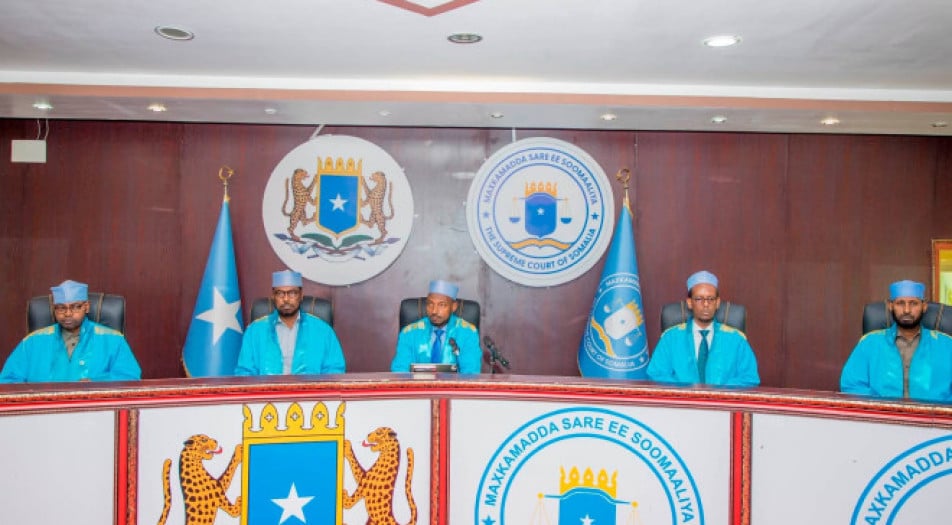
MOGADISHU, SOMALIA – Somalia’s Supreme Court declared President Hassan Sheikh Mohamud’s removal of Chief Justice Bashe Yusuf Ahmed null and void on Thursday 5 November, and on the same day its Constitutional Division ruled that the president’s term ended on 15 May, that Parliament and the federal government expired on 14 April, and that elections must be held within 90 days. The court said the decree of the night before, which gave the bench to Ibrahim Idle Suleiman, the legal affairs secretary of the president’s Justice and Solidarity Party, ignored the procedure the constitution sets for removing a judge and was designed to obstruct Sheikh Sharif Sheikh Ahmed’s case against the March amendments. Security forces were reported at the court building on Thursday afternoon, and the judges were reported to have taken shelter at the former president’s home. By Thursday evening Villa Somalia had answered neither decision.

The Supreme Court Voids the Decree
The Supreme Court’s statement declared the dismissal null and void under Articles 135 and 138 of the 2026 constitution, which allow a judge to be removed only on a proposal from the Judicial Service Commission approved by both houses of Parliament. The presidency’s decree of Wednesday night cited neither body and no article; it referred only to unspecified complaints from judges, judicial staff and legal professionals and announced a broad restructuring of the judiciary with no programme attached. According to the court, the removal was meant “to obstruct the administration of justice in the constitutional case” filed before it, and the statement on the presidency’s Facebook page carried no legal effect.
Both articles belong to the constitution President Hassan Sheikh Mohamud signed into law on 8 March, the text his government has cited for a year of extra mandate, and the Supreme Court measured his decree against it. In 2018, when a decree in the name of Mohamed Abdullahi Farmaajo removed Ibrahim Idle Suleiman and installed Bashe Yusuf Ahmed, the judge who lost his seat said the removal was unlawful and the court passed to his successor anyway. This time the bench itself refused the change within a day, and it did so before the new appointee could take a single decision.
Ibrahim Idle Suleiman, whom a video shows campaigning for the JSP at its Guriceel office, has made no public statement since the ruling, and it has not been reported whether he has entered the court building. Bashe Yusuf Ahmed, who was abroad when the decree was announced, was reported to have flown back to Mogadishu from Nairobi on Thursday. Accordingly, Somalia now has two men claiming the office of chief justice, one appointed by a president the court says is out of term and one restored by the judges who serve under him.
Five Judges Rule the Mandates Have Expired
The ruling on the constitutional petition came from five judges of the Supreme Court’s Constitutional Division, led by Justice Salah Sheikh Ibrahim Dhiblawe and including Abukar Ahmed Ali, Abdulkadir Idiris Eise, Abdulaziz Mohamed Yusuf and Abdulqafar Hussein Isaq, without Bashe Yusuf Ahmed on the bench. They rejected the first part of Sheikh Sharif Sheikh Ahmed’s petition, finding that he lacked standing under Article 86 of the Provisional Constitution to challenge the process by which the amendments were adopted. However, they accepted the second part, which attacked what the amendments had been used for, above all the extension of the federal institutions’ mandates. The Supreme Court had admitted the petition on 12 October and set 22 October for the government’s reply, and the Attorney General’s office later asked for fifteen more days.
The judges reasoned that the March amendments raised the terms of office from four years to five without stating that the new term applied to the institutions already sitting, so those institutions kept the four-year terms set in 2012. On that reading both houses of Parliament and the federal government expired on 14 April 2026, President Hassan Sheikh Mohamud’s term ended on 15 May, and everything those institutions did after those dates is legally invalid. The federal government may run a caretaker administration, limited to routine affairs. The court gave the political parties 30 days to agree on an electoral framework and ordered elections within 90 days.
Reports of the ruling differ on whether it voids the March text itself, and the reasoning published so far turns the challenge to the amendment process away on standing and strikes down the extra year it produced. President Hassan Sheikh Mohamud has argued that the extension was lawful under the amendments, and his government declared a transition period running to nationwide elections in April and May 2027. On the court’s dates, the decree that removed Bashe Yusuf Ahmed on 4 November came from a president whose term had ended almost six months earlier.
Troops at the Supreme Court
Security forces were reported to have entered the Supreme Court premises on Thursday afternoon with more than 30 military pickups and ordered Bashe Yusuf Ahmed out of the building, and accounts from inside said eight of the court’s eleven members were present when they arrived. The court’s official Facebook page, through which it had published its statement, was reported shut down the same afternoon. Bashe Yusuf Ahmed and the judges who issued the ruling were then reported to have taken refuge at the Mogadishu home of Sheikh Sharif Sheikh Ahmed, fearing arrest. The government has confirmed none of these accounts and denied none of them. Unnamed sources had said on Wednesday night that Villa Somalia was weighing measures to stop Bashe Yusuf Ahmed travelling back to Mogadishu.
Abdirahman Abdishakur Warsame, leader of the Wadajir party, an opposition presidential candidate and a member of the National Salvation Forum, accused the president of sending troops to arrest the chief justice. The opposition welcomed the ruling and called both the deployment at the court and the dismissal unlawful. Only days earlier the National Salvation Forum had named a committee to engage with the consultative conference Villa Somalia called for 14 to 18 November, and the Future Council, which includes Puntland and Jubaland, had not answered the invitation when President Said Abdullahi Deni told President Hassan Sheikh Mohamud to resign on 1 November.
The same court certified the Southwest State results this year after federal troops entered Baidoa, and on 24 August it annulled a Galmudug count that had favoured the JSP. Villa Somalia accepted the first judgment and complied with the second. Ten weeks later it tried to replace the chief justice who read the Galmudug decision with a JSP office holder, and the Supreme Court answered by ruling on the petition the replacement had been appointed to hear.
Ninety Days Against the 2027 Timetable
The 30-day window for an electoral agreement, counted from Thursday’s ruling, closes in the first week of December, and the 90 days run to early February 2027, more than three months before the 15 May vote the electoral commission set under the amendments. The November conference now opens inside the court’s first deadline, and every opposition delegation that attends can cite a judgment that President Hassan Sheikh Mohamud’s mandate has lapsed. Former President Mohamed Abdullahi Farmaajo, who leads the Nabad iyo Nolol party, has already warned of parallel elections, and Puntland and Jubaland reject both the constitution and the commission’s schedule. The amendments also created the one-person one-vote framework and the multiparty system under which the JSP was registered, and the Supreme Court left both in place while ruling that the officials who would run a vote under them are out of term.
Meanwhile, AUSSOM’s mandate runs to 31 December, inside the court’s 90 days, and Uganda has begun withdrawing the soldiers it kept in Somalia under its bilateral pact with Mogadishu. The army that would have to secure any vote held by February is fighting al-Shabaab and former President Laftagareen’s forces on the road to Buurhakaba, and the government that commands it is, by the court’s ruling, a caretaker limited to routine business. The Supreme Court has offered no mechanism to enforce its deadlines, and the security services it would rely on answer to the presidency whose authority it has just declared spent.
Villa Somalia’s only statement on the court in two days remains the Facebook post of Wednesday night that the judges have declared void. On Thursday night the chief justice whose bench ordered an election within 90 days was reported to be sheltering at the home of the former president whose petition produced the ruling, and the president it declared out of term had not said whether he would obey it.