BUURHAKABA, SOMALIA – Ethiopian troops serving with the African Union mission handed their base at Buurhakaba to the Somali National Army and left the town on Monday, ending a deployment that began in 2014 and closing the AU presence in one of the more contested districts of the Bay region. Three more towns are expected to change hands in the coming weeks, and the mission’s own mandate has four and a half months left before it expires on 31 December. The federal government asked for a two-year delay in the drawdown and did not get it, because the logistics money that keeps AUSSOM supplied ends on the same December date and the office providing it has already begun auctioning its equipment. Buurhakaba is where that arithmetic first became a departure.

What Changed Hands at Buurhakaba
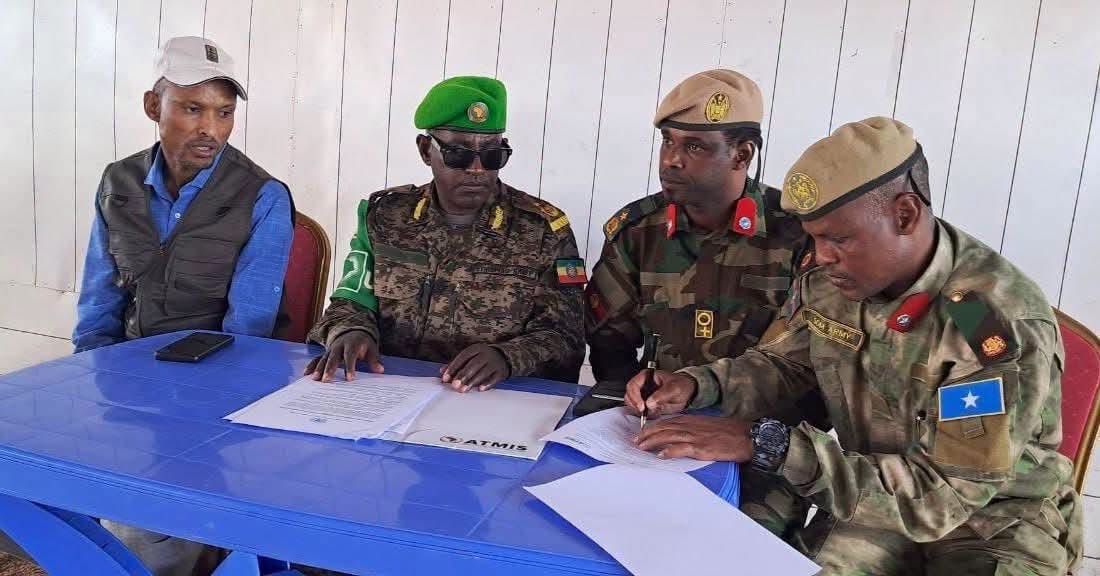
The ceremony was brief and the paperwork ordinary. Officers of the Ethiopian contingent sat with Somali commanders and a civilian official at a folding table, signed the transfer documents, and left the base and its perimeter to a Somali army unit that now carries the town alone. Ethiopian soldiers had held Buurhakaba since 2014, when the town was taken from al-Shabaab during the offensives that followed the arrival of Ethiopia’s troops under the African Union flag, and they had held it through every subsequent reversal in the surrounding countryside. Twelve years is longer than most Somali soldiers in the receiving unit have been in uniform, and long enough for the town’s markets, transport and local administration to have organised themselves around the presence of a foreign garrison.
Geography accounts for the rest of the town’s importance. Buurhakaba sits on the road between Mogadishu and Baidoa, the corridor that supplies the mission’s western sector and the seat of the Southwest administration, and the district’s approaches have never been cleared of the insurgency that operates in the scrub on either side. A garrison that anchors a supply route is worth more than the number of soldiers inside it, and its removal changes the calculation for every convoy that has to pass.
Somali officials have been careful in public and blunt in private. The concern they raise is whether the national army can hold ground that a foreign brigade held with better logistics, air support and casualty evacuation, and whether the roads will stay open once the mission’s own resupply has to run past a town it no longer garrisons. Federal requests for more time have been made repeatedly this year, and the answer arriving from the troop contributors has been a timetable that runs on their budgets. Three further handovers are already scheduled, and nobody has published the list.
A Withdrawal Running Ahead of Its Deadline
The mandate expires at the end of December, yet the withdrawal from Buurhakaba happened in August. Washington told the African Union on 1 July that it would stop funding the United Nations Support Office in Somalia when the mandate lapses, removing roughly a quarter of the office’s budget, and the office has since published a tender to hire auctioneers for its vehicles, generators and field hospitals. Contingents reading that sequence have concluded that an orderly exit beginning now beats an abrupt one in December, and a base vacated in August can be emptied at walking pace with its stores recovered.
Nothing has been found to replace that money. Troop reimbursements for the current cycle needed 190 million dollars and drew commitments of 120 million, the approved logistics budget of 481 million has never been fully financed, and the extraordinary summit in Kampala closed on 31 July by asking the Security Council for another eighteen to twenty-four months of support. The African Union’s military advisers have modelled a phased withdrawal, bilateral substitution and a smaller regional force, and a managed exit is the scenario the transition planning now assumes. Contributing capitals have spent eight months waiting for a funding decision that has not come, and their defence ministries budget in quarters.
Buurhakaba therefore marks the point where the funding gap stopped being a subject of communiqués. Contingent commanders control the pace of their own consolidation, and a contingent that expects no logistics after December will thin its forward positions first, because forward positions cost the most to sustain. The mission approved a joint offensive plan in Mogadishu on 7 August, three days before this handover, and that plan has no money behind it either. Planning documents and troop movements are now pointing in opposite directions, and the movements are the reliable indicator of the two.
The Handover Sequence Somalia Has Seen Before
This film has run twice already. The ATMIS drawdown handed forward operating bases to Somali units in phases through 2023 and 2024, and a series of those towns returned to al-Shabaab within months of the transfer, some within weeks. Moqokori, Mahas and a string of smaller positions in Hiiraan and Galgaduud followed the same arc, and each loss was explained afterwards by the same shortages of ammunition, fuel and pay. The mission that replaced ATMIS inherited the practice along with the bases, and the handover certificate has become the most reliable early warning the insurgency receives.
Nothing in the intervening period has fixed those shortages. The brigade that lost Teedaan at the start of this month had been running short of ammunition for weeks before the attack, according to serving commanders, and its collapse came in a district the army had held since 2022. Handing Buurhakaba to an army in that condition repeats an experiment whose result is already recorded, and the analysts who predicted the group would gain the edge after the ATMIS exit were describing exactly this mechanism.
The insurgency reads the sequence as clearly as anyone. Its pattern after a transfer is to leave the garrison alone for a period, map the resupply schedule, then strike the convoy or the base at the moment the new occupants are most isolated, and it has spent 2026 demonstrating the method along the Hiiraan roads. Buurhakaba’s new garrison will be watched on that timetable for the rest of the year. Meanwhile the soldiers who might reinforce it are dispersed across political tasks in the member states, which is the standing cost of a government that has spent the year fighting its own federal units. Every deployment to Galkayo, Jowhar or Dhusamareb is a company unavailable in Bay, and the units the federal government raised inside Puntland this year ended the summer absorbed into Puntland’s own forces.
What Follows the Buurhakaba Transfer
The next handovers will be harder than this one. Ethiopia holds positions across Bay, Bakool and Gedo, its contingent is the AU force closest to the Southwest capital, and Addis Ababa is managing internal security problems of its own that make an early consolidation attractive. Uganda has 4,500 troops in the south and has signalled its own limits, Burundi has already cut its role, and Egypt’s arrival was negotiated on the assumption that the logistics package would continue. Each contributor now decides its own pace, and the mission has no instrument to compel a common one. A drawdown without a sequencing authority produces gaps in the order the contributors find convenient, which is never the order a campaign plan would choose.
Mogadishu’s answer has been to look outside the African Union entirely. The army commander flew to Ankara on the day of the handover to discuss deepening military cooperation, Turkiye extended its own deployment mandate in July for a further two years, and the government has signed defence agreements with Pakistan and joined a Saudi-led maritime coalition since the spring. Each of those arrangements supplies training, aircraft and a measure of diplomatic cover. None of them supplies the fuel, rations, casualty evacuation and armoured transport that a network of forward positions consumes every week, which is the specific function the departing office performed and the one nobody has offered to take over.
What Buurhakaba establishes is the direction of travel and its speed. A mission whose funding ends in December is vacating ground in August, the federal government’s request for two more years has been answered by facts on the ground, and the Security Council has yet to decide anything about the period after the mandate. The towns on the unpublished list of three will change hands into the same conditions, and the war will register the result well before the diplomacy does.