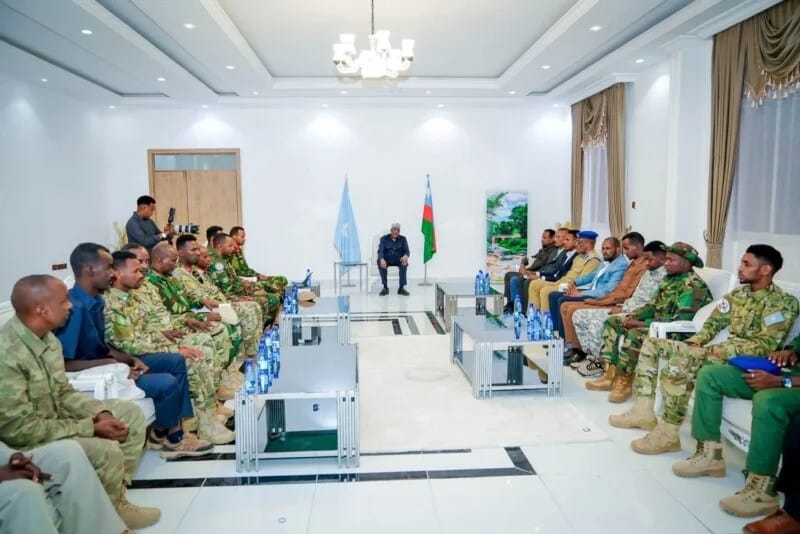
BAIDOA, SOMALIA – Aden Madobe returned to Baidoa on Saturday after a working trip to Mogadishu and told the reception waiting for him at Shaati Gaduud Airport that his administration would target the positions held by forces loyal to his predecessor on the city’s outskirts, setting those forces beside al-Shabaab in the same passage of the same speech. Minutes later Aden Madobe invited young men fighting for al-Shabaab to abandon the group and surrender, promising them reception and a place in the work of building the state. Five months after federal troops removed Abdiaziz Hassan Mohamed Laftagareen and Villa Somalia installed the former federal speaker in his place, the vocabulary of counter-terrorism has become the working language of a succession dispute inside one of Somalia’s most contested member states.

What Aden Madobe Brought Back From Mogadishu
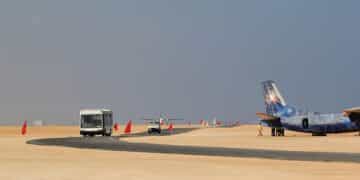
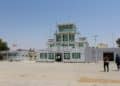
Saturday’s arrival was staged as a demonstration of normality. Members of the Southwest parliament, ministers, lawmakers, security officials and residents gathered at Shaati Gaduud Airport, and state assembly speaker Mahad Mohamed Sheikh briefed the president on a security picture he described as stable, telling him that the forces loyal to the former administration had been badly beaten in their assault on the city a week earlier. He thanked the state and federal units for shielding civilians from al-Shabaab, which he called by the Somali term Khawaarij. The choreography held until Aden Madobe reached the passage of his remarks dealing with the men now camped beyond the city limits.
Those men, he said, were the leadership of the administration he replaced, they were conducting activities on Baidoa’s outskirts, and his administration would target their locations. Aden Madobe drew the comparison with al-Shabaab himself, in public, before an audience of his own ministers and lawmakers, and he offered no evidence of operational contact between the two. He then turned to al-Shabaab’s own recruits with an appeal to abandon what he called an erroneous ideology and to surrender, saying his government stood ready to receive anyone willing to contribute to peace, state-building and development. He closed by asking residents to disregard the propaganda and the threatening messages circulating on social media.
Two offers left the same podium within minutes of one another. Fighters who have spent years inside a proscribed jihadist organisation were promised rehabilitation and a share in the state’s development. Fighters who served a president removed by federal troops in March were promised attention at their camps. Aden Madobe governs a capital where roughly thirty people died in a single pre-dawn battle five days before he spoke, and the arithmetic of that morning remains contested, with a local elder counting ten dead including four civilians against the defence ministry’s larger figure. No independent casualty count has been published, and no reconciliation track has been offered to the losing side.
The Al-Shabaab Procedure Applied to a Political Rival
The state’s security minister, Osman Isaaq Mohamed, had set the terms two days before Aden Madobe landed. Speaking on Thursday about the fighting, he asked the Kenyan government to arrest Laftagareen and hand him over through Interpol so that he could be held accountable, and he alleged that the former president’s fighters had links to al-Shabaab. Neither the extradition request nor the allegation behind it has been supported with published evidence, and Nairobi has said nothing in public about either. Laftagareen has lived in the Kenyan capital since federal troops took Baidoa in the spring.
The minister then described what awaited those fighters if they gave themselves up. In the past, he said, the administration had regarded them as brothers with grievances, and it now saw armed men connected to al-Shabaab; if they surrendered, the procedures used for al-Shabaab defectors would be applied to them. Somalia’s defector programme was designed for men leaving a jihadist insurgency, and it runs through screening, detention, religious re-education and a supervised return to civilian life. It is now the announced route back for the militia of a state president whom the government behind Aden Madobe removed in March.
The label has been travelling toward this formulation for a week. When the federal defence ministry counted the Baidoa dead, it filed them as Khawaarij mixed with Laftagareen militias and displayed bodies, detainees and captured technicals, and former Baidoa officials who examined the same images identified the dead as the Darwish the previous administration had raised. A vehicle presented as a suicide car bomb carried no blast pattern, no fragmentation debris and no crater. Every widening of the category costs the word a little more of its precision, and Aden Madobe has now taken it as far as a serving president can.
The Soldiers Who Have Not Reached Buurhakaba
Three days before the Mogadishu trip, Aden Madobe asked the federal government to send additional troops to Baidoa, having concluded that the units already in the city could not hold it. Villa Somalia has offered no public answer in the days since the request was reported, and the silence is itself a decision about where the government’s remaining soldiers will go. The request followed clashes that filled hospital wards in Baidoa and Mogadishu, and it came from a president whose own state forces had already been thinned by a redeployment, with units pulled out of Baidoa sent west to Buurhakaba, the district astride the road connecting his capital to the federal one.
The town those units went to reinforce had emptied on 8 August, when AUSSOM handed the forward operating base to the Somali National Army’s 60th Division with logistical help from the United Nations support office. Ethiopian troops had held that base since 2014 under three successive African Union missions, and the contingent left shortly after the ceremony. Federal forces expected to fill the gap have still not arrived. Government units hold the town while al-Shabaab works the countryside around it, and the group’s standing method against an isolated garrison is to cut the supply roads and strangle the settlements alongside them until the garrison inside the town is holding nothing but the town.
A finite pool of soldiers is being shuttled between a town facing al-Shabaab and a city facing a deposed president, and Aden Madobe wants a larger share of it for the second assignment. Washington told the African Union in July that it would not support continued United Nations logistical assistance to the mission beyond 31 December, which places fuel, rations, transport and medical evacuation for the entire African force on a four-month clock. Troop-contributing countries asked in Kampala for an orderly transition lasting eighteen to twenty-four months, and no funded alternative has been named since.
A Capital the Template Cannot Hold
The sequence that produced this administration follows a script already run once in this state. Flights between Mogadishu and Baidoa were suspended in mid-March, federal troops took the city on 30 March, Laftagareen resigned within hours, and Aden Madobe moved from the speaker’s chair in the federal parliament to the state presidency through a managed vote in June. Villa Somalia presented the change at the time as an exercise in institutional consolidation and a step toward a functioning federal architecture. What it consolidated has since produced a pre-dawn battle in the state capital, mortar fire into residential districts, an extradition request aimed at a neighbouring country, and a president who cannot travel his own outskirts.
Southwest has also become the place where the price of Mogadishu’s foreign partnerships is paid in the open. Turkish drone strikes on villages near Baidoa produced protests in which the Turkish flag was burned on farmland in the district, with demonstrators holding the Southwest State banner above the fire. Ankara’s partner in Mogadishu installed the administration Aden Madobe leads, and that administration now governs a population which has burned its patron’s flag in a field and is being asked to accept more federal soldiers as the answer.
Aden Madobe’s threat therefore reads as a statement about weakness. A government confident of its writ does not announce that it will strike positions a few kilometres from its own seat, and it does not need to reclassify domestic opponents as an international terrorist organisation to justify doing so. The classification exists because Somalia carries a real jihadist insurgency, one that conflict monitors credit with more than ten thousand deaths in eighteen months. Every politician folded into it makes the word cheaper, and cheap words are precisely what an insurgency lives on once the money for the men fighting it stops in December.