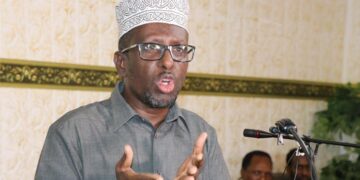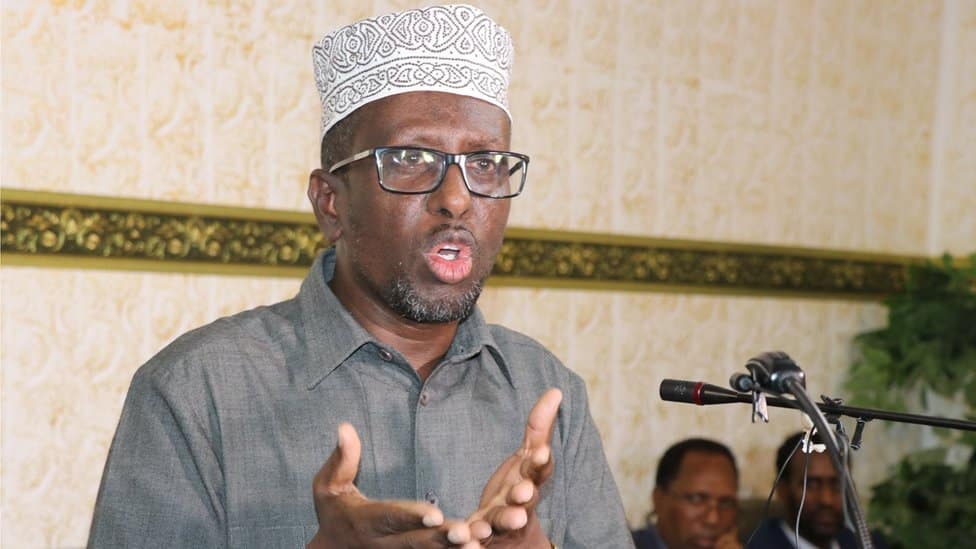
MOGADISHU, SOMALIA – Former President Sheikh Sharif Sheikh Ahmed said on Wednesday 7 October, back from three days in the United Arab Emirates, that President Hassan Sheikh Mohamud wants to declare his blood lawful to shed and is using the Emirates as the pretext, and that the weapons meant for the war on al-Shabaab are being readied to burn Mogadishu. He was answering Defence Minister Ahmed Moalim Fiqi, who on 1 October branded the opposition figures meeting in Abu Dhabi traitors and promised every traitor his due. In remarks reported a day later, Sheikh Sharif Sheikh Ahmed turned on the president’s travel, calling it a disgrace to land in Addis Ababa and fly on to Cairo, in a week when Ethiopia’s state news agency accused President Hassan Sheikh Mohamud of betrayal.

Three Days in the Emirates
“I live in the Emirates, I was there for three days, my children live there and I went for family matters,” Sheikh Sharif Sheikh Ahmed said in remarks published on Wednesday, adding that a man who asks for the constitution to be respected, for an agreed election and for war to be avoided has given nobody grounds to call him a danger to the country. He then named the president: “Hassan Sheikh wants to declare my blood lawful to shed, and he is using the Emirates as the pretext,” he said. His stay in Abu Dhabi, he went on, could never serve as a reason to make lawful “the blood of the opposition people who stand for respecting the constitution and agreeing on the election.”
On Thursday 1 October Defence Minister Ahmed Moalim Fiqi had written that the politicians meeting in Abu Dhabi were studying how Sudan’s Rapid Support Forces work for those who employ them. In his account they would come home with plots against the state and the peace, gather militias and try to restore the rule of faction leaders, and he closed with the line that every traitor to the nation would be given his due. Fiqi named nobody, while reports in Mogadishu placed Sheikh Sharif Sheikh Ahmed, Puntland’s President Said Abdullahi Deni, Jubaland President Ahmed Madobe and the former intelligence chief Abdullahi Sanbalolshe in the Emirati capital for talks on the election dispute.
Four days after the minister’s statement, President Hassan Sheikh Mohamud told an interviewer that the Emirates is a very important country with which his government would keep working to improve relations, while every agreement between the two governments stays suspended. Meanwhile, Sheikh Sharif said the opposition’s plan to hold a conference on the elections this month had run into obstacles, among them “the provocation and the war preparations you have heard the government whose time has expired is carrying out, which they want to bring against the opposition.” The same report noted that accounts had been circulating in Mogadishu of a government plan to attack the compounds where opposition leaders live. No federal reply to him had been reported by the evening of Thursday 8 October.
Where Sheikh Sharif Sheikh Ahmed Is Speaking From
Sheikh Sharif Sheikh Ahmed chaired the Islamic Courts Union, whose six months of rule in Mogadishu ended when Ethiopian troops entered the capital in December 2006. Two years later he came back through the Djibouti process, was elected president in January 2009 and held the office until August 2012, and in May 2022 he stood in the parliamentary vote that returned President Hassan Sheikh Mohamud to Villa Somalia. His presidency ran with African Union troops fighting al-Shabaab street by street around the capital, and it was during his term, in August 2011, that al-Shabaab withdrew its fighters from Mogadishu.
In May he sat with President Said Abdullahi Deni on the opposition side of the Halane talks, which American and British diplomats mediated over three days from 12 May and which collapsed over whether the president’s mandate had run out. The opposition declared that it expired on 15 May, while the president holds that parliament’s amendments lengthened the term from four years to five and keep him in office until May 2027.
On 3 June, as fighting in the capital killed at least thirteen people and displaced some 12,500 households, troops were posted around his home and that of former Prime Minister Hassan Ali Khaire. Then on 10 June more forces moved into the Buulo Xuubey quarter of Wadajir, near the residences of both men and of the Wadajir party leader Abdirahman Abdishakur Warsame.
In July Sheikh Sharif described his tie to the Emirates as personal, said he and his family had lived there for close to a decade, and denied taking any political or financial support, arguing that the Emirates had long helped Somalia with development projects, military training and financial aid. On Wednesday he placed the responsibility in advance: “the country has been confined to one hand, and if anything happens or war breaks out, it falls on the leadership of the state and the government that is spending the national wealth on shedding blood.”
Guns Bought for the Al-Shabaab War
“The weapons meant for fighting al-Shabaab, Hassan Sheikh wants to burn Mogadishu with them,” Sheikh Sharif Sheikh Ahmed said on Wednesday. He added a charge addressed to the government as a whole: “You have brought down the regional administrations, war is going on there, and now you want to bring the war into the capital city.” Since the last week of September, federal forces have fought or faced armed rivals in at least two member states, and al-Shabaab has signed a local deal of its own in a third.
In South West State, the Darawish loyal to the former president Abdiaziz Laftagareen struck the federal army’s 60th Division inside Baidoa on 29 September. In Gedo, the Beled Hawo commissioner said on 5 October that federal-led troops were moving on his town from Luuq and Doolow, and two days later the Doolow commissioner said his district would follow the policy of the Ethiopian forces until a capable Somali government exists. Furthermore, al-Shabaab announced on 3 October a deal with Hawadle elders in Mahaas, in Hiiraan, whose signatories, the Hirshabelle interior minister said on 7 October, do not represent Hiiraan and will face legal action.
President Hassan Sheikh Mohamud gave a different picture on Monday 5 October, two days before Sheikh Sharif Sheikh Ahmed spoke. Al-Shabaab, he told an interviewer, has been pushed back hundreds of kilometres from Mogadishu, and “it is also not possible for the country to return to civil war, clan warfare or political conflict.” He named no district where the front had moved and gave no timeline for the end of the war. Five weeks earlier the army had been fighting al-Shabaab at Basra, within an hour’s drive of the capital, and Adan Yabaal, taken from the group in December 2022, was lost to it again in April 2025.
In August, as bulldozers worked through Yaqshiid, Sheikh Sharif Sheikh Ahmed asked why soldiers who had given ground to al-Shabaab found their courage against unarmed families, and named the national army and the Presidential Guard as present at the demolitions. On that occasion he also told the officers commanding those units to refuse the task.
Addis Ababa on Tuesday, Cairo by Saturday
“It is a disgrace for Somali diplomacy that President Hassan Sheikh lands in Addis Ababa and travels to Cairo the following day,” Sheikh Sharif Sheikh Ahmed said in remarks reported on Thursday morning. Prime Minister Abiy Ahmed met President Hassan Sheikh Mohamud at Bole airport on Tuesday 29 September, and on Saturday 3 October the president was in Egypt with President Abdel Fattah al-Sisi, the same day an interview came out in which he offered Ethiopia two or three Somali ports.
On Sunday 4 October he signed the El Alamein declaration with Egypt, Eritrea and Sudan, which leaves responsibility for the Red Sea with the states on its coast and calls for prior notification and agreement over measures affecting downstream countries on the Nile. On Tuesday 6 October the Ethiopian News Agency answered with a piece titled “How President Hassan Sheikh Mohamud’s Betrayal Undermines Regional Realities.” It recalled Ethiopia’s role in the Sodere and Mbagathi peace processes and its troops in AMISOM, ATMIS and AUSSOM, and a Somali-language account of the piece said it warned that the president’s support for the declaration could lead Addis Ababa to look again at its security cooperation with Mogadishu.
Sheikh Sharif Sheikh Ahmed set out his own line in one sentence: “We do not want to get involved in, or become entangled in, the problems between governments and groups.” Ethiopia’s soldiers are the ones the Doolow administration now says it follows, and at the start of October Mogadishu said it had not been told of an Ethiopian plan to pull troops out of Somalia.
In the week between Fiqi’s statement and Sheikh Sharif Sheikh Ahmed’s reply, the federal government branded the opposition figures in Abu Dhabi traitors, called the Emirates a very important partner, and signed a declaration that Ethiopia’s state media calls a betrayal, while Ethiopian troops hold Doolow, whose commissioner says the district follows their policy.