WANLAWEYN, SOMALIA – More than two hundred federal military vehicles, armoured personnel carriers, troop and supply trucks and technicals among them, moved out of the Baledogle area early on Saturday 24 October and up the Mogadishu to Baidoa road toward Buurhakaba, the Bay district that forces loyal to former President Abdiaziz Hassan Mohamed Laftagareen took on 15 October. The column formed at Xero Shiino and Baledogle after a week in which roadside bombs between Afgooye and Wanlaweyn destroyed military vehicles and, by the account of soldiers in the convoys, killed up to twenty officers and soldiers, men of an Afgooye battalion among them. A Danab unit went ahead of it to clear a road said to be mined, al-Shabaab was reported to have moved fighters into the Buurhakaba area, and the federal government had published nothing on its losses or the operation by Saturday afternoon.

The Column Out of Baledogle
Residents on the Mogadishu to Baidoa road watched the convoy pass for hours early on Saturday. It came out of Wanlaweyn district, went through Baledogle and the small town of Yaqbariweyne, and kept to the main road toward Bay, with armoured personnel carriers and technicals among the troop and supply trucks. Officials have vowed to retake Buurhakaba and the other towns lost in October and to crush the forces that hold them, and no named commander has spoken about the size of the force, its route or how long it is meant to take.
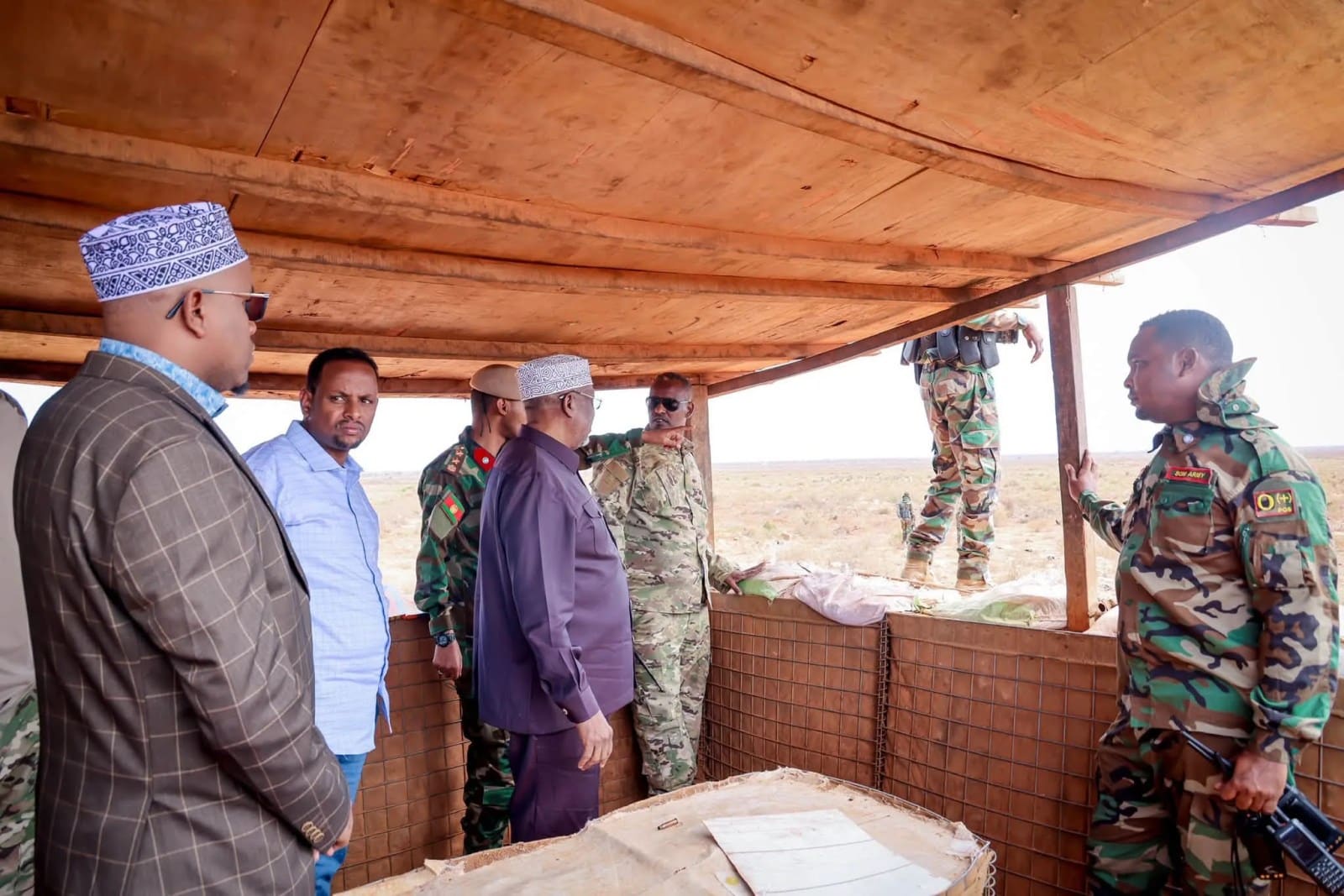
A witness in Wanlaweyn said the vehicles were moving from the bases at Xero Shiino and Baledogle, where the government had been gathering troops for its operations in Bay, and that a Danab unit was travelling ahead of the main body to check the road for buried explosives.
Danab, the special forces brigade trained with American support, began a new round of training at Baledogle in May, and Gorgor units trained in Turkiye were already reported on the move toward Buurhakaba on Wednesday 21 October, when fighting broke out between Jameeco and the town and residents began to leave. Residents later said that push by Danab and Gorgor troops ran into an al-Shabaab ambush near Jamaada, lost two armoured vehicles and fell back to its bases, while the first reports from the same day had the government forces gaining ground; no federal or military statement has addressed either account, and the column from Baledogle set out three days later.
Laftagareen’s forces answered that they would meet the column on the defensive lines they have dug outside Buurhakaba and warned of heavy fighting if it attacked. A local official said rain, mines and the defences built across the roads could all slow the government forces before they reached the district. Reports from the same area also placed al-Shabaab fighters around Buurhakaba, where the administration of President Aden Mohamed Nur Madobe had already claimed on 16 October that al-Shabaab fought beside the Darawish when the town fell. In late March the largest body of troops yet sent against Laftagareen reached Buurhakaba from Lower Shabelle in armoured vehicles, ahead of the offensive that removed him from Baidoa.
A Week of Mines Between Afgooye and Wanlaweyn
On Tuesday 20 October a passenger vehicle travelling from Mogadishu to Baidoa hit a mine between Waraaboole and Doonka, on the road the column would take four days later, and a resident said the vehicle was completely destroyed and only the driver and one woman passenger survived; the same day a second vehicle bound for Afgooye struck another device and three people died at the scene before security forces and civilians reached the wounded. No group claimed either blast, and no official spoke about them. The Afgooye vehicle was carrying a driver and two passengers.
On Wednesday 21 October and through that night, bombs hit federal forces travelling from Mogadishu toward Xero Shiino, the staging ground near Baledogle where the government was collecting troops for Bay. A mine struck a military convoy near Wanlaweyn and killed soldiers of the 54th Battalion of the 7th Brigade, which is based in Afgooye, and members of the forces said that up to twenty officers and soldiers were killed across the attacks and nearly thirty wounded. Some of the wounded were taken to Mogadishu for treatment from the stretch of road between Afgooye and the camps at Baledogle. The names of the dead have not been published, and the figures have not been independently confirmed.
The same soldiers said officers asked to send reinforcements had refused, citing the mines along the road. At least three military vehicles were destroyed in roadside bombings between Wanlaweyn and Afgooye during the week, and outlets close to al-Shabaab reported another vehicle damaged and one soldier killed in an ambush on the Mogadishu to Afgooye corridor on Saturday morning, as the convoy moved. Residents of Afgooye said al-Shabaab is active close to the town. The defence ministry has issued nothing on any of these incidents, as it issued nothing on the attacks reported in early October at Jannaale, Bariire and Qoryooley, where the army also said nothing.
Buurhakaba and the Promise From Baidoa
Laftagareen’s Darawish attacked at dawn on Thursday 15 October and by mid-morning his ministers were speaking from the centre of Buurhakaba, two months after Ethiopian soldiers of the African Union mission had handed its base to the 60th Division. Bardaale fell the next day, and by Saturday 17 October the camp held Qansaxdheere, Buurhakaba, Bardaale, Diinsoor and Awdiinle, about 30 kilometres from Baidoa, most of them taken with little serious fighting after the camp was reported to have turned to local talks and money to win over the men holding them. At Buurhakaba the camp displayed dozens of captured federal soldiers, and at Bardaale the district commissioner took refuge in an Ethiopian army base.
On Sunday 18 October the information minister of President Aden Mohamed Nur Madobe’s administration, Nuur Siidow Baaba, announced that the offensive to take the districts back would begin in Buurhakaba. He called the forces holding them Khawaarij, the government’s term for al-Shabaab, and promised the people of South West that within days they would hear news to make them very happy. The same evening, at a dinner for the state’s federal lawmakers in Mogadishu, the Speaker of the House of the People, Abdulkadir Mohamed Nur, asked the government to make the African Union peacekeepers explain how fighters he described as al-Shabaab came to hold districts the mission had guarded. President Aden Mohamed Nur Madobe, who lost those districts, was among his guests.
While the government gathered its troops at Baledogle, Ethiopian commanders whose soldiers have garrisoned towns in Bay for more than a decade told Mogadishu that their mandate does not cover a political conflict between Somalis, and their soldiers stayed out of the fighting while the towns changed hands. Addis Ababa was reported this week to have told the Security Council that its forces would defend themselves if fired upon. That leaves the federal army to retake the districts itself, from Baledogle and with the Danab and Gorgor brigades that were raised and trained to fight al-Shabaab. President Hassan Sheikh Mohamud’s government removed Laftagareen by force in March, and the five towns it lost in October are the ground it took in that offensive.
A Drone Over Bay and the Corridor Behind the Column
On the night of Wednesday 21 October an aircraft struck a motorcycle in the Bay region and killed two of Laftagareen’s fighters. Hassan Abdulqadir, the camp’s security minister and the man believed to direct its campaign, and Mustafa Qoomaal, a military figure in the same forces, were nearby and survived an alleged Turkish drone strike. Hassan Abdulqadir had toured Buurhakaba with the camp’s ministers on 15 October and had been seen in Qansaxdheere and Diinsoor after they fell. Neither Ankara nor Mogadishu has said anything about the strike, and it is unclear whether he was its target. Laftagareen’s camp has not published the names of the two men killed. A Hassan Abdulkadir Mohamed is the second of the ten names a federal committee listed on 13 October as financiers of al-Shabaab, and the listing does not say whether he is the camp’s security minister.
It was the second air strike on a figure of the Somali opposition in two months. On Thursday 3 September General Mahad Abdirahman Aden, the former commander of the Custodial Corps and Laftagareen’s father-in-law, was wounded when his home in Doolow was hit from the air, and he later named a Turkish F-16 as the aircraft. In late September Laftagareen’s fighters struck the 60th Division inside Baidoa itself, and on 13 October a federal anti-money-laundering committee listed Laftagareen, General Mahad and the camp’s spokesman among ten people it accused of financing al-Shabaab, a list that otherwise names the group’s own leaders.
The soldiers of the 54th Battalion who died this week were killed on the road the column now uses, by mines laid while the government gathered its forces at Xero Shiino and Baledogle for an offensive against Laftagareen. The only federal casualty figures reported in the week came from devices on the Baledogle road, between Afgooye and Wanlaweyn, before the column had reached the district it set out to recover, and the Danab unit at its head was clearing that road of buried explosives on Saturday morning. No figure for the army’s dead in Lower Shabelle has been published, and its commanders have announced only that the campaign for Buurhakaba has begun.