Cross-Border Raids Signal Widening Reach
Al-Shabaab attacks have intensified across Somalia and its borders in recent weeks, underscoring how the country’s political paralysis is feeding the militant group’s resurgence. On 12 June, suspected Al-Shabaab fighters launched a nighttime assault on a Kenya Defence Forces camp in Lafey, Mandera County. Around ten heavily armed militants opened fire from 600 metres out. Kenyan troops repelled them without casualties, but the brazenness of the attempt sent a clear message.

Four days earlier, on 8 June, gunmen believed to have crossed from Somalia raided Elgolicha village near the Kenya-Somalia border. They killed two civilians, including an 82-year-old man, and seriously wounded his wife. Kenya’s President William Ruto declared on 3 June that the border with Somalia would remain closed, citing persistent Al-Shabaab attacks. These cross-border operations are not isolated. They reflect a pattern of Al-Shabaab attacks expanding outward as the group grows bolder inside Somalia.
A Year of Territorial Gains
The militant group has spent the past nine months exploiting the security vacuum left by ATMIS withdrawals. Since October 2025, Al-Shabaab has retaken at least five districts in Lower Shabelle and Middle Jubba. In January 2026, the group overran a Jubaland regional forces base in Kudhaa, Lower Juba, killing over a hundred soldiers according to its own claims. That same week, it seized four SNA bases near Warsheikh in Middle Shabelle.
The numbers are staggering. Between October 2025 and March 2026, Al-Shabaab carried out more than 340 attacks across southern and central Somalia. Over 1,200 civilians were killed or injured. Nearly 480,000 people were displaced. A February 2026 vehicle-borne IED near Mogadishu’s airport killed 32 people. Analysts have long warned that Al-Shabaab would gain the edge over the SNA once ATMIS departed. That prediction has come true.
The group has also upgraded its arsenal. Intelligence reports indicate that Al-Shabaab received a significant shipment of weapons from Yemen’s Houthis in early 2026, including UAVs. This represents a qualitative shift in capability that the SNA is ill-equipped to counter.
The Political Crisis Is Al-Shabaab’s Best Weapon
None of this is happening in a vacuum. Somalia’s political class has been consumed by the electoral crisis triggered by President Hassan Sheikh Mohamud’s constitutional amendments in March. The Al-Shabaab attacks have intensified precisely as the federal government diverted thousands of troops to Baidoa to oust Southwest State’s elected president. Those same soldiers could have been holding the line in Lower Shabelle or Middle Jubba.
The Lido Beach massacre exposed Mogadishu’s security vulnerabilities. The June 3-4 clashes between government and opposition forces in Howlwadaag, which killed 13 and displaced 12,500 households, diverted even more security resources from counter-terrorism. Al-Shabaab watches and waits for exactly these moments.
The group itself has said as much. In a rare Eid audio message on 29 May, Al-Shabaab spokesman Ali Dhere seized on the political impasse to argue that Somalia remains under Western control. He claimed that American and European diplomats summoned both President Hassan Sheikh and opposition leaders to Halane base camp and delivered an ultimatum. He urged SNA soldiers to defect rather than fight in what he called a foreign-led “crusade.” The messaging was calculated. Al-Shabaab attacks on morale are as deliberate as their attacks on bases.
A Military in Crisis
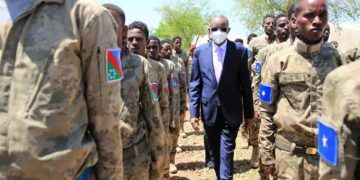
The SNA’s ability to respond is at its lowest ebb in years. Former President Sharif Sheikh Ahmed has stated publicly that the army does not have “even one brigade that is combat ready.” UAE-trained forces have been reduced to less than half their original strength. The elite Danab unit has been gutted by a corruption scandal that led to the suspension of US food rations. Turkish-trained Gorgor forces have been decimated.
The concerns over the ATMIS withdrawal were well-founded. AUSSOM, the successor mission, has far fewer troops and a more limited mandate. Joint AUSSOM-SNA operations have scored some tactical wins. In April, they captured a senior Al-Shabaab commander in Lower Shabelle. In March, SNA troops repelled a major assault near Mubarak, killing 40 militants. But these are defensive actions. The initiative belongs to Al-Shabaab.
The political fracture makes things worse. Three of Somalia’s five Federal Member States have broken with Mogadishu. Puntland does not recognize the federal government. Jubaland is running its own security affairs. Southwest State remains volatile after a military takeover. This means the intelligence sharing and coordinated operations that counter-terrorism requires are functionally impossible. As a previous TSD analysis noted, Al-Shabaab has consistently exploited inter-governmental disputes to advance its objectives.
Al-Shabaab attacks will continue to escalate as long as Somalia’s leaders remain consumed by their own power struggle. The group does not need to win battles. It only needs to outlast a political class that keeps handing it opportunities. Every troop diverted to Baidoa, every bullet fired in Howlwadaag, every month without elections is a gift to the insurgency. The question is no longer whether Al-Shabaab is gaining ground. It is whether anyone in Mogadishu is paying attention.
Both halves of that equation held through July. Somali and allied forces reported killing sixteen fighters in Hiiraan and Middle Shabelle on 26 July without changing who controls the ground, while the mediation between Villa Somalia and the opposition collapsed the following day without a joint statement. The African Union troop contributors meet in Kampala on 31 July to decide whether the force that has absorbed most of the fighting stays at strength.