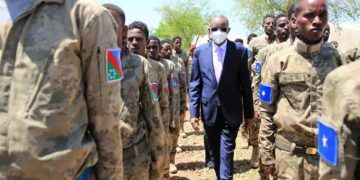
Dhusamareb, SOMALIA – The people of Galmudug have made their position unmistakable. In scenes circulating widely on social media, residents took to the streets of Dhusamareb brandishing weapons in open defiance of Galmudug federal elections imposed by Mogadishu. This was an armed population telling the federal government that it will not accept elections dictated by Villa Somalia.

This is not a routine political disagreement between Mogadishu and a recalcitrant region. The armed rejection of Galmudug federal elections represents the most direct challenge yet to Hassan Sheikh Mohamud’s centralization campaign. It comes as federal troops already control much of Dhusamareb, the regional capital, and as Galmudug President Ahmed Abdi Kariye “Qoor-Qoor” finds himself effectively besieged inside his own presidential compound.
A Region Under Federal Occupation
The crisis in Galmudug has been building for weeks. According to a senior Galmudug minister identified as Minister Kayse, heavily armed federal troops have seized strategic positions across Dhusamareb. Parliament headquarters, the Xero Inji area, and all major roads into the city are under federal control. The Galmudug leadership is politically isolated and militarily encircled.
The public response to this occupation has been defiant. Residents have rejected the Galmudug federal elections outright. Videos show civilians displaying heavy weaponry in an organized demonstration, sending a clear signal that the population stands behind its regional government. TSD has previously reported on how clan clashes near Dhusamareb were the result of President Hassan’s strategy. The current standoff is a direct escalation of that pattern.
Commander General Sadaq John publicly sided with President Qoor-Qoor. He accused Hassan Sheikh of lacking constitutional authority to interfere in Galmudug’s political future, noting that the president’s mandate expired on May 15, 2026. His warning was pointed: “The peace of Dhusamareb and the peace of Mogadishu’s Wardhiigley district are connected.” Destabilize Galmudug, and Mogadishu will feel the consequences.
The Southwest Playbook Repeated
What is unfolding in Galmudug follows a pattern that TSD has documented extensively. In Southwest State, the federal government removed President Laftagareen through a Turkish-backed military campaign, then installed parliament speaker Adan Madobe in an 88-1 vote the opposition called a sham. Hassan Sheikh’s constitutional gambit is being applied state by state.
Now the same playbook targets Galmudug federal elections. Federal troops move in. The sitting president is isolated. A replacement candidate is identified. Reports indicate Hassan Sheikh is backing businessman Libaan Ahmed Hassan, known as “Libaan Shuluq,” as Qoor-Qoor’s replacement. The Galmudug federal elections are being engineered to deliver a specific outcome, just as they were in Baidoa.
But Galmudug is not Southwest State. The armed public rejection of Galmudug federal elections demonstrates that the population is prepared to resist. President Qoor-Qoor has openly declared that Galmudug will not accept a leader imposed from Mogadishu. He rejected what he called “unconstitutional interference” and dismissed the “one person, one vote” project as a mechanism for consolidating power.
Internal Rifts Expose Villa Somalia’s Weakness
The Galmudug crisis has also exposed a significant rift within Villa Somalia. President Hassan Sheikh and NISA Director Mahad Mohamed Salad are reportedly divided over who should lead Galmudug. Hassan Sheikh backs Libaan Shuluq. Mahad Salad reportedly favors maintaining Qoor-Qoor or keeping the succession under his own influence.
Rumors have circulated that Mahad Salad has been sidelined from his intelligence role. Political insiders claim Hassan Sheikh may soon replace him with a chief more aligned with his political strategy. This internal power struggle weakens Villa Somalia precisely when it is trying to push Galmudug federal elections through against popular resistance.
The disagreement reveals something deeper. Hassan Sheikh’s coalition is fracturing under the weight of his own overreach. His divisive elections bill has alienated not just opposition leaders and federal member states, but even figures within his inner circle.
A Crisis on Multiple Fronts
The rejection of Galmudug federal elections is one front in a broader war Hassan Sheikh is waging against Somalia’s federal system. And unlike Southwest State, the Galmudug federal elections face organized, armed resistance from the population itself.
In Mogadishu, government forces clashed with opposition groups in early June. Troops surrounded the homes of opposition leaders in Bulo Hubey. The acting US ambassador intervened to prevent further bloodshed. In Jubaland, federal forces suffered a humiliating setback when troops surrendered after clashes in Raskamboni. In Southwest, a military operation preceded a managed election.
The Galmudug and Jubbaland presidents jointly warned the federal government against pursuing a “unilateral electoral process.” Qoor-Qoor stressed that Somalia requires an inclusive agreement involving all stakeholders. Turkey’s mediation efforts have stalled. International observers warn that the electoral showdown risks triggering another round of turmoil.
Hassan Sheikh’s credibility on elections and federalism has eroded beyond repair. The Galmudug federal elections were scheduled for June 20 for local councils, July 2 for the lower house, and July 9 for the presidential vote. Whether those dates hold is now deeply uncertain.
What is certain is that the people of Galmudug have rejected the terms on which those elections are being organized. Hassan Sheikh can deploy troops. He can isolate presidents. He can engineer elections. But the weapons on display in Dhusamareb carry a message that no amount of federal troop deployments can silence: Galmudug is prepared to draw a line that even Villa Somalia may not be willing to cross.
The vote has slipped ever since. The electoral commission moved the Galmudug regional council and House of Representatives elections from 20 July to 25 July and then to 30 July, and set the Banaadir district council poll for the same day with the Mogadishu mayoral vote on 5 August. The show of force in Dhusamareb has therefore achieved what its organisers wanted for now, which is delay, without resolving who decides how the state votes.