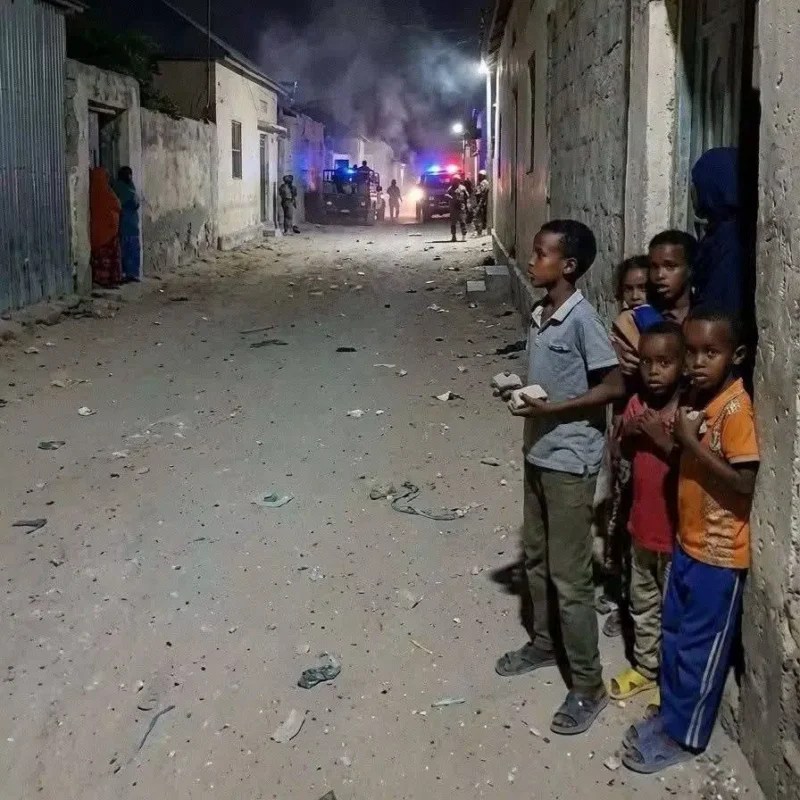
MOGADISHU, SOMALIA – Residents of Tookiyo say they were asked for eighteen thousand dollars each to keep the ground their houses stand on, a figure that surfaced this week alongside the names of businessmen said to have been handed the road-widening work that cleared the district. No demolition order signed by President Hassan Sheikh Mohamud has been produced, and no institution has published the legal basis for an operation that opened with bulldozers and heavy machine guns before dawn on 23 August. A price per plot puts a transaction at the centre of an operation the state calls enforcement, and it lands on research arguing that public land in Mogadishu now works as a currency of political finance. Three former leaders said as much from one platform ten days ago. The answer came on Friday from the Banadir governor, who described road-widening, resettlement, and scholars already consulted.

The Price of Staying Put
The account circulating from Tookiyo this week describes an operation that began as road regularisation and ended as a levy. Residents were told the purpose was to reopen planned roads and put the street grid in order, and that households holding title deeds and tax receipts would not be moved if their plots lay outside the mapped alignments. What followed departed from that description. Reports from the neighbourhood say a figure of eighteen thousand dollars was sought from each person holding a plot or a business pitch to keep it, that some paid, and that those unable to raise the money came under pressure to leave. Neither the sum nor the arrangement behind it has been independently verified, and nobody named in the accounts has responded publicly.
Furthermore, the same reporting places a group of businessmen at the centre of the work, naming Muxudiin Saawey and Ismaaciil Wardheere among those said to have been assigned to or involved in the road scheme in the district. These are claims carried in local reporting, unsupported by any court finding or published inquiry, no documentation has been produced to substantiate them, and the men themselves have made no comment. The verifiable part is narrower: an operation conducted by uniformed men with heavy weapons, in which residents were shot at and killed, has produced no traceable written authority from any office in Mogadishu, while the sums allegedly moving through it were denominated in dollars per plot.
Consequently, the question that has taken hold across the capital is procedural before it is political. Somebody ordered bulldozers and soldiers into an inhabited neighbourhood at midnight, and eight days later that person has not been identified, nor the statute the order rested on. Banadir governor and Mogadishu mayor Hassan Mohamed Hussein, known as Muungaab, gave the administration’s account on Friday: the plan is to rehabilitate public land in Kaaraan and Yaqshiid to open roads, the ground is being legalised for those living on it, documented owners will not be touched, and the first thousand resettlement plots are nearing completion at Gubadley. His statement carries no casualty figure, no legal instrument and no accounting of money collected, and a state that cannot name the author of its demolition order is describing the limits of its authority.
Three Former Leaders and One Word
The opposition reached this argument before the Tookiyo figures emerged. At a press conference on 18 August, former president Sheikh Sharif Sheikh Ahmed said the government had not halted the displacement of residents and located the decision-making squarely inside the presidency. “Sell your house or move out is how it goes, and every decision today is taken at Villa Somalia,” he said, adding that those responsible showed no embarrassment and that he did not know how they intended to go on living among the people affected. The charge is about authorship, and it anticipates precisely the gap that Tookiyo has now exposed.
Former prime minister Hassan Ali Khaire put the same accusation in property terms. He said the land of Mogadishu that had been entrusted to a president whose term has expired was signed over by that president to himself and his allies, and bought unlawfully. His phrase for the practice was burcad dhuleednimo, land banditry, and he tied it to a question about what kind of society emerges from it. Abdikarim Hussein Guuleed, until recently the president of Galmudug, described a problem that had been dragging on in Mogadishu for years and has sharpened lately into looting, with one detail that the Tookiyo price tag now illuminates. The bulldozer, he said, targets the poorest people in particular, which is what a levy of eighteen thousand dollars does when it decides who stays.
Moreover, the formulation Khaire used deserves attention for its precision. Calling the president muddo xileedkiisu dhammaaday, the one whose term has expired, is the identical construction Sharif and former president Mohamed Abdullahi Farmaajo both reached for over the demolitions in Yaqshiid, and it converts a property complaint into a question of title. An administration holding office past its electoral timetable is disposing of assets it holds only in trust, and the buyers acquire whatever a caretaker can lawfully convey. That is the argument the opposition has now made three times in a fortnight, and Villa Somalia has met it with silence on every occasion.
What the Research Already Said
Academic work on Somali political finance described this machinery more than a year before Tookiyo. A study published in July 2025 examined the auctioning of constitutionally protected public land in Mogadishu, including a cemetery and a former military camp, and found that the cash proceeds served two purposes at once, building the president’s own capital while rewarding the wealthy allies who bankrolled his election campaign. Its frame is the political marketplace, in which loyalty is bought and sold and political survival runs on financial flows. Land is simply the largest asset a government in Mogadishu controls, which makes it the obvious instrument.
Additionally, the scale involved is a matter of public record. An assessment published in May by the European Union’s asylum agency counts more than 1.1 million displaced people in Mogadishu across nearly 2,500 verified sites, the largest such concentration in the country, and states without qualification that political and military elites are regularly involved in seizing public and private land and ordering the eviction of vulnerable populations. Rising land values, it notes, drive land grabs by the political and economic elite, and large-scale violent evictions continue in Somalia’s major cities. This is a European institution describing the conduct of a government it funds.
The chronology behind those numbers runs back three years and rehearses every element visible in Tookiyo. The police academy cemetery at Hamr Jajab, where authorities sought a religious ruling to permit exhumations and families paid for permits to move their own dead. Kalluunka, cleared in late 2024 and announced months later as a public park. Sinaay market in Warta Nabadda and the Belego Arab market in Shibis, both razed in the first week of August 2025 with traders alleging a takeover by well-connected businessmen. More than 142,000 people have been forcibly evicted from temporary shelters since the start of 2025 by United Nations counting, most of them in urban settlements in Mogadishu, Baidoa and Kismayo, and a detailed accounting of the campaign records the rent on a makeshift room rising from thirty dollars to fifty.
The Mogadishu Asset Register Nobody Keeps
What makes the land programme durable is the absence of records against which any of it could be tested. Estimates put around a hundred government facilities in Mogadishu under occupation by residents, among them ministry compounds, former military bases and pre-war embassy buildings, and no reliable inventory of public property exists. That vacuum works in one direction. A government that cannot produce a register also cannot be shown to have sold anything improperly, and every clearance can be presented as the recovery of state assets from squatters. The same missing paperwork that justifies the bulldozer prevents an audit of what happens to the ground afterwards.
Meanwhile, the security arithmetic sits underneath all of it. Soldiers and heavy machine guns were available for Tookiyo, as they were for Marka and for Baidoa, at a moment when the logistics keeping the campaign against al-Shabaab in the field are being dismantled through procurement paperwork and federal reinforcements requested by allied administrations never arrive. Sheikh Sharif has already asked why an army that gave ground to the insurgency is fearless against unarmed families, and the Tookiyo accounts supply a reading of that asymmetry. Demolitions in Mogadishu generate revenue and the frontline consumes it.
The Union of Somali Ulema Councils has since asked the president, the prime minister and the Banadir administration to open an independent investigation, saying property must not be taken through force, administrative order or intimidation without a fair judicial process. Muungaab’s answer to them is that the administration has already consulted the scholars, which is the same instrument the government reached for in 2024 when it sought a religious ruling to sanction clearing the cemetery at Hamr Jajab. The council that says it is still waiting for an investigation has now been cited as having been consulted. A federal government that holds office on an expired mandate and answers for its capital’s dead only through leaks has one asset left that generates cash without a donor’s signature, and it is selling the ground its own citizens are standing on.