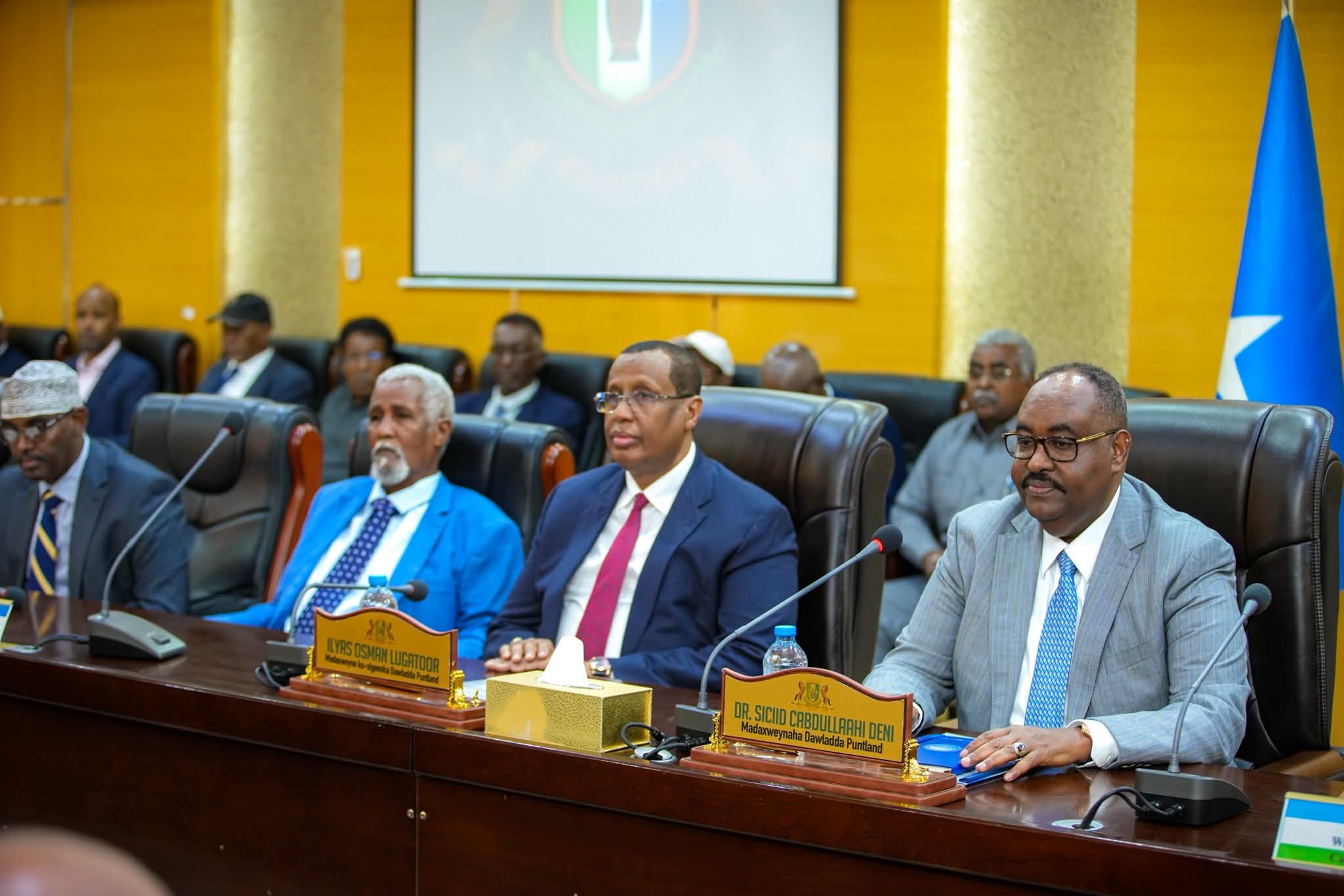
Garowe, SOMALIA – The Puntland Council of Ministers met on Thursday under President Said Abdullahi Deni and his deputy, and issued the administrative half of a confrontation that has been fought since Tuesday with mortars, rifles and defecting brigades. Its decisions bar any armed force or vehicle outside Puntland’s own security institutions from moving through the state’s territory, refer the names of politicians and military officers accused of destabilising it to the justice institutions, order the forces onto piracy and illegal fishing in Puntland waters, and put broadcasters and social media accounts on notice. Ground taken by force this week is now being written into Puntland’s legal order.

The Puntland Council of Ministers Meets Against a Clock
Praise came first in a communique otherwise built out of prohibitions. The Puntland Council of Ministers commended the operations its defence forces have carried out across several Puntland towns over recent days. Those operations, it said, broke a planned assault by the federal president whose term has expired. The cabinet described that assault as an attempt to shake both Puntland’s security and its statehood. Garowe withdrew its recognition of the mandate in Villa Somalia after the four year term expired in May, and its ministers have written about Mogadishu in those terms ever since.
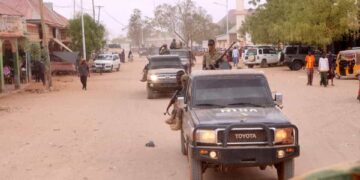
That praise rests on a week of steady gains on the ground. Puntland forces intercepted a mortar shipment moving toward the contested camp on Tuesday. At dawn on Wednesday they overran the camp itself beside Galkayo airport, detaining more than a hundred men and seizing weapons, vehicles, uniforms and ammunition. Mortar rounds fell in residential streets during the hour of fighting that followed. President Deni afterwards described the site as the place through which the federal government had been moving weapons, equipment and troops. By Thursday morning the PSF camp in Bosaso had changed hands without a shot being fired, leaving Mogadishu without a garrison of its own in either of Puntland’s two largest cities.
Movement continued overnight in the opposite direction, which complicated the picture considerably. Units based at the Barda-dheere camp in northern Galkayo crossed to Danab positions in the south of the city, inside Galmudug territory. They announced that they had joined the federal government, and the federal deputy finance minister Abdiqafar Elmi Hange took part in the transfer. President Deni had already given Mogadishu forty eight hours to pull out the forces it still holds on Puntland soil. Consequently the Puntland Council of Ministers sat down against a running clock, with its own troops in possession of the disputed camps. The federal government has answered neither the ultimatum nor the accusations behind it.
An Order Issued Twice in Seven Weeks
The operative clause of Thursday’s decision instructs every security agency in the state that no force and no vehicle belonging to anything other than Puntland’s official security institutions may move within its territory. Officials are told to act against whoever crosses that line. The Puntland Council of Ministers issued almost exactly the same instruction in June, when the dispute was still being conducted through statements rather than through artillery. That earlier text went further in one respect, forbidding outside units to remain in Puntland or even to pass through it. Puntland’s own soldiers have now taken by force the camps the June order was written to keep empty.
Reissuing an order seven weeks later is an admission about how much the first one bound. In June the ban was tied explicitly to the integration question. Garowe refused then to fold its brigades into a national army until the constitutional and electoral disputes with Mogadishu were settled, and that refusal has hardened since. What changed in the interval is that the federal government tested the prohibition. It moved weapons and men into Galkayo, and it absorbed Puntland defectors into units flying its own flag. Puntland answered this week with soldiers rather than with another communique.
Underneath the legal language sits a straightforward claim about who decides which uniform is lawful in the northeast. President Hassan Sheikh Mohamud has spent this administration converting federal member states into extensions of the presidency, taking Southwest by force and delivering Galmudug through a managed vote. Applied to Puntland, the same method has run into an administration with its own army, its own revenue and twenty eight years of institutional practice. Furthermore, the language President Deni used when he turned the Galkayo operation into a message earlier this week points in exactly that direction. The Puntland Council of Ministers has now given that message the form of a standing order.
From the Battlefield to the Courtroom
The most consequential decision taken on Thursday moves the confrontation into court. The Puntland Council of Ministers resolved to hand its justice institutions the names of politicians, military officers and other individuals accused of taking part in acts designed to destabilise Puntland’s security and its system of government. Prosecution is the stated purpose. No list accompanied the statement, and no evidence was set out in it, which leaves the scope of the exercise open to interpretation in Garowe and in Mogadishu alike. Ministers offered no timetable for the referrals either, and no indication of how many names the file contains.
Roughly a hundred and sixty men are already in Puntland custody after the Galkayo operation. Most of them are former Puntland soldiers who transferred to federal command in recent months, and several held rank in Puntland’s own forces before they went. Mogadishu regards them as members of the national army deployed on national territory. Garowe regards them as men who took foreign money and foreign orders to raise arms inside a functioning state, which is a description of treason in any legal system that takes itself seriously. Between those two readings there is no middle position available, and the courts are now being asked to choose one.
Prosecution therefore achieves something that a battlefield victory on its own cannot. It converts a political quarrel into a criminal record. It also commits Puntland to proving in open proceedings what its ministers have so far asserted in press releases. Notably, trials held without published evidence would hand Mogadishu the argument that these are political proceedings dressed as law. Puntland’s standing case against the federal government rests on being the better governed of the two. Accordingly the Puntland Council of Ministers has chosen the one arena in which that claim can be demonstrated or squandered in public.
The Coastline and the Contest Over Information
Two further decisions extend the same jurisdictional logic beyond the land. The forces were ordered to move against organised crime at sea, with piracy and illegal fishing named specifically. Anyone trespassing in Puntland’s waters is to face firm legal action. Hijackings have returned to the western Indian Ocean this year after a long lull, and the foreign trawlers working the Somali shelf never stopped through it. Puntland has policed that coastline with a maritime force of its own for well over a decade, while the federal writ offshore has stayed thin. Whoever polices those waters is exercising sovereignty over them.
The information clauses of the statement follow the same reasoning. Media houses working inside Puntland were reminded to observe the state’s press law and the professional ethics of the trade. The Puntland Council of Ministers also approved legal steps against social media owners and accounts that habitually circulate false material damaging the reputation of Puntland’s system of government. Garowe’s position is that an armed confrontation of this kind generates an information war of its own. Claims about defections, troop movements and casualties travel faster than anyone can verify them, and a state under attack, in the cabinet’s view, is entitled to defend its institutions against fabrication.
Officials in Garowe would add that the same statement instructs the forces to discharge their duties in accordance with the constitution and the laws protecting human rights. That is the standard Puntland has set for itself and expects to be judged against. Journalists’ organisations have raised concerns this year about detentions in Bosaso, and there is a practical case for keeping that space open. An administration whose whole argument is that it governs better than Mogadishu gains from reporting its own public finds credible. Above all, every clause of Thursday’s decision assumes an authority the Puntland Council of Ministers intends to exercise whether or not the federal government concedes it, and the coming weeks will test how far it reaches beyond the camps its soldiers now hold.