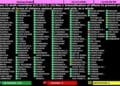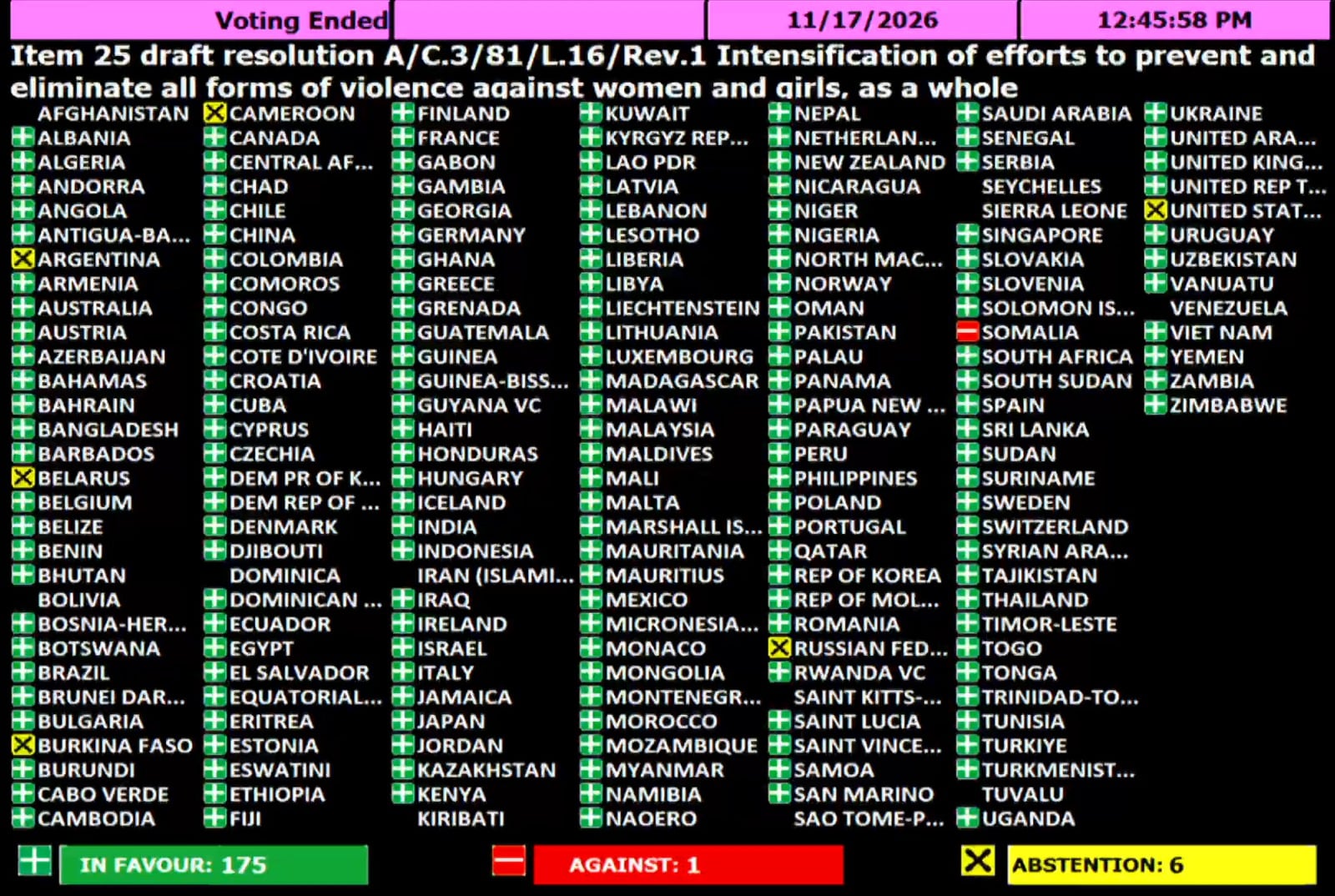
NEW YORK, UNITED STATES – Somalia cast the only vote against the United Nations resolution on violence against women and girls when the General Assembly’s Third Committee approved it on Tuesday 17 November by 175 votes to one, with six abstentions, in the last weeks of Somalia’s two-year term on the Security Council. Egypt, Saudi Arabia, Pakistan, Qatar, Sudan, Yemen and Turkiye voted in favour, as did Kenya, Ethiopia, Djibouti, Eritrea and Uganda, while the United States, Russia, Argentina, Belarus, Burkina Faso and Cameroon abstained. Somalia’s delegation spoke on none of the eleven amendments debated before the vote, entered no reservation afterwards and has published no explanation, and the voting board records its position as a single red mark beside its name.

Egypt’s Amendment and the Third Committee Vote
The Netherlands and France presented this year’s text, which the Dutch Permanent Representative said focused on gender-related killings, and Mexico’s delegate called femicide the most extreme manifestation of violence against women and girls. Before the final vote, Egypt introduced amendment L61 on behalf of a cross-regional group of 21 states, which would have required the resolution to be implemented with respect for each country’s sovereign right, its national laws and development priorities, and its religious, ethical and cultural values. Egypt’s delegate called the amendment “the minimum insurance policy” and told the Third Committee that its wording came verbatim from the declaration of the 1994 population conference in Cairo.
France moved that the committee take no action on Egypt’s amendment. Mexico, which said it normally opposes such motions, backed this one because Egypt had never put the amendment before the full membership during five rounds of informal consultations, and the motion carried by 68 votes to 54 with 30 abstentions, so the amendment never came to a vote on its merits. Ten further amendments followed, four of them from the Russian Federation, which sought to delete references to gender-based violence, intersecting forms of discrimination, intimate partner violence and women and girls in all their diversity. Every one of the ten failed, the closest by 58 votes to 72.
The United States then abstained on the whole text, objecting to the terminology of sexual and reproductive health and the notion of safe abortion in its fourth operative paragraph, and its representative told the Third Committee that each nation has the sovereign right to legislate against abortion. Russia, Argentina, Belarus, Burkina Faso and Cameroon abstained alongside it, while Afghanistan and Iran cast no vote at all. Somalia, which had not taken the floor at any point in the three hours of debate, voted no, and the Chair announced the result as 175 in favour, one against and six abstentions.
Djibouti and Egypt Voted Yes With Reservations
Egypt, having lost the procedural vote on its own amendment, still voted in favour of the resolution. Its delegate reserved on paragraph 21 for its treatment of the family and registered disassociation from the terms intimate partner violence, marital rape, sexuality and sexual rights, which Egypt said have no legal standing in its national system. Senegal listed multiple and intersecting forms of discrimination and the references to sexual and reproductive health as language that should be read in strict respect for each state’s national law, and then announced that it would vote in favour. China voted in favour as well, while rejecting every reference in the text to human rights defenders.
Djibouti, which shares Somalia’s border and its membership of the Arab League, set out its objections after the vote. Its delegate said the Third Committee had been “maneuvered into a tight corner”, named sexual and reproductive health, multiple and intersecting forms of discrimination, women in all their diversity and comprehensive sexuality education as unacceptable terms, and said Djibouti would interpret and implement the resolution only in accordance with its national laws and the values of its people. Djibouti then disassociated itself from five paragraphs of the text, and its vote was recorded in favour.
Sudan and Yemen, both at war, voted yes, as did Saudi Arabia and Qatar. In November 2024 Argentina cast the only vote against the previous edition, on violence in the digital environment, which passed by 170 votes to one with 13 abstentions. Its Secretary of Religion and Civilization, Nahuel Sotelo, said publicly the next day that the text invoked the women’s agenda to limit freedom of expression. Two days after its own lone vote, Mogadishu has offered no account of any kind, and its diplomats entered none of the reservations or disassociations that Egypt, Senegal, China and Djibouti placed on the record.
Somalia’s Other Votes in the Third Committee This Month
On Tuesday 10 November the Third Committee adopted the African Group’s resolution on female genital mutilation without a vote, after Burkina Faso, speaking for the Group, warned that resistance to abandoning the practice had become better organized and more politicized. On 17 November, in the same meeting as the violence resolution, the committee adopted the text on trafficking in women and girls without a vote, after setting aside two proposed amendments. Somalia raised no objection to either resolution, and on 17 November its delegation voted against the text that covers both, along with every other form of violence against women and girls.
On Friday 13 November Somalia voted in favour of the resolution calling for a moratorium on the use of the death penalty, which the Third Committee approved by 133 votes to 33 with 16 abstentions. Turkiye and Djibouti voted with it, while the United States, China, India, Ethiopia and Saudi Arabia voted against, and Malaysia, Indonesia and Jordan abstained. Somali law still provides for capital punishment, and military and civilian courts continue to pass death sentences, yet the delegation backed a call to halt executions four days before it opposed, alone among the 182 delegations that voted, a resolution its African and Arab partners accepted with reservations.
In March the United States cast the only vote against the agreed conclusions of the Commission on the Status of Women, which passed by 37 votes to one after the Commission rejected all eight American amendments, and on Tuesday its representative set out Washington’s objections on the Third Committee floor straight after the vote. Ambassador Abukar Dahir Osman, Somalia’s Permanent Representative, holds one of the ten elected seats on the Security Council, won in June 2024 with 179 votes in the General Assembly for Somalia’s first term since 1971 and 1972, and he presided over the Council in January. No member of his mission asked for the floor on Tuesday, and neither the mission nor the foreign ministry in Mogadishu has said what the government objected to, whether Somalia stood among the 21 states behind Egypt’s amendment, or who decided how Somalia would vote.
The Laws Mogadishu Has Yet to Finish
On Wednesday 14 October, five weeks before the Third Committee vote in New York, the House of the People approved the Rape and Indecency Crimes Bill by 132 votes to three with five abstentions, after it had sat before the chamber for years. Ambassador Khadija Mohamed Al-Makhzoumi, the Minister of Family and Human Rights Development, thanked the Speaker and the members and said the law was essential to protecting human dignity and the safety of society, women and children above all. The final text has not been published, and the bill has further stages to clear before it becomes law.
In 2018 the cabinet approved a Sexual Offences Bill drafted with women’s organisations, and in August 2020 a parliamentary committee replaced it with the Sexual Intercourse and Related Crimes Bill, which rights groups condemned for treating the marriage of a girl as lawful once she reaches puberty. The government’s own draft penal code, which reached parliament in January, provides for stoning and amputation and makes no mention of female genital mutilation. Ninety-nine percent of Somali women aged 15 to 49 have been cut, most of them between the ages of five and nine, and a European Union report placed FGM beside al-Shabaab among Somalia’s gravest problems, although Article 15 of the Provisional Constitution prohibits the practice as tantamount to torture.
In May 2024 President Hassan Sheikh Mohamud’s government asked for the last UN political mission in Somalia to close, and it left on 31 October. Somali reporting on Wednesday asked whether the no had been aimed at Egypt’s amendment and left the resolution untouched, yet the board in the chamber was headed “as a whole”, and the Third Committee transcript records the Chair adopting the draft over Somalia’s single vote. The General Assembly takes up the resolution in plenary in December, and until then the only recorded position of President Hassan Sheikh Mohamud’s government on violence against women and girls is that one vote, cast by a member of the Security Council on a board where Djibouti, Sudan and Yemen stand recorded in favour.