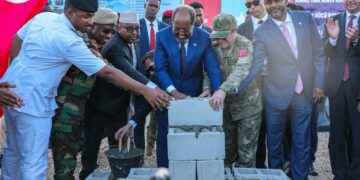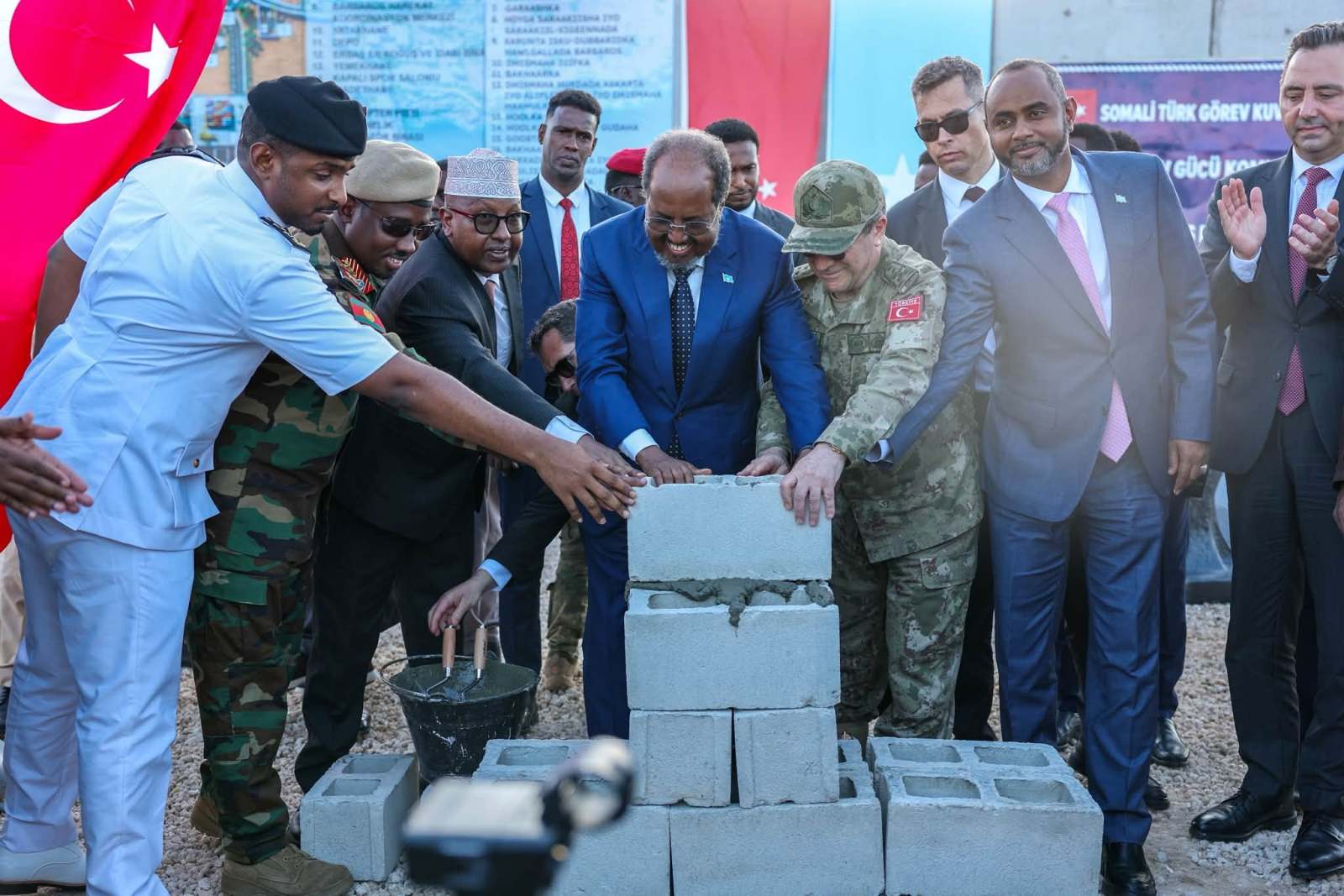
MOGADISHU, SOMALIA – President Hassan Sheikh Mohamud laid the foundation stone for a new Somali Navy headquarters in Mogadishu on the afternoon of Saturday 21 November, standing beside General Selçuk Bayraktaroğlu, Turkiye’s Chief of General Staff, at a ceremony where the Speaker of parliament said the same project adds a maritime operations coordination centre and new buildings at Barbaros, the Turkish Navy’s base in the capital. No cost or timetable was published. The president used the occasion to say the 2024 defence agreement with Ankara had caused Somalis no harm. He spoke sixteen days after the Supreme Court ruled that his mandate expired on 15 May and confined his government to caretaker duties, and on a weekend when the army command had published no plan for the Hiiraan front its allied militias have left.

The Speaker’s Account of the Barbaros Expansion
Speaker Abdulkadir Mohamed Nur called the groundbreaking “a historic move for the rebuilding and strengthening of the Somali Navy” in a post on X that evening. At the ceremony he said the work includes a site for docking and servicing ships and vehicles at the Barbaros camp. He recalled that scholars and government leaders were accused, when the plot was chosen, of planning to turn it into hotels or private premises, and said other navy facilities had already been built. Piracy, hostile foreign groups and terrorism were the threats he named; oil, fisheries and minerals were the resources. He thanked Turkiye and its defence ministry and said parliament would oversee the project.
Defence Minister Ahmed Moalim Fiqi, the commander of the armed forces, Brigadier General Ibrahim Mohamed Mohamud, Turkish Ambassador Ferhat Alkan and the unnamed commander of Turkish forces in Somalia all attended. President Hassan Sheikh Mohamud told them Somalia needs a navy with high-level training, modern equipment and adequate facilities to protect its waters, its marine resources and its long coastline. Earlier in the day Bayraktaroğlu met him at Villa Somalia. According to the presidency, the talks covered the long-term strategic relationship, defence and security cooperation and “accelerating joint efforts” against international terrorism. Turkish reports added that military officials from both countries sat in and that economic cooperation and regional developments were discussed.
Mohamed Abdulkadir Sharif Bocorrey has commanded the navy and coast guard for three weeks, having taken over on 1 November from Abdiwahab Abdullahi Omar. Turkiye’s defence ministry has said its naval units will keep protecting the Turkish survey and supply ships working off the Somali coast, where the exploration vessel Cagri Bey was sent in February under the energy side of the partnership. That month the state news agency called claims that Turkiye was taking a one-sided share of Somali oil “baseless”. Barbaros is to grow in a capital where the parliament the Speaker says will oversee it lost its mandate on 14 April, by the reckoning of the country’s highest court.
The Supreme Court Deadline and the Turkish Agreement
On Thursday 5 November the constitutional division of the Supreme Court ruled that the amendments extending federal terms from four years to five could not apply retroactively, so that President Hassan Sheikh Mohamud’s mandate ended on 15 May and parliament’s on 14 April. It ordered leaders to agree an electoral framework within 30 days and to hold elections within 90, and limited the government to routine caretaker business in the meantime. The same judgment declared void the president’s dismissal, a day earlier, of Chief Justice Bashe Yusuf Ahmed. The presidency swore in Ibrahim Idle Suleiman as chief justice on 7 November regardless.
Bashe and five fellow justices have since sued the Federal Republic at the East African Court of Justice in Arusha, and on 18 November its First Instance Division gave the government 45 days to respond. The 30-day window for an electoral framework closes on 5 December, and the Barbaros groundbreaking fell two weeks before it. By Friday 20 November opposition leaders had refused an offer, relayed through former prime minister Abdi Farah Shirdon, to meet the president at Shirdon’s home, despite promises of major concessions. Their conditions remain international mediation, the reversal of the one-person, one-vote model and the constitutional changes, and security guarantees for the presidents of Puntland and other member states who attend. Turkiye, Saudi Arabia and Egypt have joined Western and East African partners in calling for an electoral agreement.
The defence and economic agreement signed in February 2024 runs for ten years and commits Ankara to building, training and equipping the navy. In July Turkiye’s parliament extended its military mission in Somalia by two years, to July 2028. TURKSOM, the Turkish training academy in Mogadishu, opened in 2017. Ankara’s support for a government whose mandate was already contested has been a fixture of the dispute since the summer. At Saturday’s ceremony President Hassan Sheikh Mohamud said the agreements met strong opposition in parliament, that critics had offered “misleading interpretations that were not based on facts”, and that lawmakers had approved them with confidence. The Barbaros project rests on that 2024 agreement, according to reports of the ceremony. “I do not know whether you can see the benefits these agreements have brought to Somalia, but you can see that they have caused no harm to Somalis,” he said.
Ankara Welcomed as the Emirati Ambassador Leaves
In a televised address on 17 November, President Hassan Sheikh Mohamud accused the United Arab Emirates of signing port deals for Berbera, Bosaso and Kismayo behind Mogadishu’s back, of building forces outside the national army and of helping Israel recognise Somaliland. Anwar Gargash, diplomatic adviser to the Emirati president, replied by calling him the outgoing president, the reading of his mandate the Supreme Court had given on 5 November. On 19 November the cabinet ordered the Emirati ambassador to leave within 72 hours. Two days later the president stood with General Bayraktaroğlu at the site where Turkiye’s Barbaros base in his own capital is to grow.
The president who spoke on Saturday signed the Turkish agreement in his second term, faces an opposition that will not sit with him without foreign mediators, and counts Ankara among the four Quartet partners that agreed to facilitate the election talks he called for 14 to 18 November, which never convened. Ambassador Alkan met former President Mohamed Abdullahi Farmaajo in early November and then former President Sharif Sheikh Ahmed, whose petition produced the ruling, and former prime minister Hassan Ali Khaire. The Speaker who announced the Barbaros buildings is Abdulkadir Mohamed Nur, whom former intelligence chief Fahad Yasin named in September in connection with the Doolow airstrike.
Puntland and Jubaland rejected the term extension from the start. In August the Puntland government attributed the airstrikes at Garmaal and Jiifle on 18 and 20 August to Turkish aircraft, said it would hold the Turkish government accountable for the Somalis killed and the fishing boats destroyed, called Ankara contradictory for tolerating a ransom for the hijacked MV Lutuf while bombing the same coast, and appealed to the European Union, the United States and regional partners for deeper naval cooperation. A maritime operations centre run from the capital and attached to Barbaros will coordinate the waters off that same coast.
The Hiiraan Front the Army Has Not Addressed
The army command in Mogadishu has published no plan to defend northeastern Hiiraan, where residents of Matabaan, Bacda, Qabno, Beergadiid and Jiracle report rising al-Shabaab activity. Macawisley militias and army units left their positions after Ugaas Yusuf Ugaas Hassan called the region’s forces into the regional capital in late October and early November. About two thousand fighters left the Bulo Burde front for Beledweyne at the end of October. Several thousand militiamen and soldiers are now in the town. Al-Shabaab fighters moved into Coomaad in mid-November, twenty kilometres from the Matabaan front.
Officials at army headquarters described the withdrawal as a blow to the defence ministry, which is busy filling the Lower Shabelle camps the Ugandan contingent is vacating. National Security Adviser Awes Hagi Yusuf said on 3 November that the departing Ugandans belong to the bilateral force and that the AUSSOM contingent remains. The intelligence agency announced on 17 November that operations with international partners in Moqokori district on 10 and 16 November had killed Ismail, al-Shabaab’s finance chief for the Aborey area, and a driver. The agency said three commanders were wounded in the two raids. It named none of its partners and released no evidence for its account. Moqokori, Mahas and Aborey all fell to al-Shabaab in the offensive of 2025.
Turkiye’s own forces in Somalia train soldiers at TURKSOM, are the force Puntland blames for Garmaal, escort the survey ships offshore and now expand Barbaros, while the Somali units those programmes were built to field are divided between the camps Uganda is leaving and a Hiiraan front their militia allies have left. On Saturday the president spoke of a navy equal to Somalia’s long coastline. The foundation stone went down beside the Barbaros base, the army’s Hiiraan allies were in Beledweyne, and the strikes on al-Shabaab in Hiiraan that week were announced by the intelligence agency, carried out with partners it did not name.