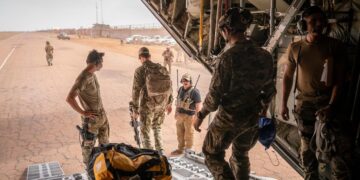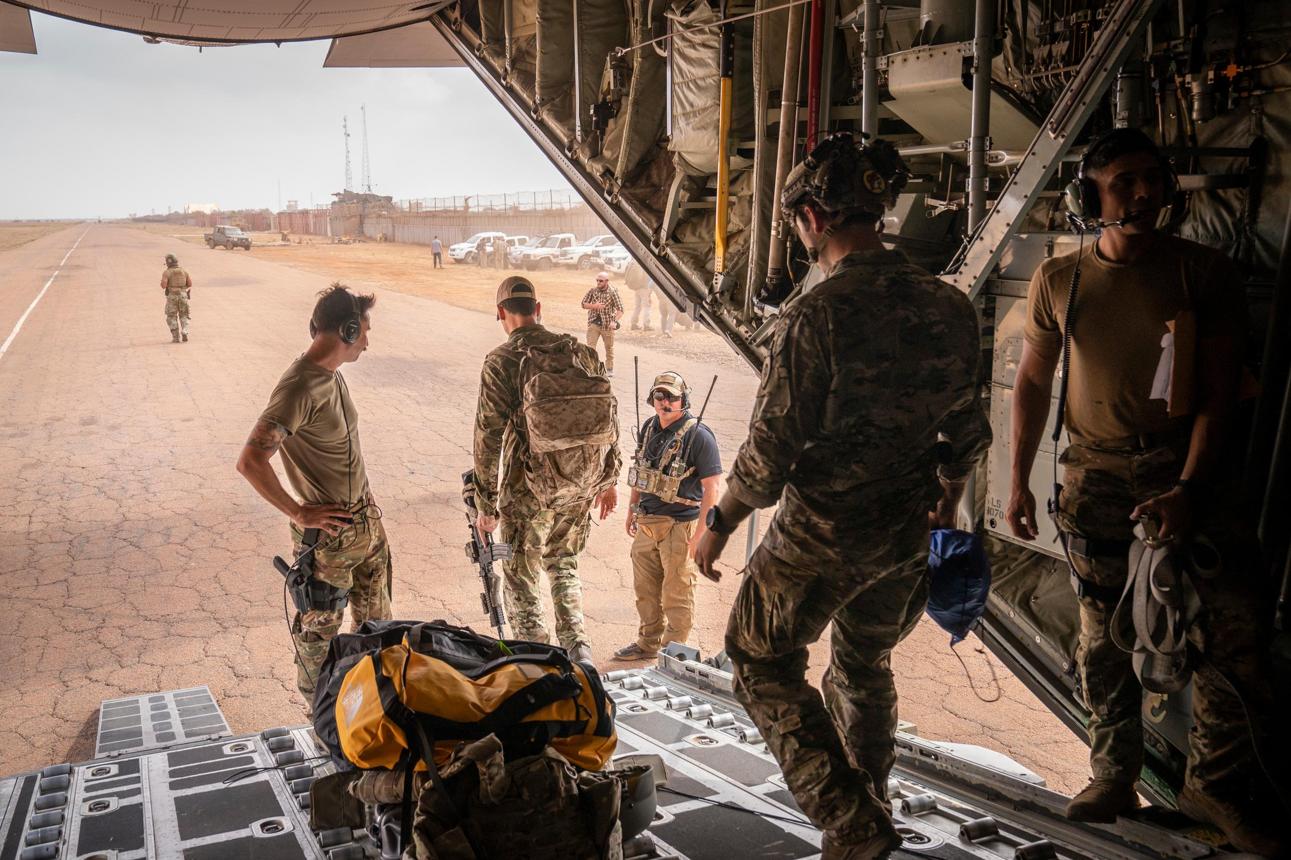
MOGADISHU, SOMALIA – The United States has moved its forces out of Baledogle airfield in Lower Shabelle, the base from which it gathered intelligence, supported airstrikes and trained the Danab commandos for fourteen years, and Lieutenant General John Brennan, deputy commander of Africa Command, told reporters on Tuesday 10 November that the move was “100% an economic decision” forced by a runway that would have cost tens of millions of dollars to resurface, and most of the personnel went to Mogadishu. The departure happened in October, in the weeks when a federal column formed at Baledogle to march on Buurhakaba and Uganda prepared to send its bilateral troops home, and none of the reporting on it carries a word from Villa Somalia or the defence ministry.

What Brennan Said About the Baledogle Airfield Runway
“The surface of the airfield was declining to the point where it was becoming dangerous to land aircraft there,” Lieutenant General John Brennan said at the briefing. He added that the relocation did not reduce American support for Somali forces and that US airstrikes, including in Lower Shabelle, had continued in recent weeks. Officials said a return to Baledogle airfield remained possible if conditions changed, though no plan to go back has been announced. Africa Command carried out four airstrikes against al-Shabaab in October, one of them on 23 October near Bulo Bashiir, about seven kilometres northeast of Janale, in coordination with the federal government.
On 28 October a local report citing people familiar with the base said the Americans had left several days earlier and that Ugandan and Somali forces had taken control of the airfield. Asked about it on Monday 2 November, an Africa Command spokesman declined to confirm the departure. “In the interest of maintaining operational security, we do not discuss details of ongoing operations,” he said, adding that the command “repositions its forces to optimize for ongoing counterterror operations.” A military official later said the troops had moved to other parts of Somalia and remained in the country, and Brennan’s briefing eight days later put a reason and a destination on the record for the first time.
In 2018 the US Navy awarded a contract worth more than 12 million dollars for emergency repairs to the same runway. In the spring of 2025 Army engineers built a medical aid station at Baledogle airfield, along with additional housing, force protection works, walkways and roads, a project Combined Joint Task Force-Horn of Africa said “further develops BMA as an enduring location”, BMA being the military’s abbreviation for Baledogle Military Airfield. Those buildings now stand beside a runway Washington has decided not to resurface, about eighteen months after the work was announced. Meanwhile, the United States has twice before pulled its forces out of Somalia and sent them back: President Donald Trump ordered nearly 700 troops out in December 2020, and in May 2022 President Joe Biden reversed the order and returned hundreds of them to restore a persistent presence.
Danab Was Built at Baledogle Airfield
Al-Shabaab held Baledogle from 2009 until 2012, when American forces arrived at the airfield, built with Soviet help in the 1970s, and began turning it into the training ground of Danab, the commando brigade regarded as one of the army’s most effective units against the group. On 30 September 2019 al-Shabaab attacked the base with a truck bomb that left a crater about twenty feet deep, followed by an hourlong firefight in which American and Somali troops held the perimeter. It was one of the largest attacks on US forces in Somalia since the battle of Mogadishu in 1993, and Danab training continued there afterwards, with an eleventh intake graduating at the camp in February 2025.
In May 2026 General Sahal Abdullahi Omar, acting army commander and chief of ground forces, opened training for Danab’s twelfth intake at the General Hassan Tuure training school at Baledogle, with Colonel Abdiaziz Hussein Mohamed, commander of the 16th Danab Brigade, and representatives of AUSSOM and Uganda’s army in attendance. Prime Minister Hamza Abdi Barre attended the graduation of that cohort at Baledogle airfield on Monday 28 September. He thanked Washington, called the partnership vital to the development of the force and restated the government’s aim of an army able to take full responsibility for the country’s security.
Four weeks after that ceremony the Americans had gone. Accounts differ on whether a small American training team stayed behind, Brennan said most personnel had moved to Mogadishu, and none of the statements so far says where or by whom the next Danab intake will be trained. The federal government has said for years that national forces will take over security responsibilities step by step. At Baledogle airfield the timing of that handover was set by an American decision about runway costs, announced by an American general. The reports of it carry no statement from a Somali minister.
The Column That Formed at Baledogle
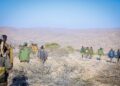
Early on Saturday 24 October more than two hundred federal military vehicles moved out of the Baledogle area and up the Mogadishu to Baidoa road toward Buurhakaba, the Bay district that forces loyal to former President Abdiaziz Hassan Mohamed Laftagareen had taken on 15 October. A Danab unit went ahead of the column to clear a road said to be mined, after a week in which roadside bombs between Afgooye and Wanlaweyn had destroyed military vehicles and, by the account of soldiers in the convoys, killed up to twenty officers and men. On 25 October Danab fought at Leego as the army opened Operation Banooda on the road to Buurhakaba.
On 26 October dozens of soldiers died at Jameeco, and the defence ministry reported only al-Shabaab’s losses. Two days later the first report of the American departure from Baledogle airfield appeared. By then the commandos trained there were leading a federal advance toward a district held by the forces of a deposed state president, along a road al-Shabaab had mined, in a South West State where President Hassan Sheikh Mohamud’s government had already replaced Laftagareen with President Aden Mohamed Nur Madobe. Brennan attributed the American departure to the runway alone, and nothing on the record ties it to the column.
Ugandan and Somali forces were reported to have taken over the airfield after the Americans left, and by Monday 2 November Uganda had begun sending its bilateral contingent home, with its military spokesman, Colonel Chris Magezi, saying all Ugandan forces, those serving in AUSSOM included, would leave by the end of 2027. The African Union plans to replace departing Ugandan troops at Sabid-Anole, Bariire, Awdheegle and Bulonagad, four sites near Mogadishu, during the November rotations. Turkish forces have also visited the airfield and are reported to have shown interest in taking it over, though no handover has been announced. Consequently, of the two foreign armies reported at Baledogle airfield this autumn, one has left and the other has set the date of its departure.
Washington Negotiated Its Northern Presence in Bosaso
On 2 August an Africa Command delegation met President Said Abdullahi Deni in Bosaso, and the Puntland State House then announced an agreement to expand the American facility in the city. On Monday 31 August a second delegation, led by Colonel James Rose, was received there. Puntland security officials have since said the planned base at Bosaso airport will allow American aircraft to fly strikes from the city itself, and that a new local counterterrorism force is planned with Washington overseeing its salaries, equipment and training. Somalia’s defence and information ministries did not answer questions about whether they knew of that agreement.
On the night of Monday 9 November airstrikes that local security sources attributed to American aircraft hit Islamic State positions at Dabablayaal and Hal Baalade in Qandala district, near the bases the Puntland Darawish hold at Togga Jaceel Sare. Puntland launched Operation Hilaac against the group in the Calmiskaad and Golis ranges in late 2024 with its own forces. Its security officials say American airstrikes account for at least two-thirds of the Islamic State fighters killed since that war began. Africa Command, however, had declared no strike on ISIS-Somalia between 6 May and 6 November, while announcing twenty-eight against al-Shabaab, all of them in the south. Accordingly, the American presence in the north is one negotiated with the government in Garowe and tied to a war Puntland is fighting. Baledogle airfield, by contrast, lies about ninety-six kilometres from Mogadishu on the federal government’s own front.
President Hassan Sheikh Mohamud’s government, which rejects the Supreme Court’s ruling that its mandate ended in May, spent the week of Brennan’s briefing preparing election talks called for 14 to 18 November. Its commandos were on the Buurhakaba road, and Baledogle airfield, where Washington trained them for fourteen years, was reported to be in the hands of Somali troops and of soldiers from a Ugandan government that has already set the date they go home.