JOWHAR, SOMALIA – Hirshabelle votes on 20 August in an election whose most consequential outcome was settled a fortnight earlier at Villa Somalia, where Hawadle traditional leaders and senior politicians of the clan agreed to let President Hassan Sheikh Mohamud choose their candidate for the state presidency. The electoral commission’s timetable opens registration on 5 August, closes the voter list on 16 August and publishes candidate names on 18 August, and it reaches local councils and the state assembly alone. The Hirshabelle presidency remains an indirect office filled by that assembly, so the ballots now moving through Jowhar and Beledweyne will choose the electors while the name those electors are expected to elevate was agreed in a room in Mogadishu.

A Calendar That Stops Short of the Presidency
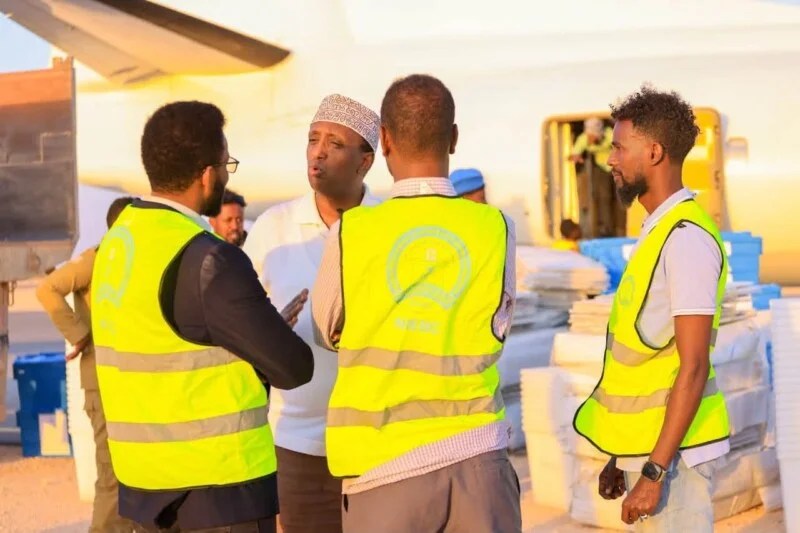
The National Independent Electoral and Boundaries Commission acted under Article 10 of its establishment law and Article 18 of the National Elections Law when it released the Hirshabelle schedule on 26 July. Polling day was fixed for 20 August, with registration and card distribution opening on 5 August. The final register appears on 16 August and the candidate lists two days after that, leaving contenders a forty-eight hour window between confirmation and the count. That phasing repeats the sequence the commission ran in Galmudug and Southwest, where assemblies were seated within a fortnight of the first voter card being issued.
President Ali Gudlawe Hussein opened the registration drive in Jowhar in July 2025 and described it as a turning point for inclusive governance. Every eligible citizen, he told his audience, would at last have a voice and a vote in determining their local leaders. Thirteen months separate that launch from the polling day now fixed. The promise covers councillors and the members of the Hirshabelle assembly, and it stops at the presidency, an office the state’s arrangements leave to the chamber and never to the register. Voters in Jowhar will therefore choose the people who choose the president, one remove from the decision that governs the state and from the office that commands its forces.
The gap between the council ballot and the executive shapes the entire Hirshabelle contest. An assembly seated on 20 August becomes the electoral college for the presidency within weeks of its first sitting, and whoever accumulates seats accumulates the succession. Political associations are now competing across Hiiraan and Middle Shabelle over a question that senior figures in the clan holding the next turn have already answered. Commission officials have urged every stakeholder to comply with the calendar and the established procedures, language that treats a contested transfer of power as an exercise in scheduling.
The Hawadle Turn Was Settled at Villa Somalia
Under the power-sharing formula that has governed the state since its formation, the Hirshabelle presidency alternates between the Hawadle and the Abgal, and the turn now falls to the Hawadle. President Gudlawe, an Abgal elected in November 2020, is expected to serve out his term and hand over to a Hawadle successor. Three presidents have held the office since 2016 and two of them came from the Hawadle, which makes the clan’s prerogative to nominate the single piece of leverage the arrangement gives it. That leverage travelled to Mogadishu on the night of 4 August.
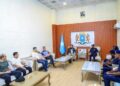
At a late meeting inside Villa Somalia, President Hassan Sheikh Mohamud sat with the Hawadle traditional leader Ugaas Yusuf Ugaas Hassan Ugaas Khaliif and a delegation of senior politicians from the community, and asked them to unite behind a single candidate. The elders and politicians went further than the request and agreed to defer the choice to the president himself, handing him the authority to name who will carry the clan’s nomination into the Hirshabelle race. Neither side issued a communiqué. The federal government has said nothing publicly about the outcome, and no name has yet emerged.
An unwritten arrangement of that kind converts the constitutional sequence into a formality. The assembly elected on 20 August will still hold a presidential ballot in Jowhar, deputies will still be counted, and the winner will still be sworn in under the state constitution, all of it downstream of a decision taken in a room with no minutes. Villa Somalia has made no secret of the wider design, having signalled its intention to secure friendly leadership in Galmudug, Hirshabelle and Southwest before opening national talks on the federal vote. Hassan Sheikh Mohamud has spent the year building the case that he is delivering universal suffrage, and the Hirshabelle succession shows what the delivery looks like in practice.
The Southwest Template Reaches Hirshabelle
The commission’s chairman, Abdikarim Ahmed Hassan, briefed ambassadors in Mogadishu on 10 August on the Banadir, Southwest and Galmudug votes and on the Hirshabelle preparations. Envoys from the United States, the United Kingdom, China, Turkiye, Ethiopia, Kenya, Sudan and Egypt sat in the room alongside the United Nations, the African Union and the Organisation of Islamic Cooperation. Banadir opened the series in December 2025 with the first direct local elections held in Mogadishu in close to sixty years, upheld by the Supreme Court over a boycott by the main opposition groups. In Southwest, 132,430 voters filled 95 seats contested by 32 political organisations, the Justice and Solidarity Party took 51 of them, and women ended up holding 16 of the 92 confirmed places, seventeen per cent against an agreed quota of thirty.
Galmudug voted on 30 July and returned the same shape of result. The Justice and Solidarity Party won 115 local council seats and 63 places in the regional assembly on 106,388 votes, 55.55 per cent of the valid ballots cast by 197,971 voters across eleven towns, with sixteen parties on the paper. Towfiiq rejected the outcome outright, called for an independent review, and argued that the process had undermined the one person one vote system and left it inferior to the clan formula it replaced. That objection echoed the armed defiance the state had shown a year earlier.
Southwest supplied the original sequence, where an incumbent was removed and a loyalist installed before the courts validated the result. The federal interior ministry had already declared the March re-election of the sitting president an illegal pseudo-election, months before the same institutions blessed what replaced him. Legality in these files tracks alignment. Hirshabelle now enters the machinery with a friendly incumbent, a supportive commission and a clan leadership that has conceded the nomination in advance, which removes the friction the earlier states generated and leaves nothing for a court to adjudicate.
A Register Drawn Where the State Still Reaches
Hiiraan is Hawadle country, and much of it lies beyond the reach of the administration organising the vote. Al-Shabaab holds the rural districts east and west of Beledweyne, presses the corridor linking the southern and central regions, and has taken back the ground around Mahas that the 2022 uprising cleared. The eleven towns that carried the Galmudug ballot describe the geography of these exercises precisely. A Hirshabelle register will be drawn on the same principle, from the district centres the state garrisons and the roads its convoys can travel in daylight. Moqokori and the Mahas hinterland, once the proof that the insurgency could be pushed back, now sit outside that map.
Seasonal flooding along the Shabelle imposes the second constraint on the same calendar. The state cabinet has been meeting on elections, security and flood risk in a single sitting, and humanitarian agencies working in Middle Shabelle have warned about displacement through the weeks the timetable runs into. A register compiled under those conditions records the people who could be reached in August. An assembly built from it will speak for Hirshabelle as a whole for the term that follows, including for the districts nobody in Jowhar can currently enter.
What the Hawadle have been offered in return is correspondingly narrow. The clan that raised the militias which drove Al-Shabaab out of these districts four years ago has been asked to surrender the nomination of its own president, in exchange for alignment with a federal government whose army has been losing the same districts back. Every soldier and every week that Villa Somalia spends assembling friendly assemblies is drawn from the same finite stock as the campaign in Hiiraan. The register closes on 16 August, candidates are named on 18 August, and the assembly that emerges on the 20th will ratify a choice made on 4 August behind a closed door in Mogadishu.