KISMAYO, SOMALIA – Two of Somalia’s most powerful regional presidents have turned on Villa Somalia in the same week. They say President Hassan Sheikh Mohamud is dismantling Somali federalism. Furthermore, they accuse him of bending the national army to political ends while al-Shabaab regroups. Jubaland’s Ahmed Madobe and Puntland’s Said Deni rarely move in step. Yet both now cast the country’s crisis as a deliberate assault on Somali federalism. Both warn the cost will be paid on the battlefield.

Notably, the timing is no accident; thhe federal government is pressing to engineer a friendly outcome in the Galmudug election. The regional leaders read that campaign as the next phase of a wider project. For them, defending Somali federalism has become inseparable from defending their own states.
Madobe Warns Against a Politicized Army
Speaking on June 16, Madobe accused federal authorities of abandoning the war for political feuds. “The federal government appears to have shifted its focus away from confronting the enemy and has instead become preoccupied with political disagreements,” he said. Furthermore, he warned against using state security forces for political ends. In effect, he tied Somali federalism and the integrity of the army together.
The Jubaland leader did not stop there. He described recent Mogadishu protests as peaceful demonstrations met with force. Moreover, he argued that the federal administration’s mandate had expired. Genuine Somali federalism, he said, gives member states the right to run their own elections. The argument is not new for Madobe. The Somali Digest chronicled how Madobe triumphed in Jubaland as federal troops failed to dislodge him. That confrontation set the template for the current standoff. Similarly, his latest warning frames the army as a national asset, not a presidential instrument.
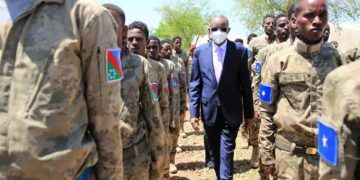
His point about the army deserves attention. As Madobe spoke, Jubaland forces and the Somali National Army were fighting al-Shabaab in Lower Juba. The two ran joint operations in the Dhasheeg-Waamo area, seizing weapons and bases. In other words, the regions still do the fighting Villa Somalia claims as its mission. Consequently, the contrast sharpens his case. The erosion of Somali federalism is also an erosion of the counterinsurgency.
Meanwhile, President Deni has gone further than rhetoric. On June 16 he declared that Puntland would keep acting independently until a consensus-based government is formed. The posture treats the current federal leadership as illegitimate. The day before, his administration accused Hassan Sheikh of fueling piracy and undermining the federal compact. Consequently, the two largest pillars of the federal bargain now question whether Somali federalism survives in practice.
This is well-worn ground for Puntland. The Somali Digest reported how President Deni accused Hassan Sheikh of creating pirates. He blamed the gutting of institutions meant to police Puntland’s long coastline. Similarly, PresidentDeni casts every centralizing move from Mogadishu as a threat to Somali federalism. His independence declaration is the logical endpoint of that argument. Notably, Puntland has held itself apart from federal processes for years. The throughline connecting both leaders is the Southwest precedent. There, Villa Somalia toppled a president and installed a loyalist through a managed vote.
The Security Bill Comes Due
The deeper danger sits where politics and security meet. Al-Shabaab has recovered ground across central and southern Somalia since the African Union drawdown began. The Somali Digest examined that trajectory in its study on the group’s edge after the ATMIS exit. Every brigade redirected toward a regional capital is a brigade not holding the line. As a result, the contest over Somali federalism is quietly setting the terms of the war.
The pattern is not confined to these two states. Galmudug rejected Hassan Sheikh’s federal elections with a show of force in Cabudwaaq. That state is now the epicenter of the dispute. In each case, the government meets resistance with troops rather than talks. Moreover, each deployment drains the same thin pool of trained soldiers. Accordingly, the army becomes a tool of internal coercion when it is most needed elsewhere.
Above all, the convergence of President Madobe and President Deni marks a shift. For years the federal states fought Villa Somalia alone and lost ground one by one. Now they read from the same page. Therefore, Villa Somalia confronts a united front it long managed to avoid. Together they cast Hassan Sheikh’s project as a war on Somali federalism itself. Whether the alignment holds is uncertain. What is clear is simpler. A government fighting its own regions has little left for the enemy in the bush.