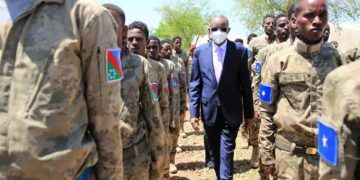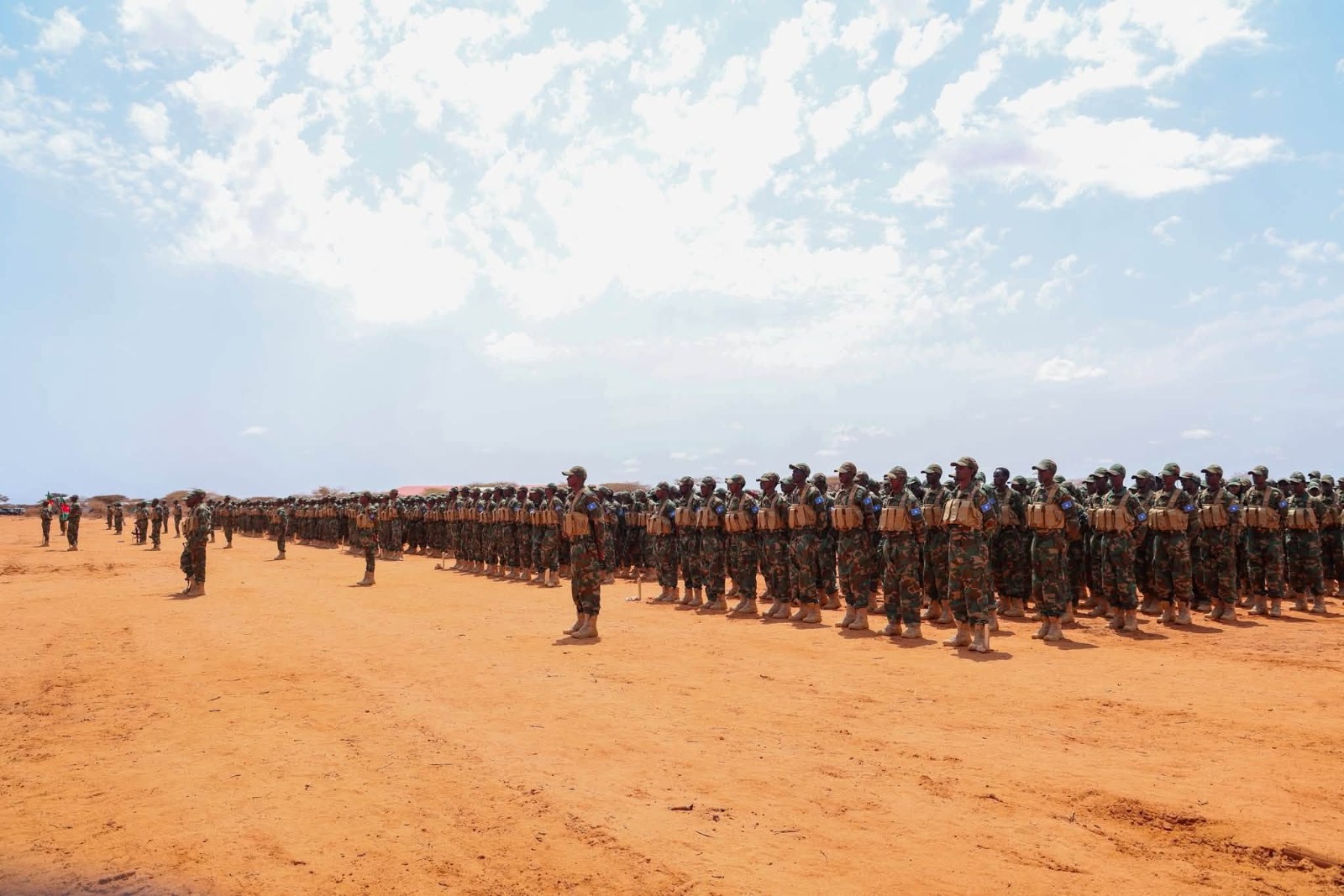
Xananbuure, SOMALIA – Roughly 3,000 soldiers passed out on Sunday at the Xananbuure training camp in Galgadud, the largest class the Somali National Army has graduated on Somali soil since the state collapsed in 1991, with President Hassan Sheikh Mohamud presiding over a ceremony that Saudi money paid for and instructors from Romania, Ukraine and Sudan delivered across nearly a year. The recruits were drawn from every federal member state, and the president told them that finishing their training at home measured how far the reconstruction of the force had travelled. Mogadishu has learned to answer the one question this parade settles, which is how to produce infantry in quantity. Everything the ceremony leaves open, about pay, retention and who funds the war after December, has decided every campaign of the past four years.

A Class That Finished on Somali Soil
Sunday’s ceremony brought the Galmudug president, the defence minister, the public works minister, members of the federal parliament and the army commander to a camp in Galgadud that Saudi officers have visited repeatedly through the year to watch the programme run. The soldiers completed close to twelve months of instruction covering weapons handling, discipline, military law and combat tactics, and the president used his address to describe them as evidence that statehood is being restored. He urged them to protect the unity and sovereignty of the country and to serve with honesty and patriotism, the standard charge to a graduating class.
Furthermore, the cohort delivers most of a commitment Riyadh made in February, when it agreed to fund training for about 5,000 Somali soldiers. Sunday’s class accounts for the bulk of that pledge in a single graduation, which is a genuine logistical achievement for a defence ministry that has spent years shipping recruits abroad in batches of a few hundred and waiting months for each to return.
The location carries real weight for a government that has watched its best units trained in Turkiye, Eritrea, Uganda and Egypt, then returned home to serve under commanders who had no part in forming them. A Somali National Army that can run a year-long basic course inside the country owns the standard, the syllabus and the records, and it stops paying foreign governments for a capability it will need permanently. Consequently, the president’s framing of Xananbuure as a marker of self-sufficiency has a defensible core.
Moreover, the geography of the intake is unusual for this administration. Recruits came from all the member states at a moment when Villa Somalia is in open confrontation with Puntland over a planned Galkayo visit and has spent the year absorbing or losing forces in Gedo, Nugaal and Bari. A national intake assembled during that quarrel is an argument the government will make often in the months ahead, and its opponents will test it against the map.
What Becomes of the Somali National Army After the Parade
Producing soldiers has never been the binding constraint on this war. The army has graduated tens of thousands since 2012, and the recurring failure sits on the far side of the parade ground, where trained men reach units that cannot pay them, feed them or resupply them, and where a significant share simply leave. Courts in Mogadishu have sentenced deserters in numbers that indicate a retention problem the ministry has never published figures for.
That pattern is familiar from the units that carried the 2022 offensive. Clan militias mobilised in Hiiraan and Middle Shabelle cleared ground quickly, then found that the Somali National Army could not garrison what they had taken, and the integration schemes meant to convert those fighters into regular soldiers produced uneven results across every region they touched. Fighters who go unpaid go home, and men who go home take their weapons and their local knowledge with them, which is how a cleared district becomes contested again within a season.
Ammunition tells the same story in sharper terms. The brigade that lost Teedaan in Mahas district earlier this month had been running short of rounds for weeks before the assault, according to senior commanders, which turned a defensible position into an untenable one long before the first shot was fired. A graduating class of 3,000 does nothing about a supply chain that leaves a battalion counting cartridges while an assault forms in front of it.
Therefore, the honest measure of Sunday’s ceremony arrives in six months, in the desertion rate of this cohort, the punctuality of its salaries and whether these battalions are still at their assigned posts when the dry season fighting resumes. Somalia has held impressive graduations before and lost the towns those graduates were sent to hold, and the ministry has never published a follow-up study on where any previous class ended up. Until it does, each ceremony is measured by the size of the parade and by nothing that happens afterwards.
The Money Behind It Runs Out in December
This class arrives at the worst possible moment in the funding calendar. Washington has signalled it will end logistical support for the African Union mission by December, and the United Nations support office has already begun selling the mission’s assets, hiring auctioneers to dispose of the supply line that has sustained foreign troops and, through them, much of the Somali force posture around Mogadishu and the corridor towns.
African Union defence chiefs approved an offensive plan this month whose financing stops at the end of the year, and the Kampala summit that was supposed to fix the mission’s budget produced no agreement. Meanwhile the drawdown continues on schedule, with the Ethiopian contingent leaving Buurhakaba after twelve years and more towns due to change hands within weeks. The Somali National Army is being handed the war on the timetable of other people’s budgets, and nobody in Mogadishu has explained what happens to the garrisons those departing contingents currently hold.
Saudi Arabia’s involvement is a partial answer to that arithmetic and a reminder of how the whole enterprise is financed. Somalia now trains its infantry on Gulf money, its commandos in Turkiye, its Danab with American support, and it fields the results against an insurgency that funds itself through taxation collected at Somali checkpoints. An army assembled from that many external accounts inherits the volatility of all of them, and the Somali National Army has no revenue base of its own to fall back on when one of those accounts closes.
Analysts warned years ago that a drawdown of foreign support would hand al-Shabaab the advantage unless the national force could hold the line on its own, and that warning was written when the withdrawal timeline still looked generous. Three thousand riflemen graduating in Galgadud in August is a thin hedge against a funding cliff in December.
Holding Ground Is the Harder Half of the War
The war has settled into a stalemate that neither side can break, according to a Crisis Group assessment published in July, which traced how the 2022 gains in Hiiraan and Middle Shabelle were largely reversed by the group’s counteroffensive in early 2025 and how the map returned to roughly where it had started. Territory changes hands and then changes back, and the constraint on the government side is the capacity to consolidate what its offensives take.
Conditions on the front lines make the point without any analysis at all. Somali forces hold garrisons at Awdhegle and Mubarak in Lower Shabelle and cannot move between them safely, because al-Shabaab controls the road that connects two positions the army has recaptured on paper. Elite units trained abroad lost the river crossings at Awdheegle, Barire and Sabiid this year, and African Union troops with American air support were required to get them back.
Additionally, the political fight consumes soldiers the front lines need. Federal units have spent much of the year deployed against member state administrations in Gedo, in Galkayo and around Baidoa, where the removal of the Southwest president produced a low-level insurgency that Turkish drones are still striking. Every battalion committed to those quarrels is a battalion the Somali National Army is not using against the insurgency it was rebuilt to defeat, and the graduates paraded on Sunday are the pool from which both sets of orders will be filled.
These recruits will inherit all of it, and their first posting will reveal which war the government intends to fight with them. The Somali National Army has never lacked Somalis willing to serve in it; what it has lacked is a state capable of sustaining them in the field and a leadership willing to spend them on the enemy that actually threatens the country.