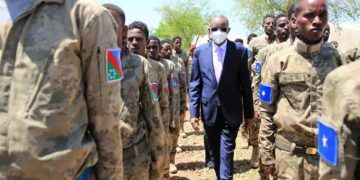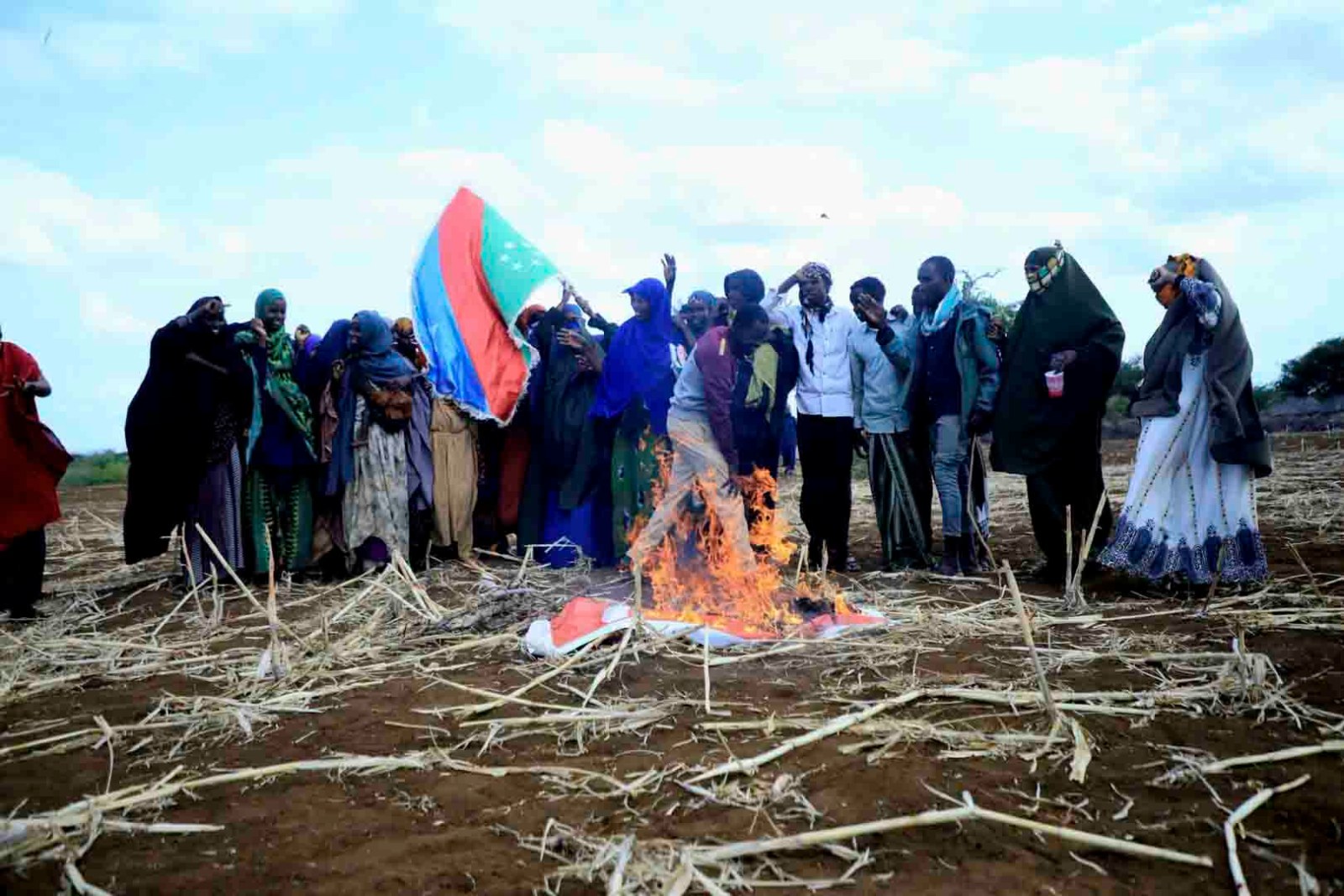
Baidoa, SOMALIA – A video circulating in recent days shows residents of Southwest State burning the Turkish flag while raising the state’s own banner, the sharpest public rejection yet of the foreign power that armed the March offensive against their president. The demonstrators, men and women filmed in the open, accuse Ankara of bombing rural communities near Baidoa, of destroying farmland and livestock and, in claims nobody has independently verified, of killing children. Five months after Turkish air power helped federal troops unseat President Abdiaziz Laftagareen, the drones have stayed, the guerrilla campaign they were meant to end has settled in around the interim capital, and the anger the strikes generate now lands on Turkiye itself.

A Flag Burned in Southwest State
In the footage, the crowd holds the flag of Southwest State aloft as the Turkish one burns, and the speakers run through grievances they say have become unbearable, from strikes on villages to torn-up farmland and dead animals. Protests over the alleged strikes have been staged in several rural areas near Baidoa, and the demonstrators tie them directly to Turkiye’s expanding military footprint in the country. However, none of the casualty claims has been independently confirmed.
Furthermore, the complaint has moved beyond the crowds and into establishment voices. Abdi Ahmed Libow, a former federal state minister of labour, asked why a country that shares no border with Somalia is bombing its interior, insisted that the communities under the strikes are neither terrorists nor a party to any war with Turkiye, and called on Ankara to withdraw its forces while pressing the international community to demand a halt. For a politician who served the federal system, the demand that an allied military leave Somali soil shows how far opinion in Southwest State has travelled since the spring.
The rupture between ally and public is recent and steep. Turkiye spent more than a decade as one of Mogadishu’s closest partners, training elite units at its Mogadishu base, equipping the federal army and funding institutions, and its soldiers drew little of the suspicion that attached to American and African Union deployments. Consequently, the sight of its flag burning beneath a state banner would have been unimaginable two years ago; the image measures how far Ankara has moved from training Somalia’s soldiers to fighting inside Somalia’s politics.
Turkish authorities offered no immediate confirmation that their aircraft carried out the reported strikes, and the circumstances around them remain unclear. Meanwhile, the videos keep circulating, and each new clip of burnt farmland or dead livestock, whatever investigation eventually establishes, feeds a grievance that official silence has failed to shrink.
The Precedent Ankara Broke in March
For two decades, Somalia’s foreign military partners confined their operations to the war against al-Shabaab and kept out of intra-Somali political disputes, applying whatever pressure they had through diplomacy and finance. That line held through every confrontation between Mogadishu and its member states until late March, when federal forces removed Laftagareen from the Southwest State presidency in an offensive that Turkiye reportedly backed with air support, logistics, equipment and units it had trained. Analysts read that involvement as a break without precedent in two decades of foreign deployments, and a destabilising one, because it converted a security partner of the whole country into a combatant for one side of its politics.
The operation followed the sequence Villa Somalia has used before, the one that converted Southwest State into a testing ground for toppling an incumbent, installing a loyalist and letting the institutions validate the result afterwards. Moreover, the air campaign has outlived the offensive it enabled: Turkish drones have struck rural positions held by fighters loyal to the removed president throughout the months since, sustaining a low-level war on the doorstep of the interim capital. The man the offensive installed comes from a different clan than his predecessor, in a region where clan balance decides whether a leadership change is accepted or fought, and the aircraft overhead have become the most visible guarantee of his administration.
Laftagareen, meanwhile, has refused to concede the field to the men who removed him. His forces hold rural ground around Baidoa and fight on, while he calls the federal units in Baidoa clan militias and argues that President Hassan Sheikh Mohamud, whose constitutional mandate lapsed in May, retains no standing to unseat anyone. However the courts eventually rule on that claim, its political force in Southwest State is visible in the footage: the crowd burning Ankara’s flag carries the state’s banner, and its quarrel with Mogadishu has widened into a quarrel with Mogadishu’s sponsor.
A Record of Strikes Without Answers
The Southwest State campaign sits on top of an unanswered record. In June, opposition figures accused Turkiye of supplying the suicide drones and weapons used in raids on compounds linked to former President Sharif Sheikh Ahmed and former Prime Minister Hassan Ali Khaire, both of whom said they had survived assassination attempts that set off gun battles between their guards and federal security forces. Turkish officials have never publicly addressed the allegation of direct involvement in those raids, and both former leaders remain central figures in the opposition coalition contesting the president’s tenure.
One strike already carries formal documentation from outside Somalia. On 18 March 2024, a drone hit the village of Baghdad in Lower Shabelle and killed 23 civilians, 14 of them children, wounding 17 more, and Amnesty International concluded the attack could amount to a war crime and called for an investigation that Ankara has never provided. Somali analysts now describe the Turkish drone operations that followed as the deadliest campaign of aerial bombardment in nearly two decades of air war over the country, a period that includes the whole American counterterrorism effort.
Furthermore, the military grievance now travels together with an economic one. Senator Abdi Ismail Samatar has published a series of essays accusing Ankara of pursuing a client state, alleging that Turkish vessels are exploring and drilling in Somali waters under defence and petroleum texts the federal parliament has never seen. The terms that have surfaced run in one direction: the hydrocarbons agreement concedes ninety percent cost recovery to the Turkish side, caps Somalia’s royalty at five percent and moves any dispute to arbitration in Istanbul. In Southwest State itself, local officials say Ankara intends to pursue mineral and rare-earth resources while it expands Baidoa’s airport to take F-16 fighter jets, an upgrade that would extend the reach of the same strike capability the protesters are burning flags over.
The Cost to the War Against Al-Shabaab
Security analysts warn that strikes aimed at political and clan constituencies thread foreign firepower directly into the fault lines of Somali politics, and that a campaign perceived as favouring one clan over another deepens the rivalries already driving the confrontation in Southwest State. Civilian casualties from air operations harden local sympathy against whoever inflicted them and feed the recruitment pipelines of armed movements, which hands al-Shabaab a propaganda opening in a region where it already presses the garrisons from the countryside.
The record of Turkiye’s own trained units undercuts the case that Ankara’s firepower is irreplaceable. Al-Shabaab drove the Gorgor commandos out of the river-crossing towns of Awdheegle, Barire and Sabiid earlier this year, and federal forces recovered the positions only after African Union troops and American air support intervened, on the same corridor where the army now holds bases it cannot drive between. An air force that can unseat a state president has not translated into an infantry that can hold a road, and the coalition that actually holds the line, the African Union mission and its Western funders, runs out of money in December.
Analysts also caution that Ankara’s readiness to take sides in domestic power struggles erodes two decades of Western investment in the African Union mission, in state institutions and in the army itself, all of it premised on the idea that a unified Somali leadership is the precondition for defeating the insurgency. Some commentators reach further back, to the 1980s, when the Barre government’s aerial bombardment of the northwest helped tip the state toward collapse, and argue the presidency is renting the same instrument against its own periphery. Turkiye arrived in Somalia to fight al-Shabaab; in Southwest State it now bombs Somalis who are fighting Mogadishu, and the people underneath have answered with the oldest gesture of political rejection there is.