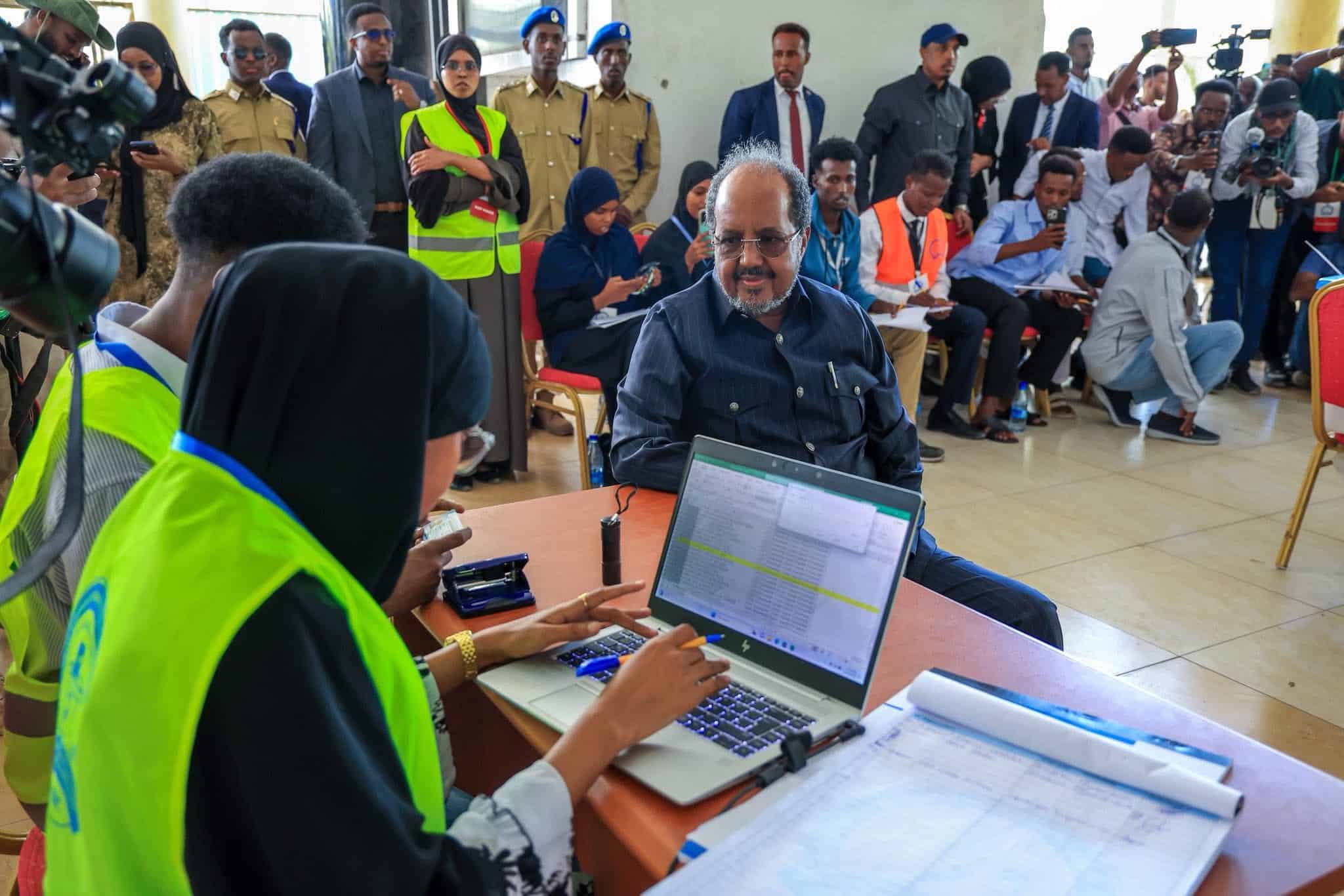
Mogadishu — Today’s local elections orchestrated by President Hassan Sheikh Mohamud’s administration in Mogadishu witnessed citizens being marched to polling stations at gunpoint, with widespread reports of voter coercion transforming what should have been an exercise in democratic choice into a grotesque display of authoritarian theater.

An elderly man’s testimony to reporters describing being forced at gunpoint to participate without access to water or food, denied the basic freedom to leave encapsulates the humanitarian cruelty underlying this political charade. His experience, replicated across multiple polling sites in Mogadishu according to widespread reports, reveals how the Federal Government has transformed elections from expressions of popular will into mechanisms of popular subjugation.
The political opposition’s unanimous condemnation of these elections as a transparent power grab designed to ensure victory for the president’s party reflects not partisan criticism but objective assessment of observable reality. When citizens require armed compulsion to participate in democracy, when the elderly endure physical deprivation to provide theatrical legitimacy, when turnout remains catastrophically low despite coercion, the fiction of electoral politics collapses into naked authoritarianism.
Coerced Democracy
The operational details emerging from today’s local elections in Mogadishu reveal sophisticated planning for democratic subversion rather than democratic participation. Multiple polling sites reported the deployment of security forces not to protect voters from intimidation but to serve as the primary agents of intimidation. These forces, who should be defending citizens against Al-Shabab, instead spent their day forcing those same citizens to participate in sham elections while extremists advanced unopposed across southern Somalia.
The pattern of coercion followed predictable sequences across different locations. Security forces would arrive in neighborhoods and conduct what amounted to forced political conscription. The elderly, infirm, and vulnerable faced particular targeting, their participation valuable precisely because it could be compelled with minimal resistance.
At polling stations, the coercion continued through different mechanisms. Voters arrived under guard found themselves processed through systems designed for speed rather than secrecy, with ballot security measures either absent or deliberately compromised. The denial of basic necessities like water and food to those held at polling sites added physical duress to psychological pressure.
The technological and administrative infrastructure supporting these local elections in Mogadishu reveals careful preparation for manipulation rather than transparency. Voter registration systems remained opaque, with no clear mechanisms for verifying eligibility or preventing multiple voting by regime supporters. Ballot counting processes excluded meaningful opposition observation, creating opportunities for manipulation at every stage. The entire architecture of the election served not to capture popular will but to create plausible documentation for predetermined outcomes.
Political Calculations
With President Hassan Sheikh facing mounting pressure over constitutional manipulation, regional rejection of federal authority, and catastrophic security failures, manufactured electoral victories serve multiple purposes in his increasingly desperate campaign to maintain power beyond constitutional limits. The timing suggests recognition that windows for manipulation are closing as international patience wears thin and domestic opposition crystallizes.
These local elections in Mogadishu serve primarily to create precedents for the national electoral manipulation Hassan Sheikh plans for his term extension. Each forced vote today makes future forced votes seem less exceptional; manipulated local outcome makes manipulated national results appear more plausible. The strategy depends on exhausting opposition and international attention through repetition of abuses until they become accepted as normal.
The deployment of security forces for electoral coercion in Mogadishu while Al-Shabab captures territory across southern Somalia suggests misplaced priorities. A government that uses its military to threaten citizens while losing to extremists has ceased to function as a security provider and becomes instead a security threat. The transformation of counter-terrorism forces into instruments of political oppression represents not tactical error but strategic capitulation to extremism.
The immediate security costs manifest in Al-Shabab’s recent territorial gains, including the capture of Mahaas after twelve years of government control. The correlation between political operations and security failures has become so consistent that Al-Shabab can reportedly time offensives to coincide with government distraction by political manipulation. Every election becomes an opportunity for extremist expansion.
Military forces corrupted through political deployment lose professional identity and operational effectiveness. Soldiers ordered to intimidate citizens rather than protect them suffer morale collapse that undermines unit cohesion and combat readiness. Intelligence services focused on political opposition rather than extremist threats develop institutional blindness to actual security challenges. The entire security architecture, built with international support for counter-terrorism, transforms into regime protection service that serves neither counter-terrorism nor regime protection effectively.
The message sent to both citizens and extremists through security force deployment for political purposes crystallizes the regime’s true priorities in the local elections in Mogadishu. Citizens learn that their government views them as greater threats than terrorists, requiring military compulsion for political compliance. Extremists observe that political operations consistently take precedence over security operations, creating predictable opportunities for expansion. International partners confront the reality that their security assistance enables political oppression rather than counter-terrorism. Each constituency draws conclusions that undermine the very possibility of effective security provision.