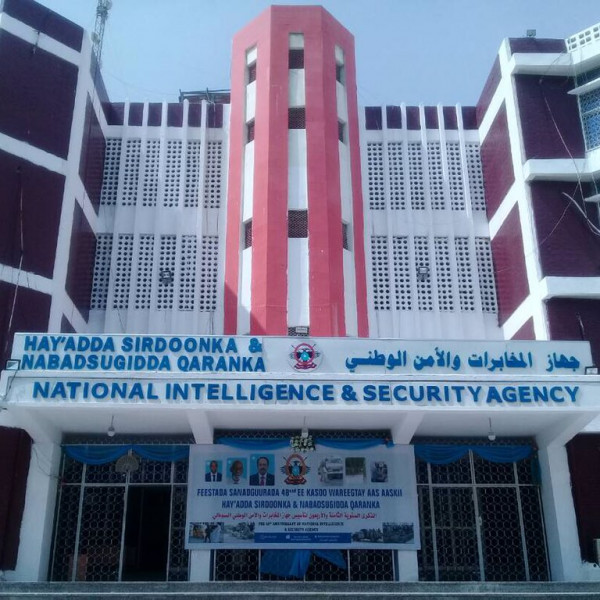
MOGADISHU, SOMALIA – NISA says it arrested eleven people it described as members of separate al-Shabaab networks during operations in Darussalam, Garasbaley, Kahda, Daynile and Afgooye announced on Tuesday 15 September. The intelligence agency said the suspects were preparing acts against security and that its officers seized weapons and other materials intended for planned attacks. NISA has published no names, arrest times, charges, court appearances, warrants or photographs of the alleged evidence. The announcement establishes that eleven people are in intelligence custody on the agency’s account. It does not provide the public record needed to test whether a clandestine network was dismantled or whether the constitutional rights attached to the arrests have been observed.

NISA Names Five Places and No Suspects
NISA presented the operation as the disruption of multiple separate clandestine networks allegedly trying to infiltrate Mogadishu and its approaches. The official state account published on 15 September named five locations and said weapons and materials had been recovered. Darussalam, Garasbaley, Kahda and Daynile sit across the capital’s expanding northern and western edge; Afgooye lies on the Lower Shabelle corridor beyond it. NISA described the detainees as operatives, but supplied no role for any individual, no target, no date for a planned act and no inventory of what officers seized.
Two NISA announcements now follow the same sequence in intelligence reporting. An arrest bulletin defines affiliation, intention and operational success before a prosecutor has placed an accusation before a court. NISA said last month that it detained nine suspected al-Shabaab members in Garasbaley, Kahda and Elasha Biyaha and that investigations were continuing. The current statement overlaps two of those locations, expands the map into Daynile, Darussalam and Afgooye, and gives no outcome from the earlier detentions. Twenty people have therefore been described in two months as members of clandestine networks around the capital without a published charge sheet linking either group to a named plot or recording whether the earlier nine remain in custody.
The former Dharkenley commissioner case documents a real infiltration problem in Mogadishu. He was arrested in 2024 after NISA accused him of passing information, and a separate case brought eleven Hodan district employees before the military court on allegations of aiding attacks. Those proceedings supplied defendants, alleged functions and evidence that could be contested. NISA may hold comparable material in the new case. Its 15 September statement asks the public to accept the conclusion while every fact that would identify the alleged networks remains inside the agency, unavailable to families, lawyers and reporters seeking to verify the arrests.
NISA Has a Forty-Eight-Hour Constitutional Clock
Article 35 of Somalia’s Provisional Constitution gives every arrested person the right to be told the reason in a language they understand, to have family informed, to consult a lawyer and to appear before a competent court within forty-eight hours. The constitutional text published by parliament also protects the legal presumption of innocence and bars a verdict based on coerced evidence. NISA’s public announcement omitted the times and dates of arrest, so the public cannot calculate when the forty-eight-hour period began or determine whether any of the eleven has appeared before a judge.
The NISA Act signed in 2023 gave the agency arrest, detention, search and surveillance powers that had previously rested on a vague legal basis. It also retained the constitutional requirement for judicial review. A United Nations special rapporteur later noted that the law assigns a prosecutor to monitor conditions and rights in NISA investigation centres and requires the internal security ministry to oversee the agency. The same assessment identified the missing external safeguard: people affected by NISA activity have no independent complaints mechanism, and investigation of agency officials requires permission from the director general.
NISA operates in the part of the security system where secrecy has a legitimate operational purpose and the highest potential cost. Publishing names before families are protected or accomplices are located can compromise an investigation. Keeping arrest times, judicial status and charges secret after the initial operation prevents any outside institution from knowing whether the law has been followed. The agency can preserve tactical material while stating when custody began, which court reviewed it, whether counsel was provided and what offence is alleged. A docket number alone would establish judicial review without exposing an operational source. None of those disclosures would require NISA to reveal an informant, surveillance method or future target.
The NISA Claim Stops Before the Courtroom
The 2023 Hodan proceedings show that an infiltration case can enter a detailed and independently reviewable public record. Eleven district officials were taken to court on allegations of assisting al-Shabaab, with prosecutors identifying the defendants, their municipal positions and the attacks to which the alleged network was connected. The later judgment named convicted employees and the information they were found to have transmitted. Those proceedings can be criticised for the use of military jurisdiction over civilians, but they produced accusations, evidence and outcomes that extended beyond an intelligence bulletin.
The geography in the new NISA claim reaches the front line around the capital. Basra, where federal forces fought for days at the end of August, sits roughly thirty kilometres from Villa Somalia on the boundary of the two Shabelle regions, and the battle required foreign air support close to Mogadishu. Farther south, al-Shabaab has destroyed military traffic on the road between government bases and retained freedom of movement through the farmland. Networks in Kahda, Daynile or Afgooye would connect that contested belt to markets, officials and potential targets inside the city. The locations make NISA’s allegation plausible; they do not establish the guilt of eleven unnamed people.
NISA can convert its announcement into an accountable security result by placing the detainees before a court, identifying the offences and producing an evidence inventory that a defence lawyer can challenge. The agency may also release people against whom no prosecutable case exists, which would be an ordinary result of a preventive operation and should be recorded. Until either documented step occurs, the published fact is narrower than the headline issued by the state: NISA says it holds eleven people, calls them al-Shabaab operatives and has supplied no public means of testing the description or tracing the custody of any individual.