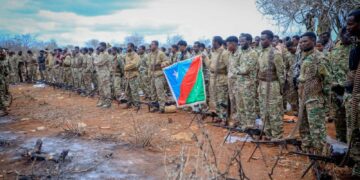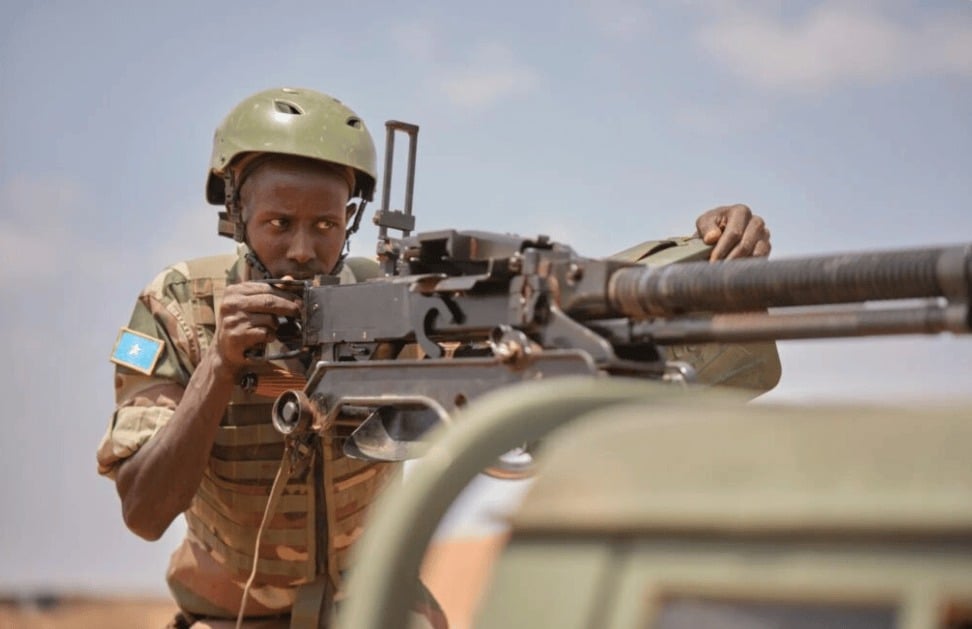
MOGADISHU, SOMALIA – The Somali Armed Forces announced on 30 August that they were running a major operation against al-Shabaab at Basra, a settlement on the boundary between the Middle Shabelle and Lower Shabelle regions, thirty to thirty-five kilometres from the capital. The statement reported militants killed, two of their commanders among them, weapons recovered and the pursuit still going on. Local accounts had the fighting in its sixth day by then, and it continued into 31 August, when Turkish F-16s were reported bombing riverbank positions in the same area. What happened at Basra this week matters less than where Basra sits and how often it has turned over, more than a dozen changes of hands since 2011. Nineteen years after the first African Union soldiers landed in Mogadishu to keep a Somali government alive, the army is fighting for a village on the road into the city.

What the Army Says It Is Doing at Basra
The federal account is worth reading closely for what it claims and for what it leaves out. The defence ministry said the armed forces had killed a number of al-Shabaab fighters including two of their commanders, recovered the weapons those men were carrying, and were pursuing the survivors in order to clear the areas around Basra and safeguard local communities, adding that the operation was continuing and that official results would be published once it had concluded. Those results have still not appeared, and in the meantime the statement named no unit, gave no figure for the government’s own casualties, and set no date by which the surrounding villages would be secure.
Local reporting fills in a different shape from the same events, because the fighting had already been running for six days by 30 August, with both sides using heavy weapons and residents describing sustained gunfire and explosions, while access to the area was restricted closely enough that no independent casualty count exists. By 31 August the district was being described as calm and under federal control, after al-Shabaab fighters attacked government positions in and around Basra and were driven off, which is a sequence worth stating plainly, since it means the army spent the better part of a week defending ground it already held thirty kilometres from the presidential palace.
The air support says the rest, because Turkish F-16 fighter jets were reported striking riverbank positions at Basra on 31 August, with local accounts of heavy casualties, no independent verification of the toll, and no confirmation from Ankara or from Mogadishu of the strikes, their targets or the number killed. A holding action at a village half an hour’s drive from the seat of government called in fast jets flown by a foreign air force whose government declines to acknowledge flying them, and every clause in that sentence is a description of the Somali security transition as it stands in the ninth month of 2026.
Thirty Kilometres Is the Whole Argument
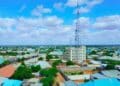
Geography explains why Basra keeps turning up in casualty reports. The Shabelle valley is the corridor that feeds Mogadishu, carrying the charcoal, the livestock, the produce and the people that move between the capital and the farmland behind it, and the villages strung along the river are the checkpoints on that road, so whoever holds them taxes the traffic and decides who reaches the city. Al-Shabaab has understood this for the whole of its existence, which is why the group has spent nineteen years contesting a belt of ground that a government with a functioning army would treat as its own outer suburbs and police with traffic officers.
Set the calendar beside the map and the shape of the failure becomes visible. The first African Union troops, Ugandan, entered Mogadishu in March 2007 to hold an airport road for a government that controlled almost nothing else. Al-Shabaab pulled its fighters out of the capital in August 2011, and the withdrawal was read at the time as the war’s turning point. Government forces took Adan Yabaal, the group’s regional headquarters in Middle Shabelle, in December 2022, during the offensive that was supposed to finish the job, and al-Shabaab took Adan Yabaal back on 16 April 2025. The mission that arrived in 2007 has been renamed twice since, and the fighting is at the same distance from the same city.
The army itself has grown throughout, since Mogadishu graduated its largest class of soldiers since 1991 this year, trained in Turkiye, in Eritrea, in Uganda and at home, and the federal government can now put more men under arms than any Somali administration in three decades. What nineteen years have not produced is the apparatus that turns a cleared village into a governed one, meaning a garrison that stays after the cameras leave, a police station that opens, a court that sits, and a district administration collecting something other than protection money, and Basra is where the absence of all four is on display.
The Offensive That Ran Backwards
The campaign launched in 2022 was the best chance in a decade and it has been substantially reversed. Clan militias fighting alongside the army cleared large parts of Hiiraan and Middle Shabelle while the government announced town after town, and then from February 2025, a little before Ramadan, al-Shabaab launched a counteroffensive concentrated in Middle Shabelle and recovered much of the territory it had lost, Adan Yabaal included. The pattern held across two years, with ground taken by momentum and given back by arithmetic, because the forces that captured a place were the same forces needed to capture the next one, and Basra sits at the near end of the line that pattern drew.
The reason is administrative before it is military. When the mission handed the Buurhakaba forward operating base to the Somali army in August 2026, the promised federal replacements never arrived and Southwest units were stretched to cover the gap, which is the same failure at a smaller scale and it recurs because holding ground requires payroll, rotation, logistics and local consent, none of which the federal government has reliably supplied to any garrison beyond the capital. The clan fighters who did the holding in 2022 have drifted away as the politics soured, and the president has struggled since February 2025 to keep even his own Abgaal kinsmen behind a campaign many of them now read as one faction’s project.
Meanwhile the government’s attention went elsewhere all summer. Federal units fought forces loyal to the removed Southwest president in Baidoa during August 2026 and flew reinforcements into the city, soldiers worked the demolition lines in Mogadishu’s cleared neighbourhoods, and the piracy file off the Nugaal coast consumed a fortnight of airpower and diplomacy. Every one of those commitments drew on the manpower and the political capital that Basra needed, and every one of them advanced a domestic objective while the insurgency held its ground on the river and waited.
The Bill Arrives Before the Ground Is Held
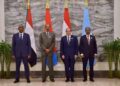
The support that made nineteen years of this possible is being withdrawn on a published timetable. The African Union mission has been operational since 1 January 2025 with roughly twelve thousand uniformed personnel, and its funding is blocked past 31 December while the office that moves its food, fuel, water and casualties auctions vehicles and prefabricated camps. American money that carried about a quarter of the logistics budget stopped at the start of July. Uganda, which supplies the largest contingent at roughly 4,500 soldiers and whose troops were the first to arrive in 2007, has named 1 August 2027 for a complete withdrawal.
Somalia’s federal government is asking the Security Council for money before that clock runs out, and the answer will be shaped by what the Council can see from New York. What it can see this week is an army fighting a six-day defensive battle at a village thirty kilometres from the presidential palace, supported by the aircraft of a country that will not confirm the sorties, while a federal member state negotiates its own security arrangements directly with Washington and the capital’s politics turn on a succession fight in Baidoa. Those same facts make the case for continued funding and the case against it.
Nineteen years of foreign deployment bought Mogadishu, and Mogadishu is a real achievement nobody should be casual about, because the city al-Shabaab left in 2011 was a ruin and the one standing now is not. What the money did not buy was the thirty kilometres past the last checkpoint. The transition now under way assumes a Somali state capable of holding ground that no Somali government has held since 2006, on a timetable written in Kampala and Washington while Villa Somalia holds none of the pens. Basra is where that assumption gets tested, and this week it was tested again.