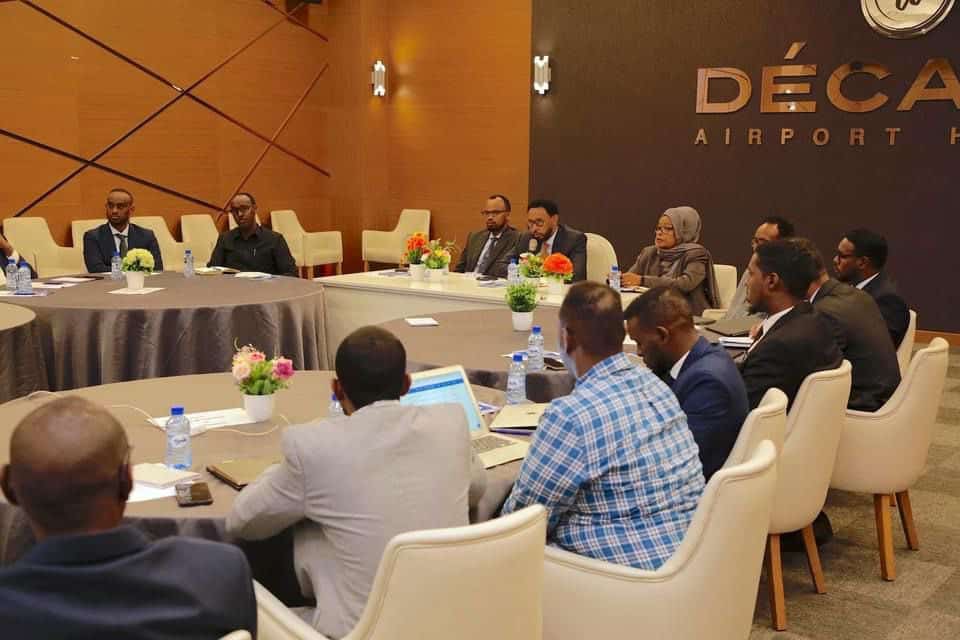
MOGADISHU, SOMALIA – Somalia’s finance minister told an audience in Mogadishu on Tuesday that between 450 and 600 million dollars of income that used to flow into the country is now disappearing, and that private enterprise has to close the gap. Bihi Imaan Egeh framed the appeal as arithmetic rather than ideology. The federal budget he manages already leans on foreign grants for roughly two thirds of its resources, and the largest of those donors has just announced its exit. A government that raises less than half of what it spends is now trying to win a constitutional fight against the regions that control the ports.

What the Finance Minister Told Mogadishu
Egeh delivered the warning on Tuesday alongside a decade of numbers meant to soften it. He put the economy at roughly 2.3 billion dollars today against about 150 million a decade ago, and said commercial bank lending to the private sector has nearly doubled in five years to around 500 million. He also conceded the part that matters most. Too little of that lending reaches agriculture, livestock and industry, which is to say too little of it reaches anything that generates domestic tax. His request to the banks was to redirect credit toward production and jobs.
The minister has held the portfolio since July 2023, and his tenure covers the one unambiguous fiscal success of the Hassan Sheikh Mohamud era. Somalia reached the completion point of the Heavily Indebted Poor Countries process in December 2023, cancelling roughly 4.5 billion dollars of debt and returning the country to the international financial system. That achievement bought Mogadishu credibility with the IMF and the World Bank, and it opened the door to the concessional lending the federal budget now assumes. It did not build a tax base, and the distance between those two things is exactly what the current figures expose.
Egeh did not specify which flows are drying up, and the omission does a great deal of work. Somalia’s external income arrives through several channels that have narrowed at once, from humanitarian appeals donors have cut, to security financing Washington has now capped, to remittance and trade flows exposed to global conditions. No public breakdown has come from the finance ministry, and none appears in the budget documents. What the country has instead is a minister telling a room of businessmen that the money is going, and that they should find a way to replace it.
A Federal Budget That Foreigners Mostly Pay For
The published figures show why the warning carries weight. Somalia’s 2026 federal budget projects 1.36 billion dollars in revenues and grants against 1.39 billion in expenditure, leaving a deficit near 29 million. Domestic revenue accounts for 479 million of that total, and the ministry expects the increase to come from income tax and administrative fee reforms rather than from customs, which remain hostage to global trade. External grants supply 878.8 million dollars, close to 65 percent of everything the government has to spend. Somali Public Agenda has tracked the same pattern of rising domestic revenue alongside persistent donor dependence across successive years.
Those grants split into two very different instruments, and the distinction is rarely made in public. Direct budget support runs to 174.4 million dollars, which donors pay into the treasury for Mogadishu to allocate. Donor-financed projects account for the remaining 704.4 million, and that money never enters the government’s discretion at all. It arrives attached to programmes, contractors and reporting lines the donors themselves control. The portion of the federal budget that Villa Somalia can actually direct is therefore far smaller than the headline total suggests, and smaller still once salaries are covered.
Set that against the argument now running through Kampala and the picture sharpens. The federal government insists it holds the mandate to negotiate Somalia’s security transition and to design the electoral system, while its opponents say both mandates expired this year. The opposition bloc has already asked AUSSOM’s troop contributors to make their support conditional on a political settlement. A federal budget two thirds funded from abroad gives that request unusual force, because conditionality is not really a threat against a government in this position. It is a description of how the government already operates.
The Transfers That Buy Federal Leverage
Roughly 212.7 million dollars of the 2026 plan goes out as grants to the federal member states, and that single line explains a great deal about relations between Mogadishu and the regions. The federal government cannot compel a state to accept its electoral model, and it cannot station troops in Garowe without a fight. What it can do is decide which administrations receive their transfers on time, and which discover that the paperwork has suddenly become complicated. Money is the one federal instrument that works without a court ruling or a battalion.
Puntland stopped treating this as a technical matter some time ago. Garowe suspended intergovernmental processes after concluding that dialogue with the federal government produced nothing, and it has since run its own budget, its own forces and its own foreign contacts. Jubaland reached a similar judgement, and the two states now coordinate closely. Neither depends on federal transfers the way Galmudug, Hirshabelle and South West do, which is precisely why Villa Somalia has found those three so much easier to manage. Puntland collects at Bosaso, Jubaland collects at Kismayo, and both treat that income as the practical guarantee of their political independence.
The correlation holds across the year with uncomfortable neatness. Administrations that need the money have gone along with the constitutional amendments and the direct-election plan. Administrations that fund themselves have refused, and have paid for the refusal in other ways. Mogadishu’s critics read that pattern as the whole story of Somali federalism under Hassan Sheikh Mohamud, in which fiscal dependence quietly substitutes for consent, and the federal budget does work the constitution was supposed to do. Villa Somalia rejects the characterisation and points to its constitutional authority over national revenue.
Why the Port Fights Are Revenue Fights
Customs is where the argument turns physical. Somalia’s ports generate the bulk of collectable domestic revenue, and the ministry’s own caution about customs receipts amounts to an admission that Mogadishu does not control most of them. Bosaso and Kismayo answer to administrations that keep what they collect. Every federal attempt to place forces near those facilities therefore carries a fiscal logic alongside the security one, whatever justification accompanies it, and the regions read the intent accordingly.
That logic has now produced gunfire. Puntland forces stopped a Puntland Security Force column near Laag north of Bosaso on 20 July, seizing military vehicles and capturing fighters, and Garowe maintains that no force of that name lawfully belongs to its defence structure. Puntland troops have since surrounded a PSF camp in Galkayo, and Deni’s administration has warned that it will treat further federal-aligned deployments as hostile. Villa Somalia disputes Puntland’s account of who commands the PSF. Galmudug has still not answered the accusation that its territory carried the supplies, and the silence has been noted in Garowe.
The timing compounds everything. Washington told the African Union on 1 July that it will stop financing the UN Support Office in Somalia after December 2026, stripping the logistics behind roughly 12,000 African Union personnel and landing on a federal budget that already shows a deficit. Mogadishu has spent the year offering foreign partners assets it does not fully control, from ports to airstrips, hoping to replace that support. Egeh’s appeal to Somali businessmen is the domestic version of the same manoeuvre. Both amount to asking someone else to finance a state that has not learned to finance itself. Somalia will not settle its constitutional argument while the federal budget depends on the partners Mogadishu keeps alienating and on the regions it keeps confronting.