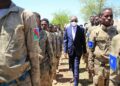
KAMPALA, UGANDA – Uganda’s chief of defence forces opened the Kampala summit on Wednesday by telling the region something its governments have avoided saying in public. The United Nations Support Office in Somalia has already cut its support to the African Union mission and the UN Guard Unit by 25 percent, and the rest disappears in December. General Muhoozi Kainerugaba added the detail that gives the meeting its edge. Washington has indicated it will not support renewal of the Security Council mandate for AUSSOM if that mandate still carries UNSOS support. The mission that holds up the Somali state now has an end date and no agreed successor.

What the Kampala Summit Was Actually Told
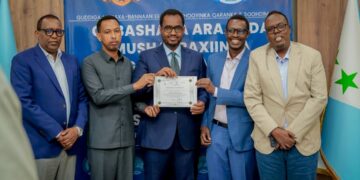
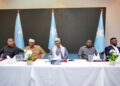
The second Extraordinary Summit of AUSSOM troop-contributing countries runs from 29 to 31 July at Speke Resort Munyonyo, under the theme of sustaining Somalia’s stabilisation process. Uganda, Kenya, Ethiopia, Djibouti, Burundi, Egypt and Somalia are in the room, alongside the African Union, the United Nations and IGAD. Defence and police chiefs met first and adopted a report. Defence ministers take it up on Thursday with AU Commissioner Bankole Adeoye and the acting head of UNSOS, Qurat-Ain Sadozai. Heads of state close the process on Friday behind closed doors and issue a communique.
Kainerugaba did not present the 25 percent reduction as a forecast. He described it as something that has already hit the theatre, forcing commanders to reorder priorities and weakening effectiveness in some areas. That matters more than any communique language, because UNSOS is not a grant that a government can replace at the margin. It supplies fuel, rations, water, transport, engineering, medical care and casualty evacuation to roughly 12,000 African Union personnel. Cut a quarter of that and units stop moving, not gradually but immediately.
Kainerugaba’s account of the American position, set out in the Ugandan military’s own record of the session, converts a financing problem into a legal one. AUSSOM’s mandate runs to the end of December, and the Security Council must vote to renew it. If Washington will not accept a text that keeps the UNSOS arrangement inside the mandate, then the mission’s paperwork and its logistics expire together. The agenda reflects that pressure. Delegates are reviewing troop deployments, air assets, force integration, the readiness of Somali forces and options for sustaining operations once the support office closes. Each of those items assumes the others are solved, which is the quiet problem with the whole exercise. Somali forces cannot absorb bases without logistics, and logistics is the thing being withdrawn.
The Bill Nobody at the Kampala Summit Wants
Everyone in the room understands what alternative arrangements mean. It means the troop contributors pay for themselves. Uganda has carried soldiers in Somalia since 2007 and has already signalled that it intends to bring them home. Burundi cut its participation after a dispute over troop allocations under the AUSSOM structure. Neither country has the fiscal room to absorb the logistics that Washington has funded for a decade, and neither has an obvious domestic argument for trying.
The hybrid financing model built for AUSSOM was supposed to solve this. Under it a share of the mission’s costs would come from UN assessed contributions, with the balance raised from the AU and partners. The model was never fully funded, and the American decision removes the assessed portion that made the arithmetic work at all. What remains is an appeal to European donors who are cutting aid, and to Gulf states whose interests in Somalia are competitive rather than complementary. The Kampala summit can restate the model, and it can ask the African Union to lobby harder for it, but it cannot vote itself the money.
Mogadishu arrives with nothing to offer either. The 8,000-troop reinforcement that the government and the AU agreed after al-Shabaab’s 2025 advances was never funded. The written transition plan that partners have requested for months, setting out which bases transfer and when, still does not exist. Somalia’s own federal budget draws about 65 percent of its resources from foreign grants, which leaves the federal government asking the Kampala summit to solve a problem it cannot contribute to solving. Hassan Sheikh Mohamud’s delegation can offer gratitude and warnings about al-Shabaab. It cannot offer a single funded battalion to replace the ones that may leave.
Why the Politics Followed the Soldiers to Kampala
Into that room the opposition dropped a letter. The Somali Future Council wrote to the same six governments on 27 July, asking them to tie further support to a political settlement and arguing that the president’s term expired on 15 May and parliament’s on 14 April. Villa Somalia rejects that reading and defends its constitutional amendments and its direct-election plan. No arbiter has ruled between them, and the Kampala summit has no standing to. The bloc copied its letter to the African Union, the Security Council, IGAD, the European Union and the American, British and Turkish missions, which tells you it expects the argument to be settled abroad rather than in Mogadishu.
The letter still lands well because it describes the room accurately. Troop contributors are being asked to keep soldiers in a country whose government they cannot be sure will exist in its current form when the mandate lapses. Puntland and Jubaland closed ranks against Villa Somalia months ago, and Puntland forces are currently surrounding a federally aligned unit in Galkayo. A general weighing whether to keep a brigade in Somalia has to price that, and the Kampala summit gives him the first structured occasion to say so to his own head of state.
Ethiopia and Kenya sit in the summit with their own calculations. Both keep forces in Somalia partly under bilateral arrangements that would survive AUSSOM’s end, which gives them less reason than Uganda to fight for the mission’s financing. Egypt joined AUSSOM as a counterweight to Ethiopia rather than out of concern for Somali stabilisation. The seven flags in the room do not share an interest, and the closing communique will paper over that rather than resolve it. Kenya has its own reasons for caution after al-Shabaab attacked its bases in Mandera in late July.
What Happens After the Communique
The likeliest outcome is a document that asks the Security Council for more time and the donors for more money, without committing any government to a number. That has been the pattern of every AUSSOM meeting since the mission replaced ATMIS in January 2025, and the April 2025 summit decisions whose implementation Kampala is now reviewing went the same way. Deadlines slip, contributions arrive late, and the mission absorbs the shortfall by doing less. Every previous Kampala summit and Addis Ababa session has ended with a request rather than a decision.
The difference this time is that the calendar has stopped being negotiable. December is not a target that can be revised by another summit, because it is the point at which both the money and the legal authority run out. Al-Shabaab reads calendars as well as anyone. The group spent the ATMIS drawdown retaking districts across Lower and Middle Shabelle, and it has spent this year moving at night on the edges of Mogadishu while the government insisted security was improving. A group that survives by outlasting foreign timetables has just been handed one it can read in a newspaper.
What the Kampala summit cannot produce is the thing that would actually change the trajectory. Somalia needs a government its own federal member states recognise, an army that answers to the state rather than to the palace, and a revenue base that does not vanish when a donor changes policy. None of those is in the gift of seven defence ministries meeting at a lakeside resort. The generals will sign a communique on Friday, the soldiers will stay a while longer, and the questions that put them there will still be open when the mandate expires.