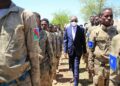
Jerusalem, ISRAEL – Somaliland President Abdirahman Mohamed Abdullahi opened his country’s first embassy anywhere in the world on Monday. Notably, he did not open it in Addis Ababa, Ankara, or London. He opened the Somaliland Israel embassy in Jerusalem, the most politically charged city on earth, at the personal invitation of Prime Minister Benjamin Netanyahu. The symbolism was as deliberate as the location. After 35 years of seeking international recognition, Somaliland planted its flag in a place guaranteed to maximize global attention and maximize Mogadishu’s humiliation. The Somaliland Israel embassy is a statement that Hargeisa no longer needs Mogadishu’s permission to act like a state.

Israeli Foreign Minister Gideon Sa’ar hosted President Abdullahi for the inauguration ceremony on June 14. As a result, Somaliland became the eighth government to establish a diplomatic mission in Jerusalem, joining the United States, Guatemala, Honduras, Kosovo, Papua New Guinea, Paraguay, and Fiji. Israel will reciprocate by opening its own embassy in Hargeisa. The two governments signed cooperation agreements covering security, trade, water technology, and renewable energy. President Abdullahi toured the Knesset, visited Yad Vashem, and laid a wreath at Mount Herzl during a state visit lasting until Thursday.
An Intelligence Foothold in the Gulf of Aden
The Somaliland Israel embassy is the diplomatic face of a far deeper strategic partnership. A DropSite News investigation published on June 13, citing three Somali officials, a former Somali security official, an EU security official, and a Somaliland official, confirmed that Israel has already established an intelligence presence at Berbera International Airport. Furthermore, discussions are underway about a full Israeli military base on elevated terrain approximately 100 kilometers west of Berbera. The intelligence operation targets Houthi positions roughly 260 kilometers across the Gulf of Aden in Yemen. Consequently, an Israeli presence at Berbera would enable drone operations, intelligence gathering, and early warning systems against the missile and drone threat that has disrupted Red Sea shipping since late 2023.
The UAE already operates a military base at Berbera port. Meanwhile, an informal alliance that analysts call the “Berbera Axis” is taking shape between Israel, Somaliland, Ethiopia, and the United Arab Emirates. The Somaliland Israel embassy formalizes what was already an open secret in the intelligence world. For Mogadishu, the implications are devastating. The federal government insists it is the only authority empowered to enter international security arrangements on behalf of Somali territory. In contrast, Hassan Sheikh Mohamud’s government cannot enforce that claim. It cannot project military power into Somaliland. It cannot prevent foreign intelligence agencies from operating at Berbera. The gap between Mogadishu’s legal position and its actual capacity has never been wider.
Condemnation Without Consequences
President Hassan Sheikh called Israel’s December 2025 recognition of Somaliland “one of the darkest days in Somalia’s history.” Specifically, he accused Netanyahu of pursuing a threefold agenda: relocating displaced Palestinians from Gaza to Somaliland, establishing military bases at Berbera, and securing Somaliland’s signature on the Abraham Accords. Yet the rhetoric was fierce. The follow-through has been nonexistent.
Somalia mobilized international support and achieved diplomatic wins on paper. The African Union Commission declared any recognition of Somaliland “null and void” in April 2026. Similarly, the AU Peace and Security Council demanded the “immediate revocation” of Israel’s recognition. The Organisation of Islamic Cooperation, the European Union, and the UN Security Council all condemned the move. However, none of these statements produced a single consequence for Israel or Somaliland. The Somaliland Israel embassy opened on schedule. The intelligence base at Berbera continues to operate. International condemnation, it turns out, is not the same as international action.
TSD has documented how Hassan Sheikh’s constitutional gambit alienated the very federal partners who might have formed a united Somali front against Somaliland’s diplomatic offensive. As a result, Puntland, Jubaland, and Galmudug are all in varying degrees of open conflict with Mogadishu over the electoral crisis. President Deni has accused Hassan Sheikh of creating pirates and dismantling the federal system. Villa Somalia’s takeover of Southwest State showed the international community that Mogadishu is more interested in controlling its own member states than defending sovereignty against external actors. The Somaliland Israel embassy is the direct beneficiary of that dysfunction.
Dialogue Without Credibility
Hassan Sheikh told reporters he chose dialogue over force in dealing with Somaliland. In theory, that position would be defensible if he were simultaneously building the political consensus and institutional credibility to make dialogue effective. In practice, he spent the first half of 2026 extending his own term and facing international rebuff, crushing opposition in Mogadishu, and deploying troops against regional presidents. Somaliland watched all of it and calculated, correctly, that Mogadishu had neither the bandwidth nor the legitimacy to respond.
The timing of Abdullahi’s visit was no accident. He arrived in Israel while Mogadishu was still recovering from the June 3-4 clashes between federal forces and opposition groups that left at least 13 dead and displaced 12,500 households. At the same time, Villa Somalia was busy searching houses and raiding hotels near Lido Beach. Somaliland’s president was shaking hands with Netanyahu and cutting ribbons in Jerusalem. The optics could not have been worse for Hassan Sheikh.
Somaliland’s independence movement has operated for 35 years on the premise that Mogadishu’s dysfunction would eventually create openings for recognition. The Somaliland Israel embassy proves that thesis correct. Consequently, every constitutional overreach, every military confrontation with regional states, every federal member state that rejects Mogadishu’s authority makes the case for recognition slightly easier. Hassan Sheikh Mohamud has become Somaliland’s most effective recruitment tool. He spent June fighting Somalis in Mogadishu while Somaliland built alliances in Jerusalem. That is the verdict the Somaliland Israel embassy delivers on his presidency.
Mogadishu has since outsourced much of the protest. Egypt condemned the purported Jerusalem mission in talks with Somali officials in late July, raising it alongside its push to free eight Egyptian sailors held by pirates, which places the loudest objection in Cairo rather than in Villa Somalia. Hargeisa has faced no material consequence for the opening.