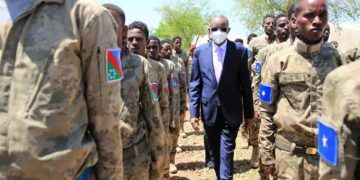
MARKA, SOMALIA – Biyomaal fighters in the KM50 area of Lower Shabelle detained a survey team last month and put its vehicle, its generators and its land measuring equipment on public display, the sharpest expression so far of a dispute over who holds title to the coastal strip running from Marka down through Jasiira and Gendershe. Biyomaal elders say the surveyors were mapping ground for an acquisition scheme backed by the Hormuud group, an allegation the company has left unanswered in public. Neither the federal government nor the Southwest State administration has commented on the seizure, on the protests that followed it or on the killings around Janaale that preceded it. Both communities in the dispute have since sought mediation from al-Shabaab.

What the Biyomaal Put on Display at KM50
The detained group was presented publicly on 8 July alongside a vehicle, electricity generators and surveying instruments, and it reportedly included foreign nationals with professional surveying expertise. Elders said the team had come to measure the Deexda area, the stretch of ground running between Marka, KM50 and the coastal settlements of Jasiira and Gendershe, which is the exact ground the community says has become the object of a coordinated acquisition. A survey party carrying generators and instruments into that landscape is doing preparatory work for a registry entry, and the Biyomaal read it as the paperwork stage of a transfer they were never consulted about.
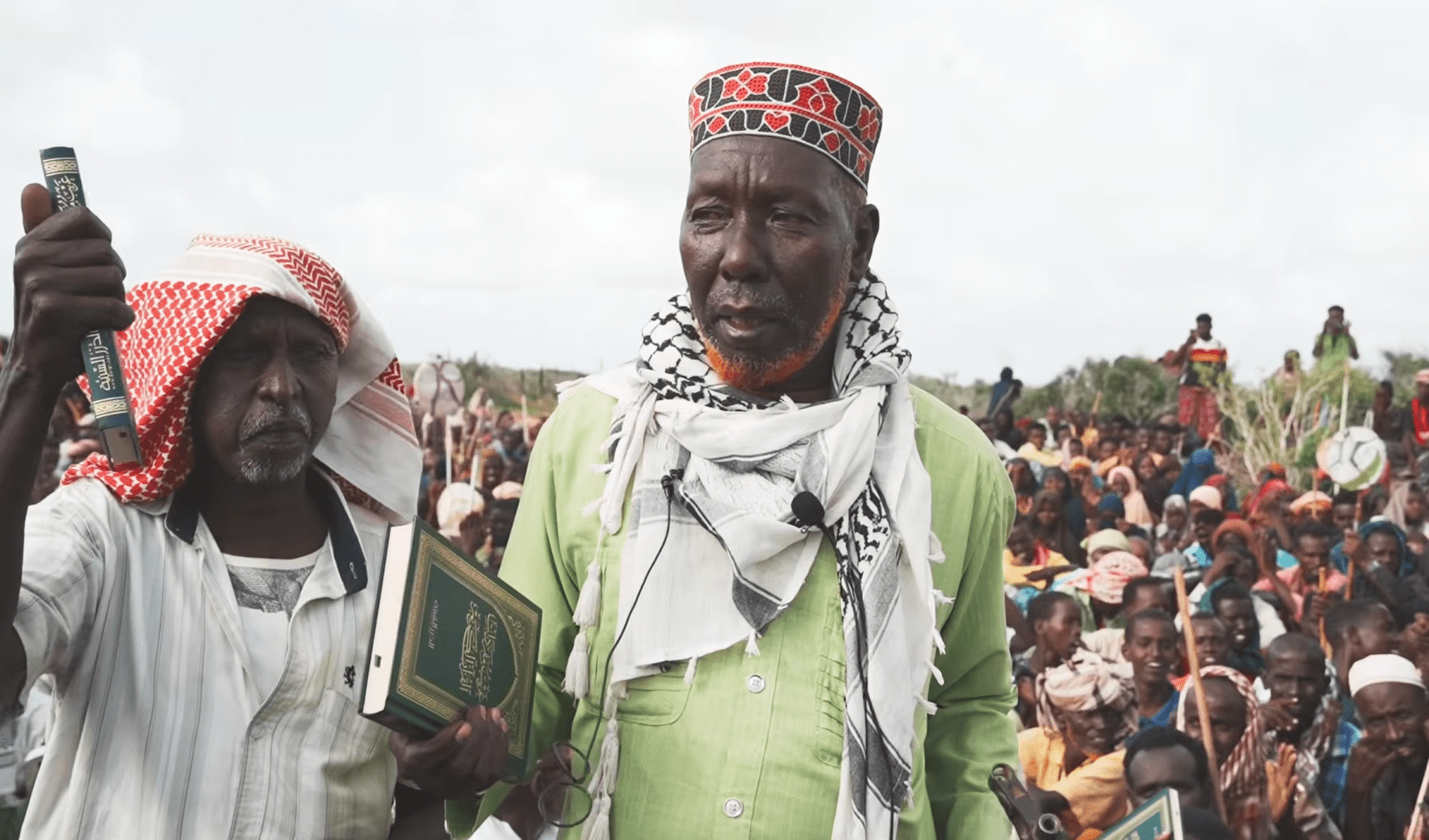
The display was followed the next day by a demonstration at KM50, about fifty kilometres southwest of Mogadishu, where elders, women and young men gathered to accuse Habar Gidir and Abgaal militias of taking farmland they describe as ancestral. Protesters held copies of the Quran alongside Kalashnikovs and said that if the appeal to religion failed they would defend the land by force. One elder told the crowd that the farms under threat contain the graves of their forebears and the wells the community depends on, and another said plainly that the Biyomaal were exhausted and out of options.
Seizing equipment is a form of enforcement, and communities reach for it when no institution will hear the case. There is no functioning land registry in Lower Shabelle that either side accepts, no court whose ruling on a coastal plot would be executed, and no district administration in most of the disputed belt with the means to stop a survey party at a roadblock. The Biyomaal did at KM50 what a lands ministry would ordinarily do at a counter in Marka, and the equipment stayed in their hands because nobody arrived to ask for it back. Detaining foreign technicians also raises the cost of the next attempt, since a contractor who loses a crew and a vehicle in Lower Shabelle prices the risk into the following survey and eventually declines the work.
A Company, a Coastline and a Contested Register
The Hormuud allegation predates this seizure by more than a year. A statement issued in the name of the Dir Biyomaal community in December 2024 accused the conglomerate’s founder, Ahmed Nur Ali Jimale, of financing a scheme to acquire Biyomaal land in Lower Shabelle, said President Hassan Sheikh Mohamud would supply the legislative cover for it, and claimed the money was meant to resettle more than ten thousand families from another clan family on that ground. The statement asked the United Nations and the International Criminal Court to treat the plan as ethnic cleansing. No evidence for the resettlement figure has been published, the company has issued no public rebuttal, and Villa Somalia has never addressed the charge.
Whatever its merit, the allegation explains why a theodolite and a generator provoked a mobilisation. Hormuud is the largest private institution in southern Somalia, with a telecommunications network, a mobile money system that functions as the region’s currency, and a shareholder base drawn heavily from Mogadishu business families, and it has spent years denying separate claims about its dealings with armed groups. A company of that size acquiring coastal land near the capital changes the value of every plot around it, and the Biyomaal case is that the transaction is being arranged in Mogadishu among people who will never farm it.
Land in Lower Shabelle has carried this problem since the banana economy was militarised in the early 1990s, when plantations along the river changed hands at gunpoint and the deeds issued afterwards were as good as whoever was holding the road that week. Successive administrations have promised a registry and delivered none. The result is that a strip of irrigated ground forty minutes from the capital has at least three overlapping systems of claim, and the Biyomaal, the Habar Gidir and the Abgaal each hold documents or memories that support their own.
The Fighting Around Janaale
Violence arrived before the surveyors did. Fighting between Biyomaal and Habar Gidir militias broke out around Janaale on 4 July and ran for three days, with banana plantations burned during the exchanges and three people killed by the count of Habar Gidir elders, who said their own farms had been attacked. Further clashes were reported on 6 July along the road between Janaale and Marka, the regional capital, and both sides used technicals with heavy machine guns mounted on them. Farmers and traders in the Janaale area have been unable to reach their land since, and a district that supplies fruit and vegetables to Mogadishu markets has lost a season of planting to a quarrel over the plots themselves.
The counter mobilisation came on 13 July, when Habar Gidir and Abgaal elders gathered near Jazeera outside Mogadishu and accused the Biyomaal of occupying land they consider historically theirs. Those elders also claimed the Biyomaal are being backed by Somaliland and by Israel, a charge for which nothing has been offered in support, and which imports the vocabulary of national security into an argument about irrigated hectares. One of them called the moment a turning point, which in Lower Shabelle has usually meant a season of raiding. Elders on both sides are now speaking to their own constituencies about defence and ancestry, a register that leaves very little room for the arithmetic of a boundary survey.
The dispute has already touched the state’s own forces. In April an elder was shot dead at Fadmuuse near Lambar 50, and soldiers from the Gorgor commando brigade were detained and questioned over the killing. The dead man had been an outspoken critic of land seizures around Baqal and Xawaalow and had taken part in a Biyomaal consultative conference in Marka shortly before he died. A Turkish trained elite unit standing in a land quarrel is the clearest sign of how far this file has travelled from anything a district commissioner could settle.
The Arbitrator Both Sides Chose
With Mogadishu silent, elders from both communities went to al-Shabaab for mediation, and they said openly that they did so because government authorities failed to intervene. The group has run functioning land courts in this region for fifteen years, enforces its judgments, charges for the service and does not lose the file when a minister is reshuffled. Every land dispute referred to it converts a grievance about hectares into a demonstration that the insurgency adjudicates what the state cannot, which is a deeper form of control than any checkpoint. A community that accepts one judgment on a plot boundary will bring the next inheritance case and the next debt to the same court, and the habit outlasts whichever garrison happens to hold the nearest town.
Lower Shabelle offers the movement plenty of room to work. The army and its partners hold garrisons at Awdhegle, Mubarak and Qoryoley while the road between two of those bases belongs to al-Shabaab, the African Union contingents in the sector are drawing down against a funding deadline in December, and Southwest State has spent the summer burning foreign flags over drone strikes and fighting the loyalists of the president Villa Somalia removed in March. An administration installed to be governable in Baidoa has no capacity left over for a land quarrel on the coast.
The federal government’s absence here follows the pattern it has set everywhere else. Its energy this year has gone into the member states, into managed votes, into a speakership and into a tour of towns that will receive it, and the same choices that produced clan fighting around Dhusamareb have left the Biyomaal and their neighbours to settle a border by militia. Somalia has an army graduating its largest classes since 1991 and a presidency telling African partners it no longer needs peacekeepers. Forty minutes from the seat of that presidency, a group of Biyomaal elders and a confiscated generator are the only land administration on the Marka coast.