
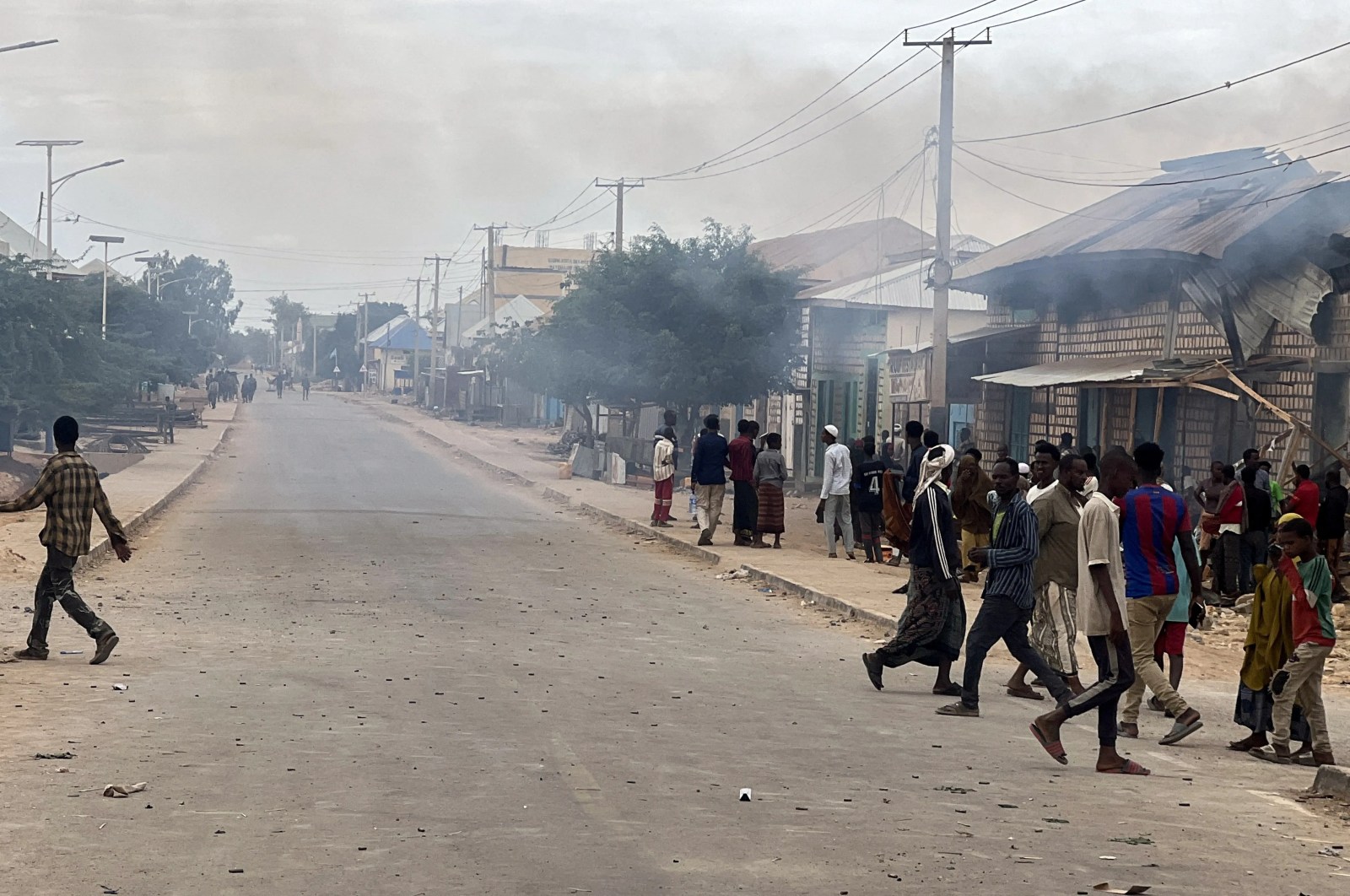
BAIDOA, SOMALIA – The federal government has told the country that the men killed in Monday’s battle for Baidoa were al-Shabaab, and the officials who ran this city until March say the photographs show something else entirely. Mogadishu displayed bodies, detainees and captured technicals after the fighting and counted close to thirty dead, describing them as Khawarij operating alongside militias loyal to former Southwest State president Abdiaziz Hassan Mohamed Laftagareen. Former local officials who examined the same images identified the dead and the captured as Darwish paramilitaries who had served under Laftagareen in the buildings the federal government now occupies. No names, no unit designations and no independent verification have followed the announcement, and a former head of state has since placed the entire episode at the door of the presidency that carried out the removal.

The Bodies Mogadishu Showed and What Baidoa Saw
The defence ministry’s account went out within hours of the shooting stopping, putting the toll at nearly thirty attackers killed with several more taken alive. Photographs and video followed, showing corpses laid out in the open, detained men seated on the ground and a line of captured vehicles the government said it had taken from the assault force. The statement used the word Khawarij, which the administration reserves for al-Shabaab, and said the attackers had moved in company with militias loyal to Laftagareen. Beyond the number itself, the ministry offered nothing that would allow anyone outside the chain of command to test the claim. Somali government casualty figures are rarely accompanied by identities, and this one arrived faster than most.
Former officials of the Baidoa administration who studied the same pictures said they recognised the faces in them. The men laid out for the cameras were Darwish, they said, the paramilitary wing that served the Southwest State administration until federal troops entered the city in March, and several were known to them personally from years of shared service. That identification carries the obvious interest of the side making it, and it will never be tested, because no institution in the country is positioned to conduct a post-mortem examination that both parties would accept as authoritative.
The government also produced the burned shell of a vehicle and presented it as the remains of a suicide car bombing. No blast pattern, no fragmentation debris and no crater has been shown alongside it. Reports circulating during the night of the attack named a federal base on the edge of Baidoa as one of the first positions hit, with government vehicles set alight there. That raises an unavoidable question about whose wreckage was photographed the following morning. The ministry has not addressed that discrepancy in any statement since, and the images have been left to do the work that evidence would ordinarily do.
Laftagareen Rejects the Label and Claims the City
Laftagareen’s office answered the terrorism charge directly, calling the description of his forces as an armed group false propaganda and saying the operation had been mounted to restore order and to remove a federal military presence it regards as unlawful. His spokesman went considerably further on Monday, announcing that the city had fallen and calling on federal troops to surrender, a claim nobody independent could confirm and one the army denied the same day. Both statements advance a single argument, which is that the men who walked into Baidoa were a state’s own security forces acting on behalf of a president removed by force.
The fighting began before dawn, with militias entering from two directions and engaging two battalions of federal troops. Residents described heavy weapons fired inside residential districts, and a shopkeeper said stray rounds killed at least two civilians inside their own homes. Gunfire was reported in Siliga, Warshadda Hassay, Boonkaay, Bangi Qiyaamay and Mursal, communications dropped out across parts of the city, and footage circulating that morning showed technicals moving between buildings with smoke rising behind them. Federal forces retook the contested neighbourhoods during the day and pushed the attacking force back out of Baidoa.
For Sheikh Adan Mohamed Nur Madobe, installed as Southwest president by a parliamentary vote in June, an assault column reaching the middle of his capital is the sharpest test his short administration has faced. Federal and state units had been positioned on the outskirts for months with exactly this scenario in mind. Security officials in Baidoa gave no detailed public account of how far the attackers penetrated or what the casualties were, and that local silence sits awkwardly beside a ministry in Mogadishu confident enough to publish a figure within hours. Laftagareen’s fighters withdrew, and the argument over who they had been started immediately.
A Former President Traces the Fighting Back to March
Former president Sharif Sheikh Ahmed placed responsibility for the bloodshed on the federal government on Tuesday, calling the clashes a direct consequence of a change of power imposed by force in Southwest State in March. He said he had opposed Mogadishu’s earlier move to extend the tenure of regional leaders, Laftagareen’s among them, and had objected again when federal authorities used troops to remove that administration and install a leadership of their own selection. His appeal to President Hassan Sheikh Mohamud asked for a return to dialogue before the country fragments past the point of recovery.
The sequence he described is a matter of record. Civilian flights between Mogadishu and Baidoa were suspended in mid-March. Federal forces and allied paramilitaries then entered the city on 30 March and seized the police stations, the commercial districts and the strategic installations, and Laftagareen resigned within hours of their arrival. Two people were killed and twenty-five wounded during that operation. A parliamentary vote in June produced Madobe, who then travelled to the airport to meet the Ethiopian contingent holding Sector 3 and to promise deeper security cooperation with it. Southwest officials had spent the preceding weeks accusing Mogadishu of diverting Egyptian-supplied weapons to allied militias, keeping them away from the front against al-Shabaab.
Southwest was the state where the method was assembled and demonstrated, and the claim now being made in Mogadishu is that the method produced a counter-terrorism engagement. Sharif carried his objection into the electoral file as well, describing contests whose results are settled by one man and delivered afterwards, and alleging that officials had paid rural voters fifty dollars each during the Southwest and Galmudug polls. Villa Somalia has offered no response to the vote-buying allegation, and the president’s record on elections and federalism has been contested by the opposition for the better part of three years.
What the Terrorism Label Buys and What It Costs
Filing the Baidoa dead under Khawarij does specific work for the government. It converts a political confrontation into a counter-insurgency engagement, which dissolves any obligation to negotiate, licenses the use of units raised and equipped for the war against al-Shabaab, and places the deaths beyond the reach of ordinary parliamentary questions. The label also travels well abroad, where partners financing the Somali security sector read a casualty figure attached to al-Shabaab as a return on their investment. Mogadishu made the same classification on the morning of the battle itself, before any body had been examined.
The cost falls on the currency of the word. Baidoa is a garrison town inside a live insurgency, holding one of the largest displaced populations in the country. Its residents are being asked to accept a body count they can check against the faces of men they knew by name. By the account of the city’s former officials, several of the dead drew a Southwest State salary under Laftagareen and policed these same streets. Southwest State spent last week burning Turkish flags over drone strikes it says killed farmers, which is what a population does once official accounts of who died have stopped being believed. Each disputed label makes the next genuine claim about al-Shabaab easier for the same audience to wave away.
The security arithmetic is worse than the political damage. Two battalions of federal troops spent Monday fighting Laftagareen’s paramilitaries inside a regional capital. The formations that broke the assault are the same ones the December funding cliff will strip of African Union support. Al-Shabaab holds the roads around Baidoa and needed no presence in the city to collect the day’s profit. President Hassan Sheikh Mohamud told African partners on Sunday that Somalia no longer requires foreign peacekeepers to guarantee its security. Thirty-six hours later his army was clearing a state capital of the previous administration’s guards and reporting them as terrorists.