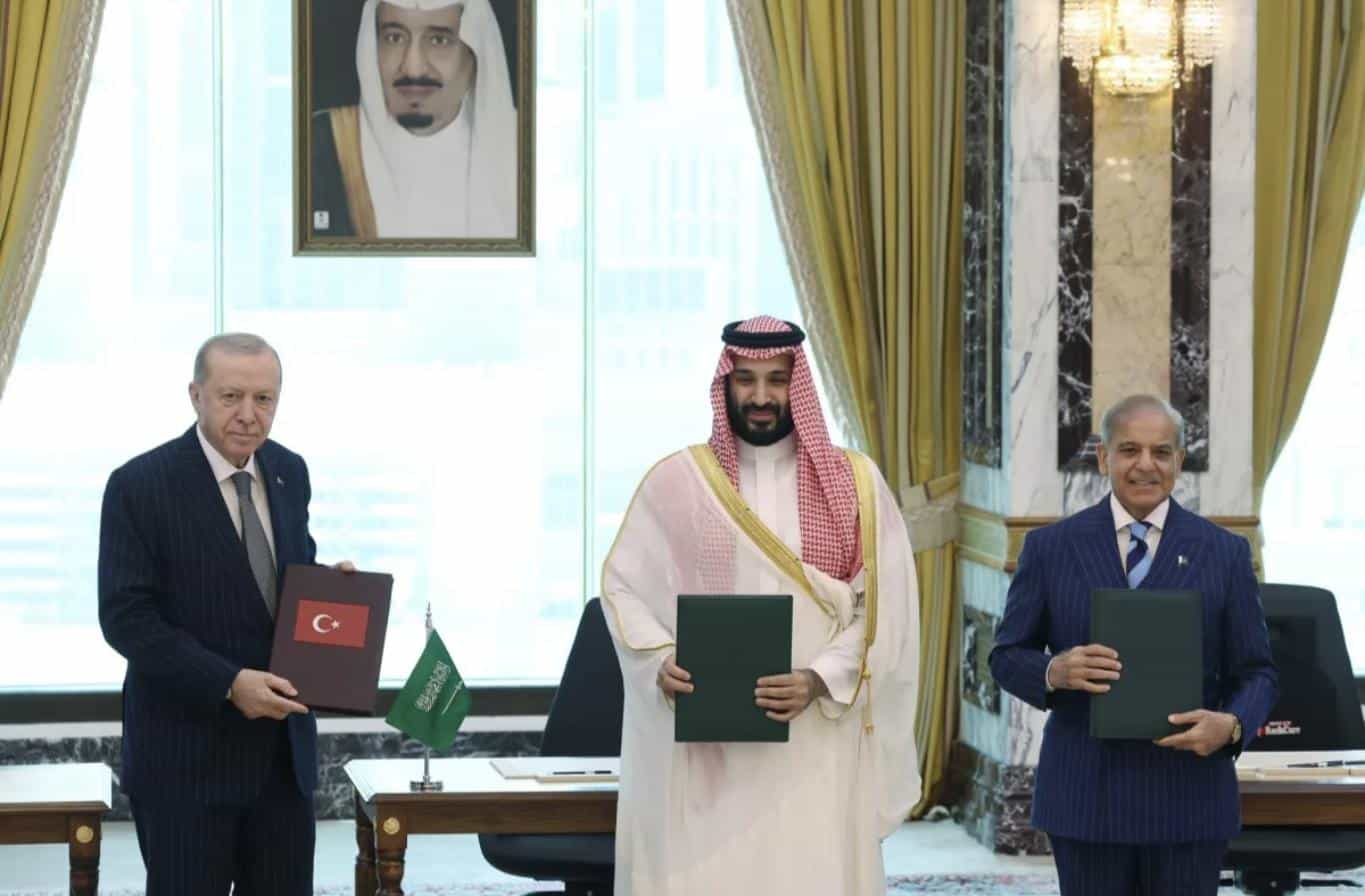
MOGADISHU, SOMALIA – Saudi Arabia, Turkiye and Pakistan signed a joint defence agreement in Mecca on Friday, and Somalia’s defence ministry issued a statement the same day calling it an important historical step towards collective security and a strategic partnership capable of meeting shared threats. The ministry offered no detail on the agreement and described no role for Somalia in it. Mogadishu has now welcomed or joined four separate security arrangements since the end of July, in a month when Puntland forces overran two federally aligned camps, the electoral timetable stayed unwritten, and the logistics package that keeps the African Union mission in the field moved four months closer to expiry. The Mecca pact is the newest entry in a collection of security relationships that keeps growing while the army they are supposed to serve keeps losing ground.

What Mecca Produced and What Somalia Said About It
The agreement binds three states with substantial military weight and long-standing ties to one another. Saudi Arabia has spent the past year assembling a coalition to protect Red Sea shipping from Houthi attack, Pakistan supplies the manpower and the nuclear guarantee that has underwritten Gulf security thinking for decades, and Turkiye brings the drone fleet and defence industry that has made it the indispensable partner across the Horn of Africa. Iranian officials responded within hours, warning Riyadh that a security arrangement with Ankara and Islamabad would not defend the kingdom. The three governments have not published the text, so the obligations each has accepted remain unclear, and whether the pact carries a mutual defence clause or amounts to a framework for cooperation is the question every capital in the region is now asking.
Somalia’s contribution was a communique. The defence ministry congratulated the three governments, said the pact reinforced cooperation, solidarity and shared responsibility, and expressed the hope that it would serve the peoples of the region and support peace and security more broadly. Nothing in the statement indicated that Somalia had been consulted, invited or assigned any part in the arrangement, and nothing explained what a country outside the agreement gains from endorsing it.
The timing places the statement in a sequence rather than in isolation. Somalia signed a defence memorandum with Pakistan in Islamabad on 4 August, its defence minister met the Pakistani army chief two days later, and its foreign ministry had already signed the country into the Saudi-led Red Sea coalition at the end of July. Turkiye’s military mandate in Somalia was extended for another two years in July. Every party to the Mecca agreement already holds a bilateral defence relationship with Somalia, which is precisely why the omission is conspicuous. Three governments that between them train Somalia’s best units, guard the sea lane its exports depend on and hold its largest foreign military footprint built a new structure together and did not think to put Somalia in it.
Four Agreements Somalia Has Signed and One Unpaid Army
The stack of arrangements now covers most of the threats a Somali government could name. Turkish troops train the Gorgor and Haramcad units and operate from a base in Mogadishu, Pakistan has undertaken to help with military capacity building, the Red Sea coalition addresses maritime security along a coastline Somalia cannot patrol, and the African Union mission holds the ground the army cannot. What none of them addresses is the condition of the force underneath. Somalia has signed for capability and has not signed for salaries, ammunition or a functioning logistics chain, and those are the three things its brigades run out of first.
That force lost Teedaan in the Hiran region at the start of the month, and the brigade that held it had been starved of ammunition for weeks before the position fell. Al-Shabaab has retaken towns cleared twice over, the central regions have gone backwards across a year, and the federal government spent the first week of August equipping and then losing units in Mudug that were never pointed at the insurgency. Foreign partners can supply doctrine, drones and training, and none of that reaches a brigade whose supply chain fails.
The money problem sits underneath the military one. Washington told the African Union on 1 July that it would not support renewing the AUSSOM mandate in December, and the United Nations support office that provides fuel, rations, aviation and casualty evacuation stops with it. Defence chiefs from the troop contributors met in Mogadishu last week and approved an accelerated offensive with no funding behind it. A ministry that cannot resource the campaign it has can nevertheless issue a statement welcoming somebody else’s alliance, and the statement costs nothing, which is part of its appeal. Somalia’s own defence budget depends on donor transfers that arrive late and fall short, and no amount of diplomatic company changes that arithmetic.
Somalia Signs Into Other People’s Architecture
There is a coherent case for the accumulation, and Somali officials make it. A weak state with a long coastline, a jihadist insurgency and no reliable revenue is better off inside as many security structures as will have it, because each relationship carries training, equipment or political cover, and none of them has to be paid for in cash. Turkiye’s mandate has produced two functioning special forces brigades. The Bosaso and Mogadishu arrangements have brought American and Turkish capability that Somalia could not build in a generation.
The cost of that approach is sovereignty exercised through other people’s institutions. Somalia’s maritime security now depends on a Saudi coalition, its best troops on Turkish trainers, its logistics on a United Nations office funded by a Washington that has given notice, and its counterterrorism cooperation increasingly on arrangements the federal member states negotiate directly. A government whose defence policy consists of joining structures it does not shape has limited standing to complain when the structures are shaped without it, or when Puntland and Jubaland conclude they can do the same thing on their own account. Both states have signed directly with Washington inside the past fortnight, using the argument Villa Somalia uses abroad, that a partner should deal with whoever can deliver.
The Mecca signing will change nothing in Hiran, and the ministry that welcomed it knows as much. No clause in a Gulf defence agreement moves ammunition to a besieged brigade or pays a soldier who has gone three months without wages. What it does record is the reflex. Confronted with a bad month at home, Villa Somalia reached for a foreign announcement, as it did at Kampala in July and in Islamabad on 4 August. Somalia is now better connected internationally than at any point since 2012 and less able to hold a district in the central regions than it was two years ago, and those two facts have stopped being a coincidence.