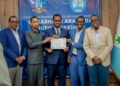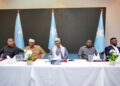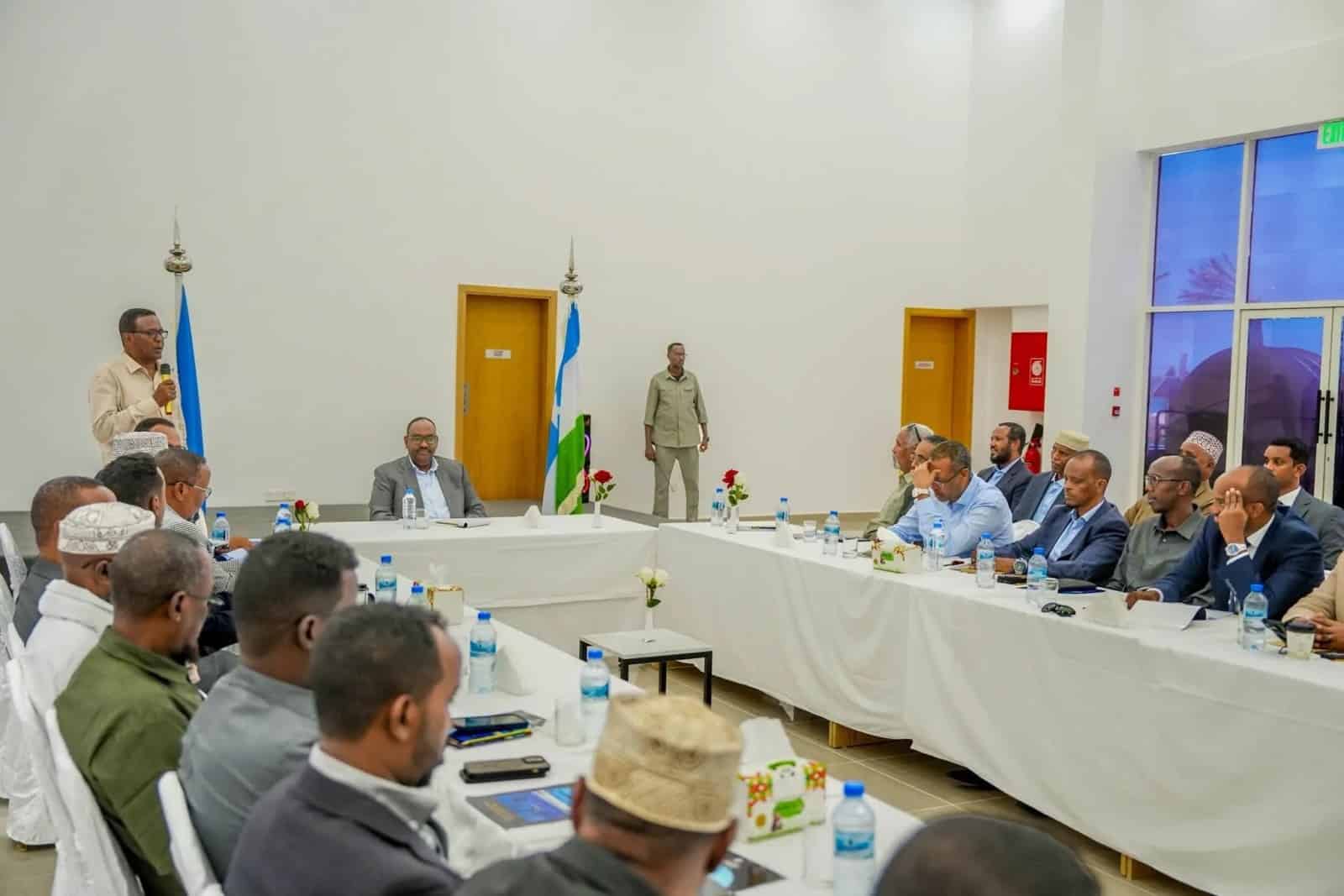
BOSASO, SOMALIA – President Said Abdullahi Deni chaired a security meeting for Bari region in Bosaso on Tuesday 1 September and closed it with sixteen numbered decisions that halt the import of any vehicle that can be fitted with weapons unless the army command issues a permit signed by the president, ban unlicensed weapons from the towns, bar off-duty soldiers from carrying arms in the streets, and order the security agencies to seize the weapons used in clan fighting and to prosecute the people who organise it. The document also orders full enforcement of Puntland’s anti-piracy decisions, an investment conference, a standards agency for medicines and food, the Bosaso master plan and a ban on unauthorised settlement of grazing land. A day after Deni met the commander of American special operations forces in Bosaso, Puntland has written down what it will control in Bari and whose signature it takes.

What the Bari Meeting Decided
The meeting brought together the Puntland ministers and members of the House of Representatives based in Bari, the officers of the armed forces and security agencies, and the Bari regional and Bosaso district administrations. Its agenda ran from operations against the terrorist groups through illegal weapons, piracy and smuggling, clan fighting, trade and investment, cleanliness and the opening of closed roads in Bosaso, to government revenue, narcotics, the quality of medicines and food, grazing land and new settlements. The decisions are grouped under four headings, and the first and longest deals with security and the control of weapons.
Ten of the sixteen decisions fall under that security heading, beginning with a reaffirmed ban on carrying or moving unlicensed weapons inside Puntland’s towns. The government takes ownership of every illegal weapon seized, and the security and justice agencies must act against anyone caught possessing, importing, selling or using such weapons anywhere in Puntland. Bringing vehicles into Puntland that can be fitted with weapons or military equipment is stopped outright. The only exception is a permit from the army command carrying the president’s own signature, and the security agencies have full authority to confiscate any military vehicle that enters without one. Anyone working to incite or organise clan fighting faces legal action, weapons used in clan fights are to be seized, the participants in those fights are to be prosecuted, and no soldier outside an official operation may move through a town armed.
The remaining decisions under the security heading order the agencies to accelerate the campaign against the terrorist groups across all of Puntland’s territory, to block the import, sale and use of every kind of drug and alcohol, to implement in full the government’s decisions on piracy and smuggling, and to act against anyone connected to piracy. The three other headings cover revenue and trade, where the government commits to raising income from the coast and the ports, to a Puntland investment and trade conference and to a standards agency with power to prosecute traders in substandard medicines or food; the Bosaso master plan, under which closed roads are opened and the city’s environment improved; and grazing land, where settlement outside the government’s plan is prohibited and anyone who has fenced or seized pasture illegally is to be prosecuted.
A Signature on Every Technical
The decision on vehicles reaches past the weapon to the platform that makes a weapon politically useful in Bari. A rifle in a town is a policing problem, and a pickup with a mounting for a heavy machine gun is the founding asset of a militia. Requiring the army commander’s permit and the president’s signature before any such vehicle enters Puntland therefore places every future armed formation in Bari under a single point of approval. Deni drew that line against the clan militias forming inside Puntland at the end of July, and the Bari decisions convert the warning into an administrative procedure with a named signatory.
A weapons shipment intercepted in Galkayo in early August exposed Mogadishu’s hand in arming groups inside Puntland, and the federal government’s practice of moving arms and vehicles to allied politicians in the member states is the background against which a ban on unpermitted military vehicles has to be read. By requiring a Puntland permit for any such vehicle crossing into its territory, the government in Garowe has asserted that the federal government’s consignments are subject to Puntland’s law on Puntland’s roads, and it has done so in a document addressed to its own agencies, which need no one else’s agreement to enforce it.
The rule that no soldier moves armed through a town outside an official operation carries the same logic inward. Bosaso’s own security incidents have as often involved men in uniform as men without one, and a clause that separates the soldier on duty from the soldier at home gives commanders and police a shared standard to enforce. The prohibition on organising clan fights, with prosecution for the organisers and seizure of the weapons, treats the clan war as an offence with identifiable authors, which is the position Deni took when he named the militias and their sponsors in July. Whether the agencies enforce these rules evenly, against the well-connected as readily as against the unknown, is the test the document sets for itself, and the president has put his signature on the answer.
The Coast, the Pirates and the Revenue
Decisions seven and eight on the coast arrive at the end of a month in which the sea off Bari and Nugaal has been the most contested piece of Somali territory. The MV Lutuf was freed from Eyl after a ransom of two and a half million dollars, and Puntland has since accused federal officials of brokering that payment while foreign aircraft struck fishing settlements on the Nugaal coast without acknowledgment from any government. In that setting, an order to the security agencies to implement the government’s anti-piracy decisions in full and to act against anyone connected to piracy is addressed as much to Mogadishu and the foreign navies as to the men on the beaches. It states that the coast is policed by Puntland, and that Puntland will be the one to say who is a pirate.
The same coastline is where an arms and training pipeline from the Houthis to al-Shabaab comes ashore, on thinly monitored stretches of the northern shore that a United Nations panel and American intelligence have both described, with Houthi trainers reported travelling to Bari itself. For that reason the Bari meeting’s clause on smuggling sits beside its clause on piracy, since the boats that carry the ransom crews and the boats that carry the weapons use the same water and the same landing places, and a government that can police one can police the other. Its first decision on revenue made the connection between the coast and the treasury explicit, committing Puntland to raising income from the coast and the ports specifically.
Deni had spent 26 August in Garacad inspecting a government-built cold storage plant and a privately financed fish factory under construction, and the revenue decision follows that visit directly, as does the plan for a Puntland investment and trade conference. The standards agency for medicines and food, with authority to prosecute, belongs to the same programme of making Bosaso’s commerce something a state regulates and taxes. The coast in this document is a source of revenue to be secured, a border to be policed and a jurisdiction to be defended, and the meeting has treated those three as one problem with one set of agencies responsible for it.
Bari Is Governed From Bosaso
Mogadishu does not appear anywhere in the sixteen decisions, which name the army command, the president, the security and justice agencies, the standards agency and the Bosaso district administration and assign every duty to one of them. That allocation is the practical expression of the position Puntland has held since it withdrew recognition from the federal institutions in March 2024. The meeting with Colonel James Rose at Bosaso on 31 August had the same character, a member state negotiating its own security arrangements with a foreign command, and the Bari decisions twenty-four hours later read as the domestic half of that arrangement, a government showing what it will police in the territory where a base is being discussed.
Mogadishu’s announcement of the Basra operation on 30 August named no unit, gave no casualty figure for its own side and set no date for results, and the contrast with the Bari document is in the form as much as the content. The Bari document assigns each decision to a named body, specifies the exception and the signatory for the one rule that has an exception, and orders the agencies to act immediately. The Bari Regional Police Command raided the Laanta Hawada and Xaafatu Carab neighbourhoods of Bosaso the same day, arresting several suspects and seizing hashish, an assault rifle and hand grenades, the enforcement the decisions order, already under way before they were published.
Unauthorised settlement on grazing land is banned and those who fence or seize pasture face prosecution, at the same time as Mogadishu’s own land clearances have become a source of political finance levied per plot on families being moved off. Puntland’s decision runs the other way, toward preventing new claims on public land, and it is issued by a state government answerable to its own parliament. A security meeting for one region has produced a written programme for weapons, vehicles, soldiers, clan fights, drugs, pirates, smugglers, medicines, roads and pasture, and it has named who is responsible for each. Bari is being governed from Bosaso, by a government that publishes its rules and signs them.