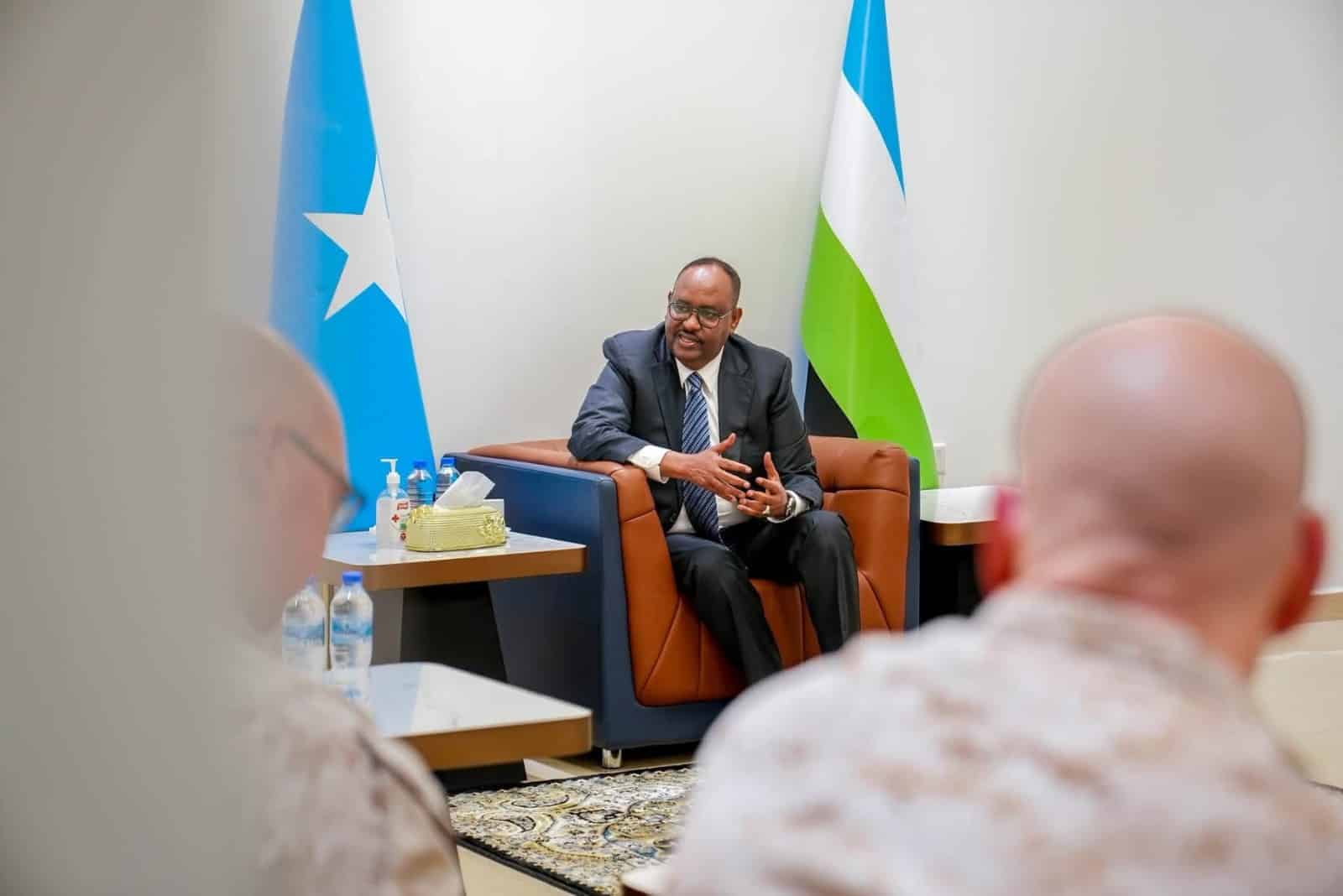
BOSASO, SOMALIA – Puntland President Said Abdullahi Deni met the commander of Washington’s special operations forces in East Africa at Bosaso on Monday 31 August to accelerate plans for an American base in the city, the day after his government accused Turkish aircraft of bombing its coastline and said it would hold Ankara fully accountable for the Somalis killed there. The delegation was led by Colonel James Rose, and the talks covered joint operations against the Islamic State and al-Shabaab in the Calmiskaad and Calmadow ranges, counter-piracy work, training for the Puntland Defence Forces and security along a shoreline the administration puts at 1,600 kilometres. Washington was brought in through the front door on the same morning Turkish F-16s were reported bombing Middle Shabelle without telling anyone, and Villa Somalia has said nothing about either.

What Washington Discussed in Bosaso on Monday
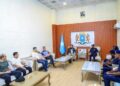
The composition of the room says more than the agenda does. Deni brought members of his cabinet, presidential advisers, senior military officers and the director-general of the presidency, which is the arrangement a government assembles for a working negotiation instead of a courtesy call. Facing them sat Colonel James Rose, who commands Washington’s special operations across East Africa and whose portfolio covers the actual conduct of counterterrorism partnerships from Kenya to the Red Sea. The published agenda ran to expanded security cooperation, counterterrorism, maritime security, counter-piracy operations, training for the Puntland Defence Forces and, at the centre of it, accelerating plans for an American base at Bosaso.
That last item arrives with a history behind it. On 2 August Deni signed an agreement in the same city with Major General Claude K. Tudor, the special operations commander at United States Africa Command, widening bilateral cooperation and clearing the way for an expanded American footprint at Bosaso for counterterrorism and maritime security across the Red Sea and the Gulf of Aden. In September 2025 the American ambassador travelled to Bosaso with Tudor and praised Puntland’s campaign against the Islamic State, and in November 2025 the AFRICOM commander met Vice President Ilyas Osman Lugatoor there on the same two subjects. Monday’s was the fourth meeting in that sequence and the first at which the word accelerate was used in public.
The military logic is straightforward enough that Washington has worked at it quietly for a year. Calmiskaad and Calmadow are where the Islamic State’s Somali branch keeps its camps, and Puntland’s forces have spent 2026 clearing them with American air support and a locally raised militia holding the ground behind them. Bosaso sits at the mouth of the Gulf of Aden, within short flying distance of Yemen and the Bab el-Mandeb, and a facility there would give Washington a second Somali foothold lying entirely outside Mogadishu. That is the asset Puntland is offering, and it is offering it directly to the buyer.
The Same Morning, Two Different Partners
The timing is what lifts this above a routine security meeting. A day earlier, Puntland’s Ministry of Security published a statement rejecting the federal account of the MV Lutuf release, accusing senior federal officials of brokering the ransom that freed the ship, attributing the coastal airstrikes at Garmaal and Jiifle to Turkish aircraft and saying it would hold the Turkish government fully accountable for the Somalis killed and the fishing dhows destroyed. The closing paragraph of that same statement asked the European Union, the United States and regional allies to deepen joint naval cooperation. By Monday morning the president was in Bosaso with Washington’s special operations commander for East Africa, which is what deepened cooperation looks like when somebody acts on it inside twenty-four hours.
That same morning, Turkish F-16 fighter jets were reported striking riverbank positions at Basra in Middle Shabelle, about 35 kilometres northwest of Mogadishu, where federal forces have been fighting al-Shabaab for a fortnight. Local accounts described heavy casualties among the dead and the wounded, and no independent verification of the toll exists. Neither Ankara nor Mogadishu confirmed the strikes, their targets or the number killed, which is now the settled pattern on this file and one more occasion in a single month on which Somali airspace has carried unacknowledged foreign aircraft.
Set the two encounters side by side and the difference is procedural, which is precisely the difference Garowe has been arguing about since the middle of August. Monday’s meeting produced a published readout from the presidency, a named commander, a stated agenda and a room full of Puntland’s own ministers and officers. The strikes on the Nugaal coast produced thirteen dead, an air force that no government would identify while the bombing was still going on, and a promised federal report that has still never been written. Puntland frames its objection as a question of consent, and the question it puts to any foreign operation on its territory is who was told beforehand.
Garowe’s Objection Is to the Method
Read cold, the president’s own remarks days earlier sound like an argument against the thing he then went and agreed to. Speaking at Garacad, Deni accused foreign countries of using the piracy revival as a pretext to put forces on Puntland’s coast and reach its marine resources. “The intention is to extract our resources through deploying forces to our coast under the guise that Puntland has failed to defend itself from piracy,” he said. He warned that coastal communities could not accept civilians being killed in the name of counter-piracy, insisted Puntland has the capacity to do the work without foreign military intervention, and pointed to earlier international naval patrols during which he says the marine wealth was stripped.
Puntland’s own account reconciles the two positions, and it has held to that account all month. Its line is that counter-piracy missions, maritime security operations and airstrikes conducted inside its territory or its waters should not proceed without its knowledge and its cooperation. What Deni described at Garacad is a foreign force that arrives uninvited, works to a mandate written somewhere else and treats the coastline as an opportunity. What happened in Bosaso is that Washington came to the administration, named its commander, sat down with the cabinet and negotiated training for Puntland’s own soldiers, and Washington let Garowe put the whole of it on the public record. Garowe reads those as opposite arrangements, and by the standard it has stated all month they are.
A record sits underneath the argument as well. Puntland ran the campaign that broke the last piracy wave, holds the coastline where the skiffs launch, and keeps the police, the courts and the prisons that put the previous generation of hijackers away. On 24 August its fisheries ministry asked shipowners, shipping companies and insurers to route any negotiation through Puntland’s own authorities, and the settlement that freed the MV Lutuf for two and a half million dollars went around every part of that machinery. Bosaso on Monday shows the alternative Garowe keeps describing, which is a partner treating it as the authority on its own ground, and Washington is the one currently willing to do that.
Nobody From Mogadishu Was in the Room
The federal government has not said whether it was consulted about Monday’s meeting, informed of it, or invited to it. Washington has published nothing of its own about the encounter either, and every detail available comes from the Puntland presidency. That silence in Mogadishu matches the one that followed the August agreement, when Washington signed at Bosaso and Mogadishu was left to read about it afterwards. It also sits awkwardly beside the claim the federal state minister for defence made on 22 August, that Mogadishu holds sole authority to license anti-piracy work in Somali waters, a claim he advanced while identifying no vessel, no aircraft and no flag. Inside a fortnight that authority has been tested twice, by an air force that does not ask and by a partner that asks somebody else.
The wider arithmetic pushes in the same direction, because Mogadishu and the African Union are scrambling to secure funding for the mission before the Security Council meets, the American money that carried roughly a quarter of its logistics stopped at the start of July, and Uganda has named 1 August 2027 for the withdrawal of its entire contingent. As the multilateral structure thins out, bilateral arrangements take its place, and a bilateral arrangement gets made with whichever Somali authority will sit down and sign one. Garowe has spent the summer signing.
Washington has its own reasons for finding the arrangement convenient, and every one of them is a matter of interest. A base at Bosaso serves the Gulf of Aden and the approaches to the Bab el-Mandeb, it sits beside the Islamic State’s last mountain redoubt in the Horn, and it comes with a partner force that has fought that enemy through eighteen months of mountain warfare without needing to be built from nothing. Puntland gets recognition as a security actor in its own right, training for its soldiers, and an American presence on a coast it says Ankara has been bombing. Somalia’s constitution treats foreign forces as a national matter, and on the evidence of one room in Bosaso and a flight of F-16s over Middle Shabelle, the parties who matter are arranging the country’s security without the government that claims to hold it.