KAMPALA, UGANDA – The Uganda People’s Defence Forces said on Monday 2 November that the withdrawal of the soldiers they keep in Somalia under a bilateral arrangement with the federal government was “effective immediately” and would be finished within days, and that the rest of the contingent, including its African Union battalions, would leave gradually by the end of 2027. The first 109 soldiers flew out of Mogadishu on Friday 30 October, and President Museveni is reported to have told President Hassan Sheikh Mohamud that part of the Ugandan force would be gone by 15 November, the day after Villa Somalia’s conference with its rivals opens. Ali Omar, Somalia’s state minister for foreign affairs, said on Monday that “things are not dire now, but it could create problems if their troops suddenly pull out”, and the federal government has not said which of its units will take over.

What the Uganda People’s Defence Forces Said on Monday
Colonel Chris Magezi, the acting director of defence public information, said in the statement that the first cohort of soldiers had already returned to Uganda, and that the Uganda People’s Defence Forces would “gradually withdraw all its forces in Somalia” by the close of 2027. “This will mark the end of Uganda’s enduring 20-year peace and stabilization support operations in Somalia,” he said. The army gave no total for the bilateral contingent, named none of the bases it holds and published no schedule for the battalions under African Union command.
The African Union authorised 4,500 Ugandan troops for AUSSOM, and a separate contingent, put at between 2,000 and 2,500, serves under the security pact Kampala and Mogadishu signed at the end of 2024. Ugandan soldiers have helped protect Aden Adde International Airport and the port of Mogadishu, according to accounts of the deployment, and the bilateral force is the one Defence Minister Kiryowa Kiwanuka said on 15 August would stay in Somalia even if the African Union mission wound down, warning at the time that a hasty withdrawal could open a security gap if Somali forces were not ready to take over. The army’s statement of Monday, issued eleven weeks later, sends that force home first, and Kampala has published no cabinet decision on the change.
General Muhoozi Kainerugaba’s own post of Thursday 29 October, “As we promised, we have started withdrawing UPDF from Somalia”, did not say which of the two forces was leaving, and the statement four days later is the first to put the bilateral contingent at the front of the queue. On 28 August the army chief had written that the Uganda People’s Defence Forces were withdrawing completely and that no Ugandan soldier would remain after 1 August 2027. The end of 2027 is five months later than that date, and it is the third timetable Kampala has given for the same departure since August, after the 1 August deadline and the open-ended start announced on 29 October.
The 109 Soldiers and Battle Group 48
The 109 soldiers left Aden Adde on Friday evening aboard a Fokker 100 registered in Kenya as 5Y-SKE and leased to Uganda, the first flight to carry part of the Ugandan force out of the country. According to the same report, President Museveni had told President Hassan Sheikh Mohamud that some of his troops would leave Somalia by 15 November at the latest, and the departures expected in early November would fall in Lower Shabelle and involve soldiers of both the bilateral contingent and the African Union mission. Neither government has said which units were on the aircraft.
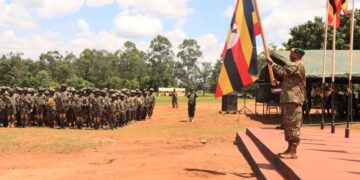
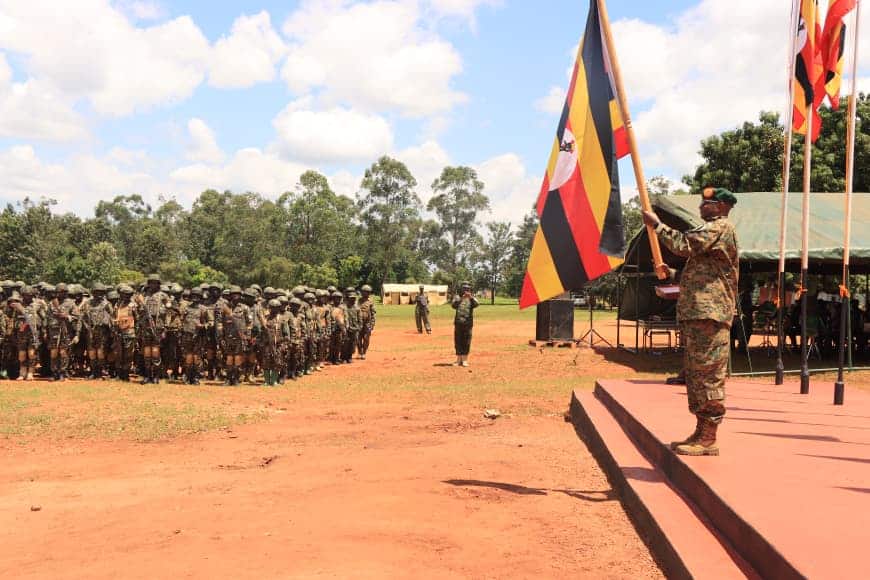
On the same Friday the Uganda People’s Defence Forces published their own account of a ceremony at the peace support training centre at Singo, in Nakaseke District, where Battle Group 48 was flagged off for deployment to AUSSOM after its pre-deployment course. Major General Felix Busizoori, the deputy commander of the land forces, told the departing soldiers to “behave as if everyone is watching you”, and the battle group’s commander, Colonel Michael Opio Ochuka, thanked the army leadership for entrusting him with the contingent. The army had announced on 17 October that it was welcoming Battle Group 48 to the mission area, where it replaces Battle Group 45.
Uganda’s battle groups hold Sector One of the mission, which takes in Mogadishu and Lower Shabelle, and the sector has cost them heavily. Al-Shabaab overran the Ugandan base at Bulo Marer on 26 May 2023, an attack in which President Museveni said 54 Ugandan soldiers died. On the night of 8 October this year the group claimed an attack on a Ugandan base in Qoryooley district, and fighters struck the government base at Jannaale the same night, according to local sources. Twenty-two days later the first flight home left Mogadishu, while a fresh battle group of the Uganda People’s Defence Forces was still being sent the other way.
The Handover Mogadishu Has Not Published
At Entebbe on Monday 26 October President Hassan Sheikh Mohamud asked President Museveni to keep Ugandan troops at Barawe, Bulo Marer, Qoryooley and Jannaale until Somali forces were ready to take them over. Reports last week said the federal government had not presented a single handover plan for the Lower Shabelle positions that guard the approaches to the capital, and that it was preparing a new bilateral agreement that would let Ugandan troops go on guarding the airport and other key sites. Monday’s statement from the Uganda People’s Defence Forces made no reference to any such proposal. A letter from AUSSOM to the UN support office dated 31 October, verified by two diplomatic sources, warned that the withdrawal could leave parts of Lower Shabelle open to al-Shabaab attacks.
About 2,000 federal soldiers in more than 200 vehicles left Baledogle in October for Buurhakaba, which former President Laftagareen’s forces took in the middle of the month, and al-Shabaab ambushed the column at Jameeco on 26 October, the day of the Entebbe talks. Soldiers have described dozens of their comrades killed, while the defence ministry has published a count only of the militants it says died. The head of the military court, Hassan Ali Nur Shute, and the commander of the ground forces, Sahal Abdullahi Omar, went to Baledogle last week to question the commanders, and two sources said American forces had left the airfield, one of them adding that the Ugandans and the Somali army now hold it.
Brigadier General Ibrahim Mohamed Mahmoud, the Somali army’s chief of defence forces, sat with General Muhoozi Kainerugaba at Special Forces Command in a meeting reported on 12 October and appealed for more Ugandan training, and the two men agreed the relationship should extend to trade and investment. No statement from him on the withdrawal had been reported by Monday, and the federal defence ministry had issued none either. The military court’s questioning of the Baledogle commanders was reported in the same week that the first Ugandan flight left Mogadishu, and the posts in Lower Shabelle that the Ugandans are leaving fall to that army.
The Conference on 14 November and the Money After December
Villa Somalia has invited its rivals to a consultative conference in Mogadishu from 14 to 18 November, and the electoral commission has set the federal vote for 15 May 2027, a date the opposition rejected. President Museveni’s reported deadline for the first departures falls on the conference’s second day. In August, reports said President Museveni had privately warned President Hassan Sheikh Mohamud that Uganda would leave unless he reached a settlement with his political opponents within a year, and the troops of the Uganda People’s Defence Forces are now leaving on a calendar that runs past the May vote by more than seven months.
The AUSSOM mandate that covers the remaining Ugandan battalions expires on 31 December, and Washington told the African Union in July that it would not support the UN logistics office that feeds, fuels and evacuates the mission beyond that date. A twelve-month drawdown of that support is reported to begin in January, and the battalions of the Uganda People’s Defence Forces that stay behind after the bilateral contingent leaves will depend on it for their fuel, food and medical evacuation. General Muhoozi Kainerugaba told the troop-contributing countries in Kampala on 29 July that the support office had already cut its help by twenty-five percent, and President Museveni told the same summit two days later, “if the international community wants to pull out, let them.”
Under the mission’s force allocation Uganda was assigned 4,500 soldiers, Ethiopia 2,500, Djibouti 1,520, Kenya 1,410 and Egypt 1,091, although the numbers on the ground may differ, and Ethiopia is reported to be considering the withdrawal of 3,000 to 4,500 troops it keeps outside the mission in Bay, Bakool and Hiiraan. Ugandan soldiers became the first African Union troops in Mogadishu in March 2007, and the Uganda People’s Defence Forces remained its largest contributor under all three of the mission’s names, through the 2010 Kampala bombings and the losses at Bulo Marer. By Monday the first 109 of them had been home for three days, and Mogadishu had still not named a single unit to take the posts the bilateral contingent is leaving.