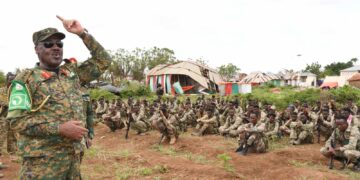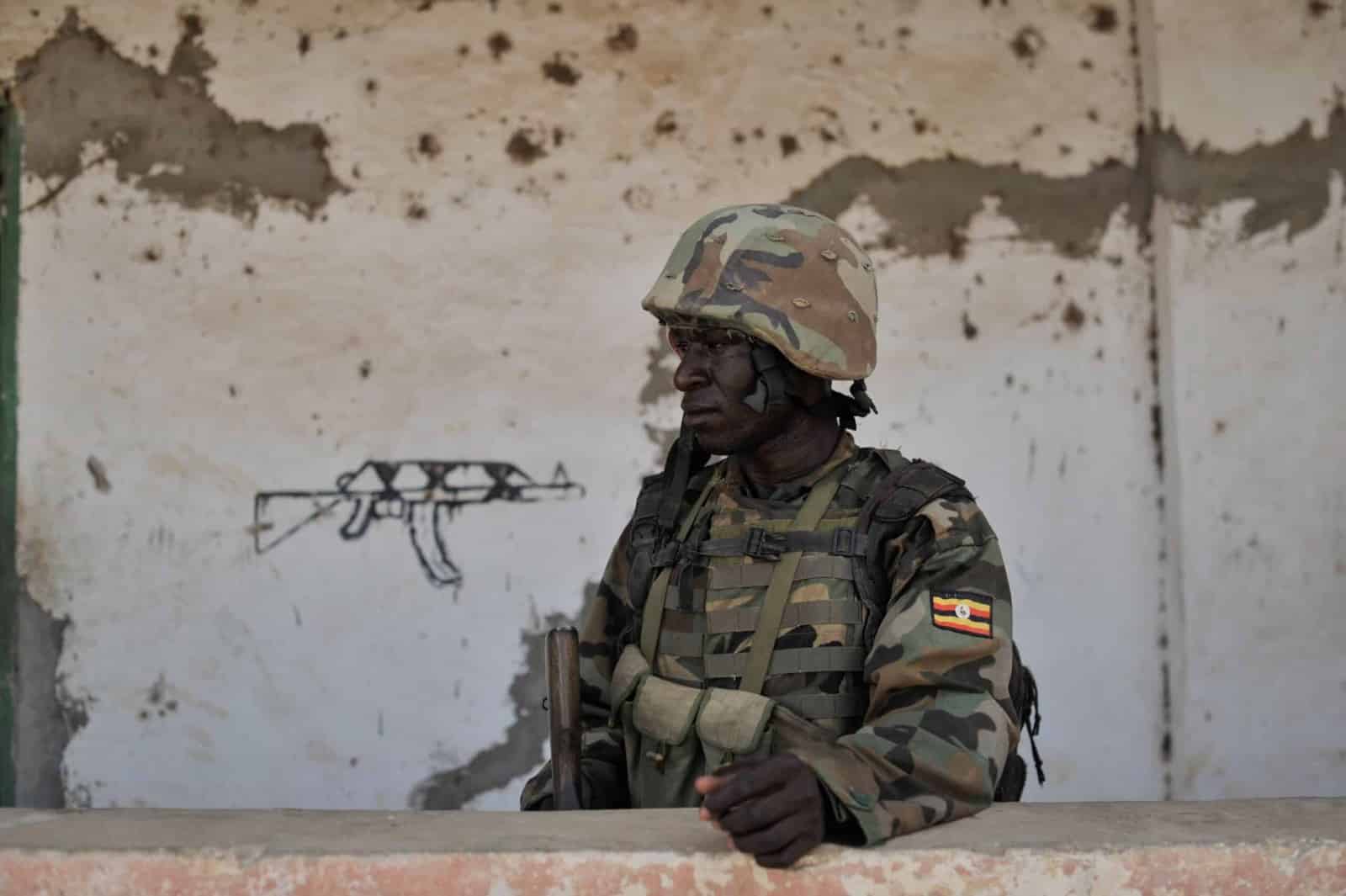
KAMPALA, UGANDA – Uganda has put a date on the end of the longest foreign deployment in Somalia’s war. General Muhoozi Kainerugaba, Uganda’s chief of defence forces and the son of President Yoweri Museveni, announced on Friday that the Uganda People’s Defence Force will complete a total withdrawal by 1 August 2027, closing nearly twenty years in which Ugandan soldiers have been the floor under Mogadishu’s security. “We are withdrawing completely from Somalia by the 1st of August 2027,” he wrote. “They will not be UPDF in Somalia after that.” The date lands on a mission whose funding is blocked, whose logistics arm is auctioning its own equipment, and whose largest contributor has now named its exit. Behind the calendar sits a reported condition, that President Museveni told President Hassan Sheikh Mohamud to settle with his opposition within a year, making Uganda’s deadline a judgment on Villa Somalia’s politics.

Uganda Trades a Threat for a Date
Kampala has threatened to leave before, and the difference this time is the specificity. In February, Kainerugaba warned that Uganda could pull out early if the mission’s funding crisis went unresolved, he had signalled a planned exit before that after nearly nineteen years of deployment, and officials in Kampala have argued for years that Mogadishu has had two decades of protection in which to build institutions capable of standing on their own, an argument that hardens every time the capital’s politics produce a new emergency for the mission to absorb. Friday’s statement converted that standing complaint into a calendar entry, delivered in public with a day, a month and a year attached, on a deployment that has outlasted four Somali presidents and three mission names, from AMISOM through ATMIS to the present force.
Caveats attach to the announcement, and Mogadishu will be quick to cite them. It came as a personal post from the army chief, no Ugandan cabinet or parliamentary instrument has yet formalised the date, and it remains genuinely unsettled whether the deadline is state policy or the commander’s own position. However, Kainerugaba commands the force in question, his father commands the state, and the family’s public statements on Somalia have tended to precede Kampala’s formal decisions by months, so the distinction offers thinner protection than Villa Somalia would like.
Timing sharpens the message further. Only four weeks earlier, on 31 July, Uganda hosted the leaders of the mission’s troop-contributing countries in Kampala, where the summit appealed to the international community for steady funding to keep the operation alive. A month after convening that appeal, the host country’s own army chief told the public that its largest beneficiary would be gone within a year. Whatever the communique said, Uganda has now priced its patience, and every other contributor reading the announcement can see that the exit queue has formed and that the first place in it belongs to the force everyone assumed would leave last.
The Ultimatum Behind the Calendar
The public deadline reportedly rests on a private warning. President Museveni is reported to have personally told President Hassan Sheikh Mohamud that Uganda would withdraw its forces unless he reached a political settlement with his opposition within one year and ended the infighting that has consumed the government’s attention. The condition is remarkable because it names the disease. In Kampala’s reading, the time and energy that should be running the security transition are being spent on a domestic power struggle, and Uganda declines to keep garrisoning a capital whose government is at war with its own political class. The demand also carries a quiet irony from a president four decades into his own tenure, though Museveni’s leverage over Somalia rests on soldiers, and soldiers are the one commodity Villa Somalia cannot replace on the timeline he has set.
Somalia’s mandate crisis gives the warning its content. Hassan Sheikh Mohamud’s electoral term has expired, the constitutional amendments and the managed state elections that followed have been rejected by the opposition, by Puntland and by Jubaland, and the Supreme Court has annulled the Galmudug vote his commission ran, a ruling the commission accepted this week. Accordingly, the settlement Museveni reportedly demanded would require Villa Somalia to unwind two years of centralisation inside twelve months, with the clock running through the same season in which the president intends to hold the vote his opponents call illegitimate. Nothing in the government’s conduct this August suggests an appetite for the reversal.
The same month Kampala set its condition, Mogadishu asked the African Union to fight its domestic opponents. The memorandum authorising AUSSOM against al-Shabaab’s “affiliated militias” in Southwest, sought by the federal government against forces loyal to the president it removed in Baidoa, displays exactly the entanglement Uganda is refusing to inherit. A mission built to fight an insurgency is being asked to hold the ring in a succession fight, and the country that has carried that mission longest has answered with a leaving date.
What Leaves With the UPDF
Uganda is the mission’s spine, and the numbers say so. Kampala keeps roughly 4,500 soldiers inside AUSSOM, the largest single contingent among its 11,862 uniformed personnel, and about 2,000 more under bilateral arrangements outside the mission’s books. Ugandan troops hold the sectors around Mogadishu and Lower Shabelle, the ground al-Shabaab must cross to threaten the capital, and Ugandan units fought beside the Somali army to take Mubarak in March and to hold it against the counterattack that followed. The first African Union soldiers into Mogadishu in March 2007 were Ugandan, and they arrived when the government they came to protect controlled little beyond the airport road.
Meanwhile, the machinery meant to sustain any successor force is already being dismantled around it. The mission’s funding is blocked past 31 December, American money that carried roughly a quarter of the logistics budget stopped at the start of July, and the UN support office that moves the mission’s food, fuel, water and casualties is auctioning vehicles and prefabricated camps while its first staff terminations take effect in September. Last year that support office spent five hundred and two million dollars against the mission’s own one hundred and ninety, which is the measure of how much of the war runs on lines Somalia does not control. Washington has said it will neither veto a mandate extension nor pay for one, while faulting Somalia for the pace of its own takeover.
The record of recent handovers shows what follows a departure. When the mission handed the Buurhakaba forward operating base to the Somali army in August, the promised federal replacements never arrived and Southwest units were stretched to cover the gap. Researchers warned before the last transition that al-Shabaab gains ground wherever the handover outruns the replacement, and the group has spent this year proving the study right across Hiiraan, Lower Shabelle and Middle Shabelle.
Flowers Meet a Fixed Calendar
Mogadishu’s public answer is confidence. President Hassan Sheikh Mohamud declared this month that Somalia is ready to assume its own security, saying the government would hand the departing foreign troops “beautiful flowers” and send them home. The line was written for an audience that believes the transition is a ceremony, and it treated the timetable as Somalia’s to set. Uganda has now scheduled the ceremony itself, and the readiness the president asserts will be tested against a date his government did not choose, cannot move and learned about from a post. Washington’s parallel complaint, that Somalia has moved too slowly on the takeover after years of international backing, means the two capitals paying for and manning the mission have now reached the same verdict from different directions.
The army that is supposed to absorb the load spent August elsewhere. Federal units fought Laftagareen’s forces in Baidoa and flew reinforcements into the city this week, soldiers and Presidential Guard units worked the demolition lines in Mogadishu’s cleared neighbourhoods, and the piracy file off Eyl closed with a settlement after eleven days of foreign airstrikes. Every one of those commitments drew strength from the fronts the UPDF currently underwrites, and each of them advanced a political objective while the insurgency kept its ground. The soldiers Uganda is withdrawing watch the roads into the capital, and the soldiers Mogadishu commands were busy this month with its enemies inside the constitution.
Uganda arrived in Somalia when nobody else would come, and it has buried more soldiers there than any other contributor. Its army chief has now told the government it protects that the remaining time is eleven months and the price of an extension is a political settlement in Mogadishu. The clock Kampala started will run through the same season as the electoral crisis that provoked it, and Villa Somalia now holds one calendar for both.