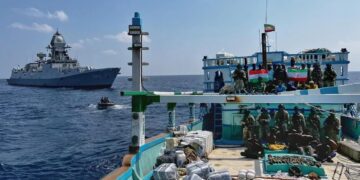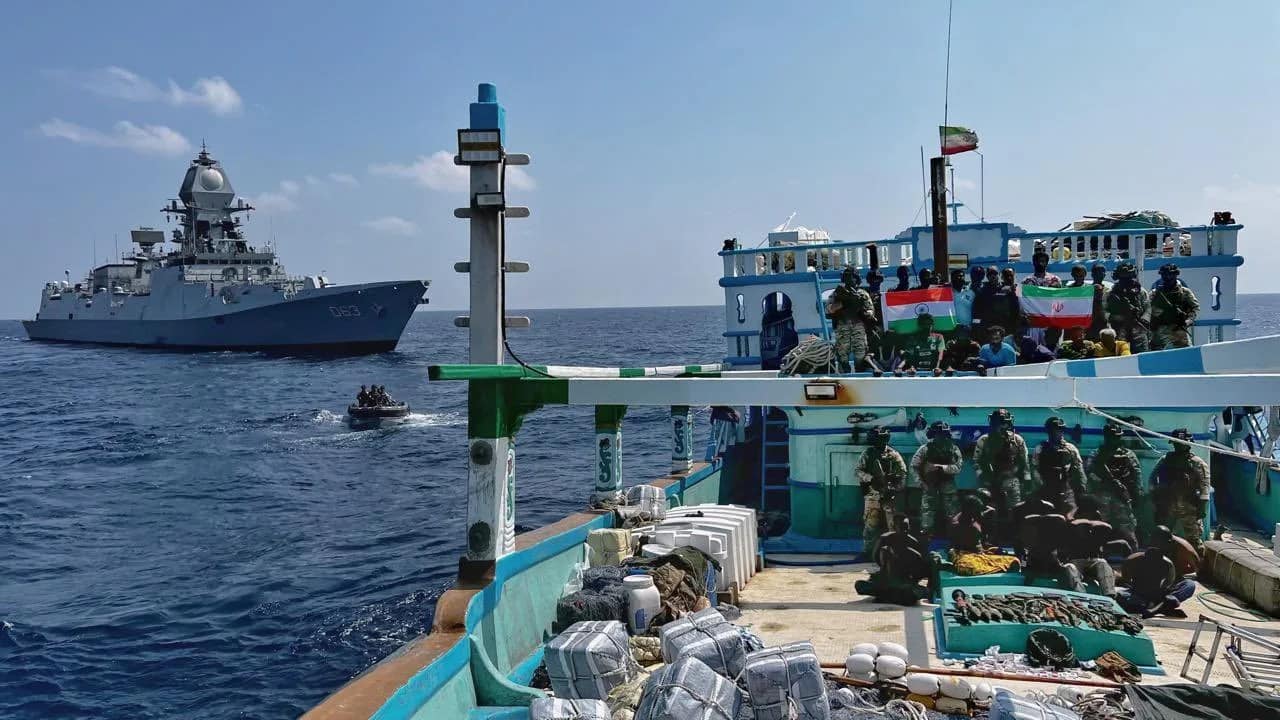
BANDARBEYLA, SOMALIA – Indian marine commandos, some of them parachuted from an Indian Air Force C-17, retook the Iranian fishing dhow Azini in the Arabian Sea on Monday 2 November, four days after twelve armed men seized it between Bandarbeyla and Hafun on Puntland’s Karkaar coast, and India’s defence ministry said all twenty crew were freed without casualties. A Puntland Maritime Police Force officer said the Indian force disarmed the twelve suspects, took their phones and let them go, that they came ashore at Bandarbeyla with the dhow’s two Somali guards, and that the regional authorities learned of the operation only after it was over. India’s published statements do not say what became of the hijackers, and the federal government in Mogadishu has said nothing at all.

The Azini Between Bandarbeyla and Hafun
The Azini was taken on Thursday 29 October with, by Puntland’s count, twenty-one Iranian fishermen and two Somali security guards aboard, and a report from the Bandarbeyla coast two days later put the boarding party at twelve armed men. By Saturday the dhow had moved roughly 110 nautical miles further east, about 185 nautical miles off Bandarbeyla, which carried it toward one of the main merchant routes across the Arabian Sea. The European Union’s Maritime Security Centre for the Indian Ocean issued the alert, and India’s statement described the vessel as a likely “mother ship”, the floating base from which Somali gangs have repeatedly launched attacks on larger merchant ships far from land.
India sent a warship and a maritime reconnaissance aircraft to shadow the Azini and used what its navy called non-kinetic measures to stop it running further. Subsequently, marine commandos boarded it, reinforced by a second group dropped from the C-17 more than 3,000 kilometres from Mumbai. Defence Minister Rajnath Singh announced the result on Monday, praising a “meticulously coordinated 48-hour operation”, and the navy described India as a “First Responder and Preferred Security Partner” in the region. Iran’s embassy in New Delhi thanked the Indian government, its navy and its air force for the rescue of the Azini crew.
The Puntland officer counted twenty-three people aboard when the Azini was taken, twenty-one crew and two guards, while India confirmed twenty rescued and has not explained the difference or mentioned the guards. Moreover, the ministry’s line that the operation ended “without casualties or injuries” does not say whether it covers the hijackers, and the Puntland officer said three of the men who came ashore at Bandarbeyla carried minor injuries without saying who they were. India has run this kind of operation before, and in March 2024 an Indian warship and commandos dropped from a C-17 forced 35 pirates aboard the bulk carrier MV Ruen to surrender after a forty-hour stand-off about 2,600 kilometres off the Indian coast.
Two Accounts of Twelve Armed Men
A Puntland Maritime Police Force officer, speaking without authorisation, said the Indian commandos who boarded the Azini disarmed twelve suspected pirates, seized their mobile phones and released them, after which the twelve and the two Somali guards came ashore at Bandarbeyla. He added that the regional authorities heard about the operation once it had already ended. Two reports published on 3 November said instead that Indian forces had captured nearly ten pirates and that Singh had shown them, but the text of Singh’s own post speaks only of the “safe release of the crew and vessel from significantly-armed pirates”, and neither it nor the defence ministry gives their whereabouts. Until New Delhi says where the men are, the Azini case has no suspects on record in any court.
On Friday 25 September Puntland’s maritime police freed the Sibu 1 between Garacad and Hobyo after two days of fighting and took fifteen prisoners, and sixteen of the twenty crew it brought out were Indian nationals. Four days later the same force retook the Honour 25 at Dharinbaar in the Bandarbeyla district and detained sixteen members of the group holding it, after the pirates had shot dead five sailors, three Pakistanis, an Indian and the ship’s Myanmar chief engineer. The Honour 25 had been held since 21 April with about 18,500 barrels of gasoline bound for Mogadishu, and the Sibu 1 had been boarded 136 nautical miles east of Al Mukalla in Yemen thirty-six days before Puntland’s force reached it. Two operations within a single week put thirty-one suspects in Puntland custody and brought sixteen Indian sailors out alive, a month before the Azini was taken.
Consequently, the twelve men from the Azini, if the Puntland officer’s account holds, walked onto the same district’s shore that Puntland’s force had cleared a month earlier, without weapons or phones but also without charges. Meanwhile, the Indian statements on the Azini reported so far mention neither Puntland nor the federal government, and they name no Somali partner at any stage of the forty-eight hours.
The Coast Puntland Has Been Clearing
The same Bandarbeyla district gave up a third ship on Tuesday 29 September, when the pirates holding the tanker MT Eureka ran it aground at Hulcaanood and put its twelve crew ashore, eight Egyptians and four Indians, before escaping. That run of recoveries followed an August in which Puntland repeatedly warned that the revival of piracy off its coast was being encouraged from outside. On 21 August its Ministry of Security and DDR said it was investigating information that “forces outside Puntland” were involved, and in the same statement it demanded an explanation for strikes by international warships on 18 and 20 August in Nugaal, which it said had hit fishermen and their property.
Three days later the Ministry of Fisheries and Marine Resources warned shipowners and insurers that ransom payments would fund further attacks and recruit new men into the trade, and President Said Abdullahi Deni described the hijackings of the MV Lutuf and the Sibu 1 as part of a campaign to damage Puntland’s reputation. Puntland has named no foreign actor and published no evidence for that claim, and within five weeks of Deni’s remarks its maritime police had taken back the Sibu 1 and the Honour 25 by force.
Iranian dhows fishing off the Horn often sail with their transponders off and without broadcast identification numbers, and a maritime intelligence tally of this year’s attacks on fishing vessels counts at least eight targeted and four confirmed hijackings, including the Iran-flagged Alwaseemi 786 in March and the UAE-flagged Fahad 4, which pirates used as a mother ship against a merchant vessel within three days of seizing it in April. Furthermore, the Azini was the third Iranian fishing boat hijacked off Somalia since July, and the count of attacks reported since April is the highest since 2013. Pirates involved in several of these seizures have cited the foreign fleets fishing Somali waters as their grievance.
New Delhi Answers for the Azini and Mogadishu Says Nothing
Searches of federal statements in English and Somali through the morning of Wednesday 4 November found nothing from Villa Somalia, the defence ministry or the ministry of ports on the Azini, on its crew or on twelve armed men landing in Bandarbeyla. The federal government has no naval force operating off Karkaar, and its most visible contribution to this year’s piracy file came in August, when it credited Turkish warships with freeing the MV Lutuf, a release Puntland said had been paid for. On the Honour 25, held from April to September with ten Pakistanis aboard, Mogadishu’s part for five months was its assurances to Islamabad.
Over the last ten weeks Puntland’s maritime police have done the fighting close to shore and kept the suspects, while foreign navies have acted further out, on their own timetables, against vessels carrying their own nationals or their own trade. The Indian sailors on the Sibu 1, a tanker under a United States Treasury designation since December 2025 for moving Iranian petroleum products, were brought out by Puntland’s force, while the Iranian fishermen on the Azini were brought out by India’s. Furthermore, the Azini operation is the second time in three months that Puntland has learned of foreign military action off its coast after the fact, following the August strikes in Nugaal that its security ministry asked the warships’ governments to explain.
On 27 October the United States Coast Guard ruled that Somalia “is not maintaining effective antiterrorism measures in its ports” in a notice that covers every Somali harbour and exempts neither Bosaso nor Berbera. In practice, the jurisdiction that answered at Dharinbaar, Garacad and Hulcaanood was Puntland’s, and the one that answered for the Azini was India’s. Finally, twelve men who held twenty-three people at gunpoint for four days are now somewhere in Bandarbeyla district, according to the only Somali official who has spoken about them, and neither New Delhi nor Mogadishu has said what should happen to them.