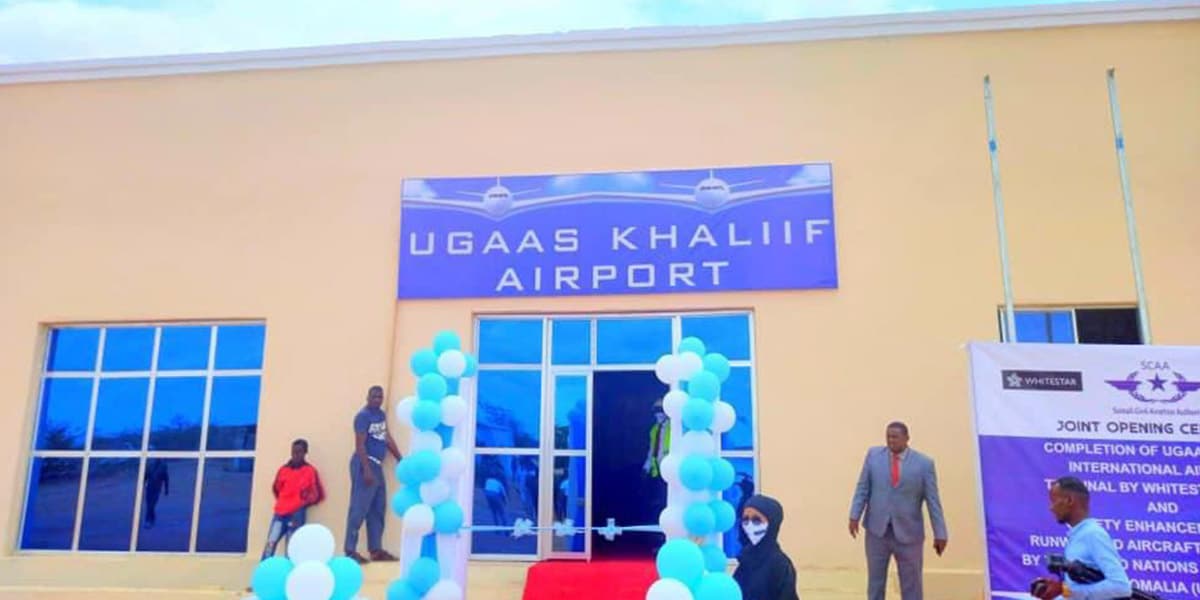
BELEDWEYNE, SOMALIA – Hawadle Macawisley fighters drove onto the runway at Beledweyne airport on Thursday 19 November to stop an aircraft reported to be carrying federal troops, and the Djiboutian peacekeepers who guard the Ugaas Khaliif airfield for the African Union fought them for about half an hour until the plane turned back and the Djiboutians held the strip, and Djibouti’s embassy said afterwards that none of its soldiers had been killed or wounded. The clan militia that carried President Hassan Sheikh Mohamud’s campaign against al-Shabaab in Hiiraan from 2022 has spent November gathered in the regional capital behind the Hawadle leader Ugaas Yusuf Ugaas Hassan. In the same weeks al-Shabaab moved into Coomaad, and an African Union battalion sent to fight the group has now had to fight for a runway against the government’s former allies.

The Plane That Turned Back at Beledweyne Airport
Macawisley units with combat vehicles passed the checkpoints that Djiboutian troops keep around the airfield on Thursday afternoon and entered the compound at Beledweyne airport, according to local accounts, and armed men were filmed standing on the runway while their officers issued warnings. Their stated purpose was to stop aircraft that, they said, were bringing soldiers sent by the federal government to reinforce its forces in Beledweyne. Djiboutian troops based nearby then tried to push them off the runway and clear the way for an approaching plane, which aborted its landing and flew back to Aden Adde International Airport in Mogadishu. The fighters withdrew from the airport that evening after talks between their commanders, airport officials and the African Union troops.
The first accounts of the exchange said two Djiboutian peacekeepers were killed and two wounded, with at least five Macawisley fighters injured. Later reports from the scene put the toll at one Djiboutian soldier killed, three wounded and six Macawisley dead, and said the Djiboutian contingent ended the fighting in control of Beledweyne airport. Other local accounts on Friday counted at least one militia fighter killed and six wounded when the Djiboutians opened fire. None of these figures from Beledweyne airport has been independently confirmed. On Friday 20 November Djibouti’s embassy in Mogadishu said its forces, in contact with the command of AUSSOM’s fourth sector, had repelled the attack and kept the airfield from being seized, and the mission’s command said no soldier of the Djiboutian contingent had been killed or wounded.
Mumin Mohamed Halane, who spoke for the Macawisley, said afterwards that the militia “will never again allow a plane carrying federal troops to land at the airstrip”. Djibouti’s contingent in the African Union Support and Stabilization Mission in Somalia, known as AUSSOM, is responsible for Beledweyne and the district of Bulo Burde to its south, and its new battalions have arrived in Hiiraan through the airfield. Mogadishu had published no account of the flight by Friday morning. A Djiboutian battalion that came to Hiiraan to fight al-Shabaab spent Thursday afternoon clearing the runway at Beledweyne airport of Macawisley fighters, who fought beside federal troops on the Bulo Burde front until the end of October, so that federal reinforcements could land.
A Vice President’s Gate and the Ban on Military Flights
Late on Wednesday 18 November, hours before the airport fight, forces guarding Hirshabelle’s vice president, Abdifatah Hassan Afrah, clashed with local Macawisley at the front gate of the house where he is staying in Beledweyne. Hirshabelle said armed militiamen had attacked the residence and been driven off, and that its forces had seized small arms and a rocket-propelled grenade launcher from them. Mohamed Shuriye Nur, a member of parliament who formerly directed communications at the Hirshabelle presidency, said the attack had killed a woman and wounded two of the attackers. On Friday the Hirshabelle presidency condemned it again in a statement that banned armed men from Beledweyne airport and directed AUSSOM and “all branches of the armed forces” to keep them out, and it said security at the airfield had been restored.
Abdifatah Hassan Afrah became vice president when the Hirshabelle assembly re-elected President Ali Gudlawe in Jowhar on Saturday 24 October, three weeks after the electoral commission declared that the Justice and Solidarity Party had won 78 of the state’s 99 seats. The Hawadle had said for months that no state vote could be held in Hiiraan without a political settlement, and on Tuesday 29 September their elders announced that officials of the Hirshabelle administration would be barred from landing at airports in Hiiraan until such a settlement was reached. They said the airports would stay open to the public and warned specifically against military aircraft using Beledweyne airport. “Officials associated with Hirshabelle cannot land at this airport,” they said.
On Friday 6 November Ugaas Yusuf Ugaas Hassan told Hawadle soldiers in the national army to gather in Beledweyne and said there was no government left to defend, and unverified local accounts put the number who left their posts within two days at about two thousand. A federal delegation under Petroleum Minister Dahir Shire Mohamed came on Tuesday 10 November and left without an agreement. The Ugaas and Abdullahi Mohamed Ali Sanbalolshe, a former commander of the National Intelligence and Security Agency, are both now in the town leading the campaign against President Ali Gudlawe’s administration. On Thursday the Macawisley enforced on the runway at Beledweyne airport the ban on military aircraft that the Hawadle elders had announced in September, and the federal government had tested it with a troop flight.
The Front the Macawisley Left Behind
The fighters on the runway on Thursday came, in large part, from the trenches that held al-Shabaab back in central Hiiraan. At the end of October about two thousand Macawisley, by local estimates, left their forward positions outside Bulo Burde and Matabaan and drove into Beledweyne with their combat vehicles, two days after they occupied the Lama-Galay military compound without firing a shot. Earlier, on Saturday 3 October, al-Shabaab had announced an agreement with Hawadle elders in Mahaas under which they undertook to keep the Macawisley out of their areas, on the corridor that links Hiiraan with Galgaduud.
Fighting began at Coomaad, about twenty kilometres from Matabaan, late on Saturday 14 November and ended with government troops withdrawing and al-Shabaab fighters entering the settlement, according to local accounts, and by Tuesday 17 November neither Villa Somalia nor Jowhar had said who held it. On the same weekend armed Makane fighters paraded in Beledweyne for the Ugaas and a rally on Sunday 15 November turned out against both the Hirshabelle administration and the federal government. On Thursday the federal troops reported moving in Hiiraan were aboard a flight bound for Beledweyne airport, and they were meant for the town where the Macawisley are gathered.
Burundi has moved to take its troops out of Somalia, leaving AUSSOM with fewer contingents to spread across the south. Djibouti’s soldiers were deployed to Beledweyne to secure the town and its approaches against al-Shabaab, and on Thursday they fought to keep Beledweyne airport open for a federal government that has spent October and November in a standoff with the Hawadle over who governs Hiiraan. President Hassan Sheikh Mohamud’s prime minister told the Hirshabelle inauguration, in remarks reported on 9 November, that the people of Hiiraan had led the uprising against al-Shabaab since May 2022. Ten days later the men who led it fought African Union troops for the runway at Beledweyne airport, and the federal soldiers they turned away were bound for the regional capital, a week after local accounts put al-Shabaab inside Coomaad.
Correction, 21 November 2026: An earlier version of this article said one or two Djiboutian peacekeepers were reported killed; Djibouti’s embassy and the AUSSOM command have since said no Djiboutian soldier was killed or wounded.