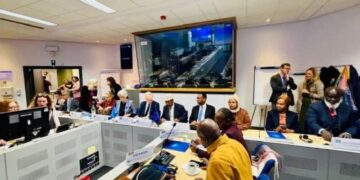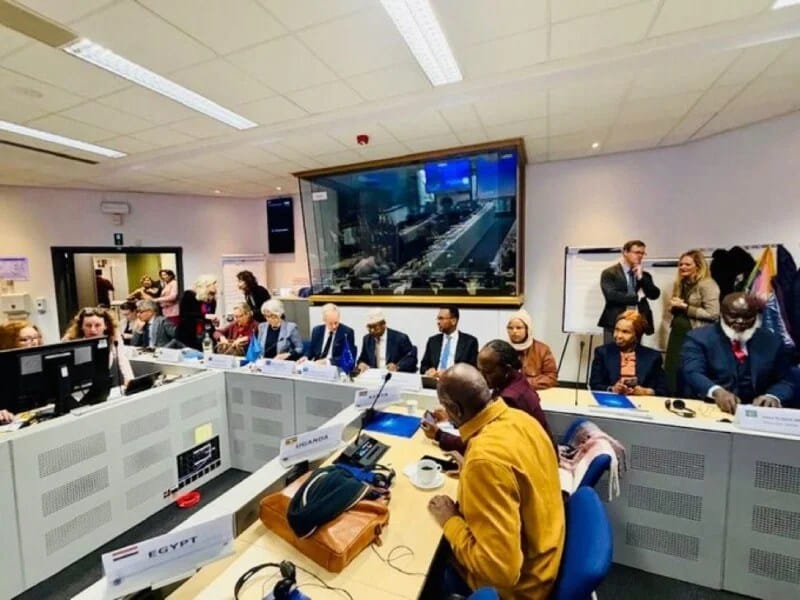
BRUSSELS, BELGIUM – Abdihakim Mohamed Yusuf, chief of staff to President Hassan Sheikh Mohamud, co-chaired a meeting in Brussels on Thursday 19 November with Olof Skoog of the European Union’s diplomatic service, at which about fifty governments and organisations heard how Somalia proposes to take charge of its own war against al-Shabaab once the African Union mission’s mandate expires on 31 December. On the same day in Mogadishu, Prime Minister Hamza Abdi Barre told the opposition there was “no international community left to mediate between us”. The government’s delegation in Brussels arrived four days after Washington reversed its decision to stop funding the logistics that keep African Union troops in the field, on the same afternoon that Djiboutian peacekeepers fought the Hawadle Macawisley for the runway at Beledweyne.

The Plan the Government Presented in Brussels
Defence Minister Ahmed Moalim Fiqi opened the Senior Officials’ Meeting alongside Annette Weber, the European Union’s Special Representative for the Horn of Africa, and set out where the security transition stands and what Somalia still needs from its partners. Jihan Abdullahi Hassan, President Hassan Sheikh Mohamud’s senior adviser on defence, then presented the government’s vision of full Somali ownership of national security. El Hadji Ibrahima Diene, the African Union’s Special Representative and head of the mission known as AUSSOM, pointed to joint operations between Somali forces and his troops, and Graham Maitland spoke for the United Nations department of political affairs and peace operations.
According to the European Union’s account of the Brussels session, the room held the United Nations, AUSSOM and most of its troop contributors, namely Djibouti, Ethiopia, Kenya and Uganda, together with EU member states, Egypt, Turkiye, Britain, the United States, Saudi Arabia, Qatar and Kuwait. Participants agreed on “the importance of maintaining close coordination in the period ahead”, called for further technical and political consultations, and noted the importance of “an inclusive political settlement”. Weber called the meeting “an important milestone”. Delegates were told the main obstacles were the capacity of the armed forces, the funding of security operations and the war against al-Shabaab itself. No agreement on troop numbers, funding or a timetable was announced, and the discussions in Brussels are meant to feed into the Security Council’s decision on renewing AUSSOM in December.
The African Union mission needs about $190 million a year and faces a large shortfall in that budget, and the European Union approved €75 million for it in April. In September, as the funds dried up, Fiqi declared Somalia ready to take over from the African Union. Two months later his government was in Brussels presenting options for the same handover to the governments that pay for the mission, the officers who command it and the neighbours whose soldiers die in it.
Hamza Abdi Barre and the Mediators He Says Are Gone
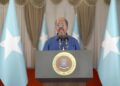
Hamza Abdi Barre, speaking at a ceremony for the Waaberi arts troupe in Mogadishu on the day of the Brussels meeting, said: “We expelled the UN envoy and dismantled C6+. Come on then; there is no international community left to mediate between us.” The cabinet he chairs ordered the ambassador of the United Arab Emirates out of the country within 72 hours that same Thursday. On Friday 20 November he went further, saying the government did not want Somalia’s politics tied to foreign mediation and that the country had regained the confidence and capacity to make its own decisions. “Our Somali brothers, whether in the federal member states or in the opposition, there is no enmity between us,” he said, adding that the only difficulty was that they found it hard to understand where the country now stood.
President Hassan Sheikh Mohamud’s government asked for the last UN political mission to close, and UNTMIS left Somalia on 31 October with the constitution and the election both in dispute. On Thursday 5 November the Supreme Court ruled that the federal mandates had expired and gave the parties until 5 December to agree an electoral framework. The United States, Britain, Turkiye and the European Union, known as the Quartet, then agreed to facilitate the talks Villa Somalia called for 14 to 18 November, and the Somali Future Council said it would attend only if the same four partners mediated, so the forum never convened.
The European Union’s ambassador, László Máthé, met former prime minister Mohamed Hussein Roble, and Turkiye’s ambassador, Ferhat Alkan, met former President Mohamed Abdullahi Farmaajo in early November and then former President Sharif Sheikh Ahmed and former prime minister Hassan Ali Khaire. On Friday President Hassan Sheikh Mohamud offered the opposition talks at a venue of their choosing, having received this week a British delegation led by Charlotte Pierre, the Foreign Office’s director for Africa, with Ambassador Charles King, which raised inclusive political dialogue and the security transition at Villa Somalia. Brussels and Ankara sat with his chief of staff on Thursday while their envoys met the men his prime minister says no foreigner will mediate with.
Uganda’s Drawdown and Washington’s One-Year Reprieve
Uganda, whose troops entered Mogadishu in 2007, has about 6,500 soldiers in Somalia, roughly 4,500 under AUSSOM and about 2,000 under bilateral arrangements, and on Monday 2 November its acting military spokesman, Chris Magezi, said the army “will gradually withdraw all its forces in Somalia” by the end of 2027, beginning with the bilateral contingent, after the army chief, General Muhoozi Kainerugaba, announced the withdrawal on 29 October in a post he later deleted. The African Union had already set out plans for AUSSOM to leave Barawe and hold four bases that Uganda’s bilateral force is vacating, and reports from Lower Shabelle said Ugandan troops handed over five forward positions around Barawe on Sunday 15 November. African Union technical talks on base handovers opened in Mogadishu on Wednesday 18 November and run to 24 November, the day before the Brussels meeting and for five days after it.
Ethiopia plans to withdraw about 3,000 troops, Burundi has moved to take its contingent home, and Egypt has pledged about 1,091 soldiers for Middle Shabelle. United States forces left Baledogle airfield this month, and Washington is reported to be planning to expand its infrastructure in Jubaland and Puntland. Turkish officers have visited Baledogle since the Americans left, and Ankara is reported to want the facility for its own forces.
On Sunday 15 November a State Department spokesperson said the United States would “support a one-year renewal of the mandates” for AUSSOM and the UN Support Office in Somalia, two months after telling reporters that American funding would end and that the support office, with an annual budget of about $500 million, would be wound down over twelve months from January 2027. The spokesperson said the decision was not an “indefinite commitment” and urged “more sustainable regional security solutions”. Somalia’s defence ministry welcomed it the next day, and the Security Council held closed consultations on the missions on Tuesday 17 November. The Secretary-General’s October report put the number of African Union personnel the support office sustains at nearly 12,000.
Djibouti’s Statement on the Beledweyne Runway
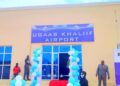
Djibouti’s embassy in Mogadishu said on Friday 20 November that its forces, in contact with the command of AUSSOM’s fourth sector, had repelled the attack on Ugaas Khaliif airport at about one in the afternoon on 19 November and prevented the airfield from being seized. The embassy described its contingent as part of Djibouti’s commitment to the peace and stability of Somalia and promised continued support to the people of Hiiraan. Reports of the statement said no Djiboutian soldier was killed or wounded, which contradicts the first accounts from Beledweyne of one or two dead. Djiboutian troops have held the airport since 2012, and on Thursday they kept it open against Macawisley fighters who drove onto the runway to stop a plane they said was carrying federal reinforcements.
The airport was closed on Friday and will stay shut through Sunday, its manager, Aadan Mohamed Ali, said, while the runway and other damaged areas are repaired, and Ugaas Yusuf Ugaas Hassan, the airport administration and Djiboutian officers are due to meet over the incident. The Hirshabelle administration has banned armed men from the airfield. Djibouti sat in the Brussels room as a troop contributor on the same Thursday its soldiers held the Beledweyne runway, and the fighters they held it against had stood beside federal troops on the Bulo Burde front until the end of October, when about two thousand of them left their trenches for the regional capital.
The federal government announced on 19 November that American aircraft had struck al-Shabaab near Leego, Yora Lafagari and Jamaame between 13 and 15 November, and in the same week al-Shabaab fighters moved into Coomaad, twenty kilometres from the Matabaan front the Macawisley abandoned. In Brussels the government asked fifty partners to help it take over security from the African Union, in Mogadishu its prime minister told the opposition that no partner was left to mediate, and at Beledweyne on Thursday the soldiers keeping the airfield open for federal flights were Djiboutian.