MOGADISHU, SOMALIA – Defence Minister Ahmed Moalim Fiqi opened Somalia’s National Internal Security Conference on Tuesday 1 September with the assertion that the country is ready for a Somali-led framework that is accountable, efficiently managed and financially sustainable. He was speaking sixteen days after President Hassan Sheikh Mohamud told African Union peacekeepers to take a bunch of flowers and go home. The two-day gathering in Mogadishu proceeded without Puntland or Jubaland, and with Southwest represented by the interim administration installed after federal troops removed its elected president. From the same platform the national security adviser told the room that AUSSOM would not be leaving, and that any African Union drawdown depends on a readiness the Somali army has yet to demonstrate. Ahmed Moalim Fiqi is claiming a capability that his own government’s timetable, budget and field commanders all treat as unfinished.

Ahmed Moalim Fiqi Opens a Conference Two States Would Not Attend
Somalia requires a security framework capable of protecting civilians and the country while reflecting its financial realities, Ahmed Moalim Fiqi told the opening session. He called for stronger monitoring mechanisms, closer coordination among security institutions and repaired relations between the federal government and the federal member states. Reliable and sustainable funding was the condition he attached to the whole design, and he argued that strategic decisions have to be converted into measurable results. “Security institutions have different responsibilities, but they all serve one national goal: securing Somalia and protecting its people,” he said. He praised the soldiers fighting militants and pirates, and welcomed the international assistance that continues to underwrite the sector he was describing as self-sustaining.
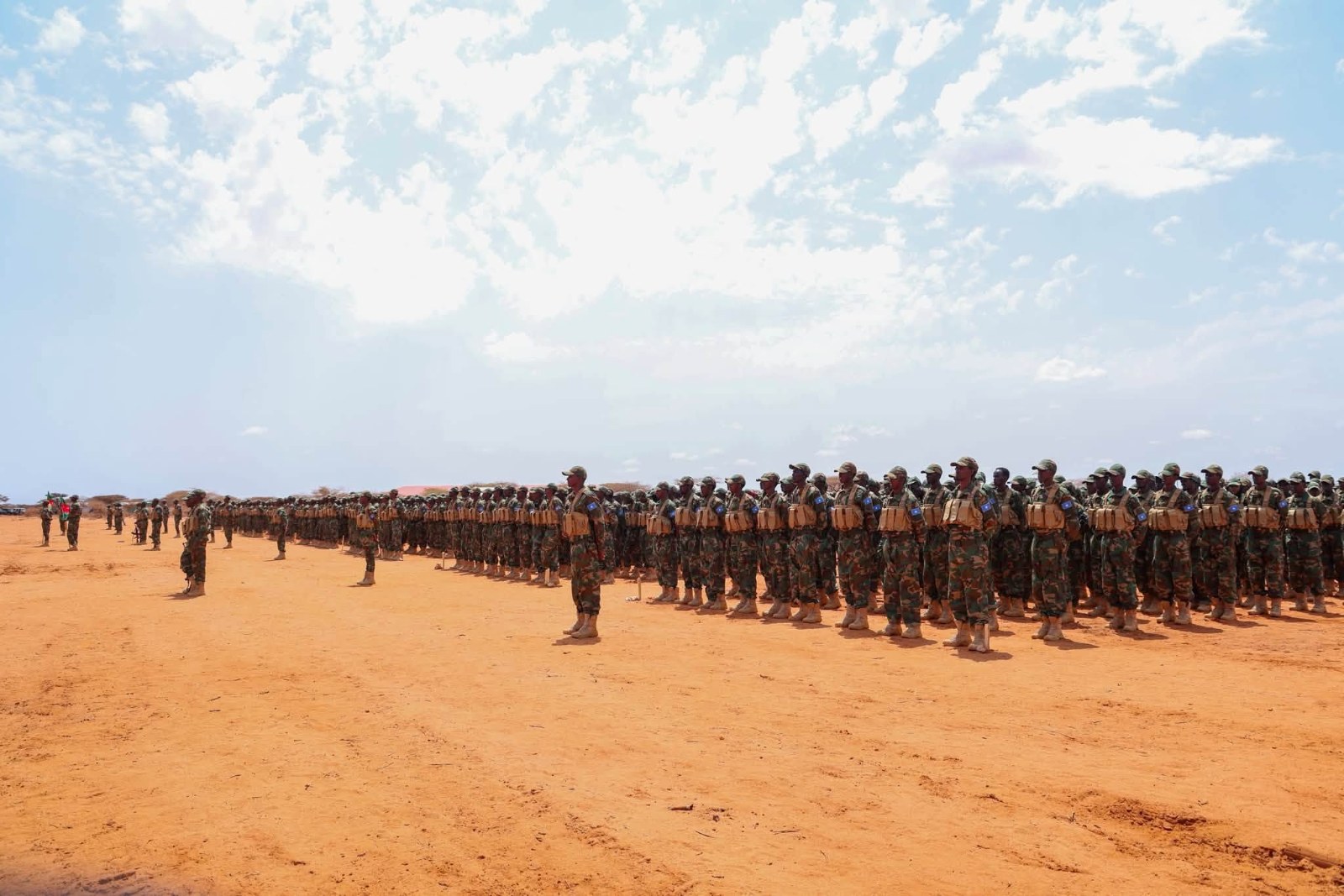
Faster recruitment, expanded training and sufficient equipment make up the programme Ahmed Moalim Fiqi set out to deliver that framework. He offered two events in evidence: the graduation President Hassan Sheikh Mohamud attended in Galgadud region, and the Haramcad police cadets going through the General Kahiye Academy in Mogadishu. He then ruled out the comparison that opposition politicians and security analysts have pressed on Mogadishu all summer. There was no way Somalia could experience an Afghanistan scenario of the kind some had dimly suggested, he told delegates, a reference to the Taliban’s return to Kabul in 2021 after two decades of American and allied deployment.
Ahmed Moalim Fiqi was addressing a conference the Ministry of Internal Security had organised around three sessions, covering domestic policing, coordination between agencies and the sustainability of the arrangement as a whole. Reducing dependence on international donors was the explicit frame of the third session. Internal Security Minister Abdullahi Sheikh Ismail, known as Fartaag, ran sideline meetings with the security ministers of Southwest, Galmudug, Hirshabelle and Northeast State. Puntland and Jubaland stayed away entirely, and between them those two administrations hold the ground where the Somali state has fought al-Shabaab and Islamic State most consistently. Neither was in the room when the federal government sat down to decide who defends the country after the African Union goes.
An Adviser Attaches the Condition the Minister Left Out
“AUSSOM will not leave the country,” National Security Adviser Aweys Haji Yusuf told the same conference at which Ahmed Moalim Fiqi had just declared the country ready. Any withdrawal of African Union troops would be tied to the Somali government’s readiness to assume national security responsibilities, he said. He dated the transition to a joint Somali and United Nations assessment conducted in 2022, which recommended a gradual transfer beginning with political affairs, law and justice. The Security Council approved a plan in 2025 for Somalia to take over the responsibilities of the transitional assistance mission by 31 October 2026. Progress against al-Shabaab and the capacity-building of Somali forces, he said, would set the pace of everything that follows.
“If Somali forces are strengthened and operations against al-Shabaab advance, Somalia could assume greater security responsibility sooner than currently planned,” Aweys said. He cautioned in the same breath that a deterioration in the security situation could stretch the timetable out. Two members of one government therefore described two different countries in a single morning, one of them already capable and the other capable on conditions nobody has yet met. Ahmed Moalim Fiqi has not reconciled the two accounts publicly. Villa Somalia has issued no statement explaining which of them represents federal policy.
The federal government has asked for a two-year delay to the withdrawal of foreign troops, a request that sits awkwardly beside the confidence on display in Mogadishu. Six troop-contributing countries that met in Kampala on 31 July asked the Security Council for a further eighteen to twenty-four months of the mission Somalia is being told it no longer needs. Officials in Bay region voiced doubts about whether national forces could hold their positions alone after the last Ethiopian handover. An assessment published on 19 August concluded that Somali units do not always possess the heavy weapons, intelligence capabilities, air support and sustained logistics available to the foreign contingents they replace.
The Army Ahmed Moalim Fiqi Describes and the One in the Field
European asylum assessors put the Somali National Army at roughly 32,000 soldiers on paper and about 19,000 who are actually deployable. The same assessment records clan-based recruitment undermining cohesion, uneven training and equipment across formations, desertion, defection to the insurgency, soldiers holding second jobs, and infiltration by al-Shabaab. It also describes the Somali Air Force as non-functional, which leaves every operation of consequence dependent on foreign aircraft. Pay, ammunition, fuel and casualty evacuation are the supplies these brigades exhaust first, well before manpower becomes the limiting factor. The 3,000 recruits who passed out at Xananbuure in August, the largest single class Somalia has produced since 1991, will meet the same shortages that thinned the formations sent before them.
Adan Yabaal remains the plainest test of the claim Ahmed Moalim Fiqi is making. Government forces took the town in December 2022 and lost it to al-Shabaab on 16 April 2025, during a counteroffensive that was supposed to finish the group. They have not retaken it in the sixteen months since. Al-Shabaab controls the road between two army bases in Lower Shabelle and taxes the traffic moving along it. Fighting at Basra, thirty kilometres from Villa Somalia, produced a defence ministry statement on 30 August that named no unit, gave no government casualty figure and promised results that were never published.
Federal troops spent August and early September fighting forces loyal to the ousted Southwest president Abdiaziz Laftagareen inside Baidoa, a city the African Union mission garrisons against al-Shabaab. The anti money laundering committee has since moved against his bank accounts and his travel documents. The Africa Center for Strategic Studies counted more than 7,300 deaths from militant attacks in Somalia between 2023 and August this year, with al-Shabaab responsible for 95 percent of them, against a total above 3,500 for the whole decade to 2022. Ahmed Moalim Fiqi is describing a force whose best formations have spent the year deploying against Somalia’s own member states while the insurgency doubled its lethality.
Ahmed Moalim Fiqi Inherits a Handover Written by the Budget
Washington notified the African Union on 1 July that it would not support United Nations logistical assistance to AUSSOM beyond 31 December. It cited the federal government’s failure to take full ownership of its security functions and to sustain the progress made against al-Shabaab. That decision removes the roughly 500 million dollars a year of fuel, transport, rations, communications and medical evacuation carrying nearly 12,000 African Union personnel and some 20,900 Somali security forces. The United States has said it will not veto a renewal of the mission’s mandate, which expires on 31 December. Washington will therefore allow the mandate to be renewed while withdrawing the logistics that make it executable, and Ahmed Moalim Fiqi opened his conference into that gap.
Resolution 2719 was supposed to solve this, allowing up to three quarters of an African Union peace operation’s costs to come from UN assessed contributions. Washington has blocked its application to Somalia at every attempt since December 2024, on the grounds that the conditions for it have not been met. A Secretary-General’s report in May put the mission’s funding gap at more than 38 million dollars against a total budget of under 155 million. Troop reimbursements for the year needed 190 million and drew pledges of 120 million. The mission began losing its support structure in August, when the UN advertised for auctioneers to sell its vehicles, generators and prefabricated accommodation in Somalia.
Ethiopian troops handed the Buurhakaba forward operating base to the army’s 60th Division on 8 August, after twelve years in a town that sits 185 kilometres from Mogadishu on the Baidoa road with al-Shabaab in every direction beyond the perimeter. The Ethiopian contingent left within hours of the ceremony, and the 60th Division now holds a garrison ringed by the insurgency. Uganda holds the largest contingent in the mission at 4,500 men, and its chief of defence forces has named 1 August 2027 as the day the last of them go, ending a deployment that began when Ugandan troops entered Mogadishu in March 2007. President Hassan Sheikh Mohamud offered the flowers on 16 August to a force that had already booked its own departure. The schedule Ahmed Moalim Fiqi now presents as a Somali decision was set in Washington by people closing a logistics account.