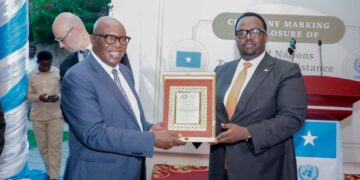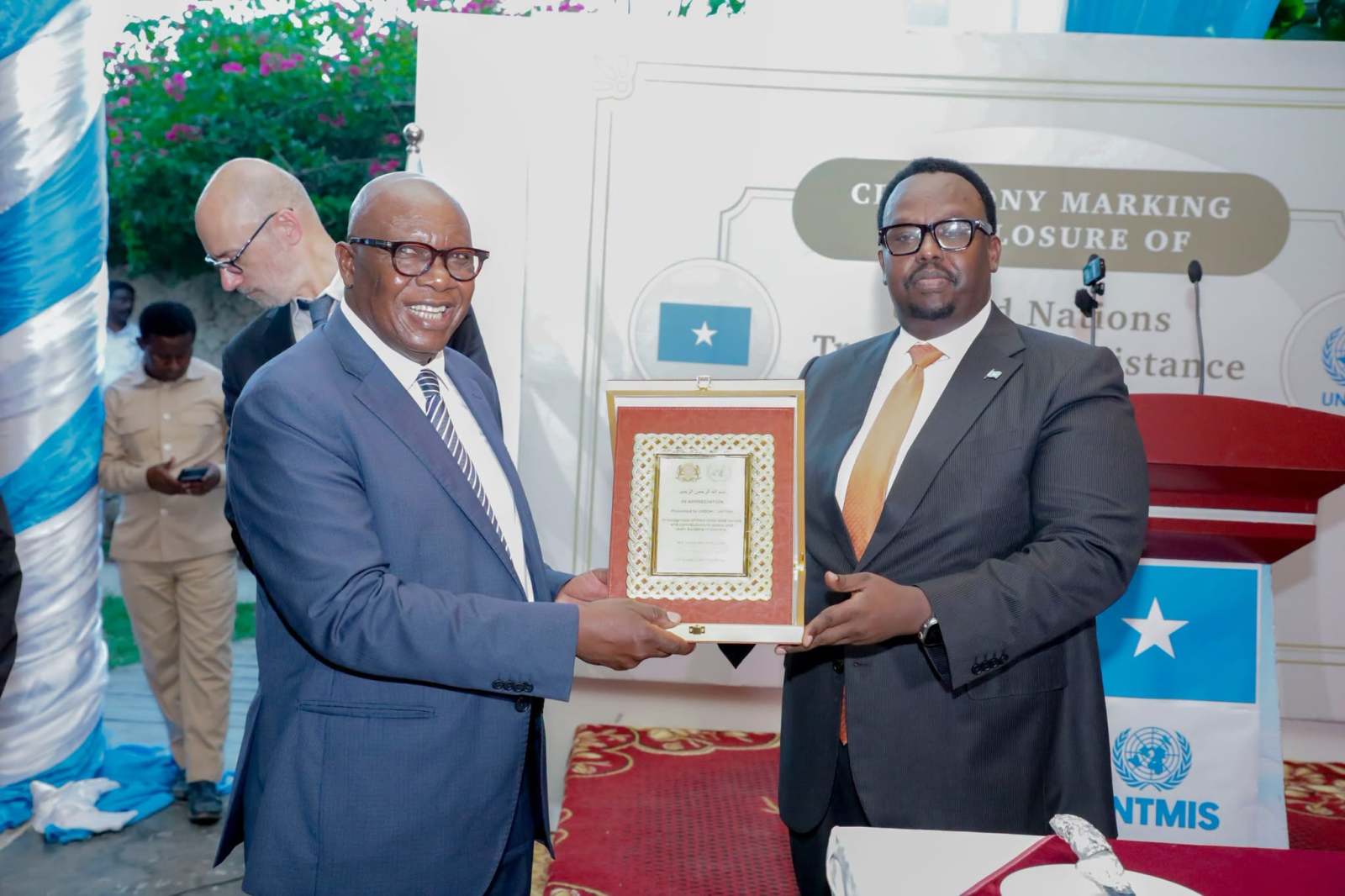
MOGADISHU, SOMALIA – The United Nations Transitional Assistance Mission in Somalia, UNTMIS, ceases operations on Saturday 31 October, closing thirteen years of UN political work that began with UNSOM in 2013 and ending a two-year handover that replaced the federal government’s first request, made in May 2024, to shut the mission within five months. Its acting head, Raisedon Zenenga, marked the closure at a ceremony in Mogadishu on Monday 26 October beside Deputy Prime Minister Saleh Ahmed Jama. Somalia itself asked UNTMIS to spend its last two years on state-building, constitutional review and elections. Former President Sheikh Sharif Sheikh Ahmed, who attended the ceremony, has asked the Supreme Court to annul the new constitution, the opposition has rejected the election timetable, and on the day of the ceremony al-Shabaab ambushed a federal column at Jameeco on the road to Buurhakaba.

The Letter That Set the UNTMIS Clock
Foreign Minister Ahmed Moalim Fiqi wrote to the Security Council on 8 May 2024 asking it to end the mission by October of that year, citing “consideration of our strategic priorities” and saying Somalia would not seek renewal of resolution 2705. The request arrived five weeks after Puntland withdrew its recognition of the federal government over the constitutional amendments of 30 March 2024, and President Said Abdullahi Deni had already handed the text of that decision to a UN delegation in Garowe led by the then special representative, Catriona Laing, as Puntland moved to deal with the international community directly.
Two days after the letter, the government told the Council it was ready to prepare a complex transition within an appropriate timeframe, and its proposal of 28 August asked for a two-year phased handover from November with a mandate limited to state-building, constitutional review and electoral processes, with a review after the first year. The Council adopted resolution 2753 unanimously on 30 October 2024 and renamed the mission UNTMIS from 1 November. During the negotiations the United States opposed any end date, while the three African members, Guyana, China and Russia insisted on 31 October 2026.
Doubts about the readiness of Somali institutions were raised within days of the letter, and the end date the Council finally set held through both phases. Phase one handed over the simpler tasks of UNTMIS and cut its staff by 31 October 2025, under a roadmap agreed with the federal government. Resolution 2809, adopted on 23 December 2025, renewed the African Union mission to 31 December 2026 and told UNTMIS to cease operations on the date Somalia had asked for, and Somalia sat on the Council for that vote, in the first year of its 2025-2026 term.
In January 2019 the administration of former President Mohamed Abdullahi Farmaajo declared the then envoy, Nicholas Haysom, persona non grata after he questioned the arrest of Mukhtar Robow. Notably, the minister who signed the 2024 letter, Ahmed Moalim Fiqi, now runs the defence ministry.
A Constitution Before the Supreme Court
Former President Sheikh Sharif Sheikh Ahmed says he filed his petition on 11 October and that the Supreme Court accepted it a day later. He asks the court to annul every step taken to amend the provisional constitution and everything that followed from those steps, arguing that the changes should have gone through the special procedure in Chapter 15, which in his reading guarantees the independence of the Oversight Committee and the Independent Constitutional Review and Implementation Commission. He also denies that any agreement on the amendments was ever reached. The federal government’s position is that the constitution approved this year provides the legal basis for its planned elections, and its justice minister has welcomed the case as a sign of confidence in the courts.
Constitutional review was the first of the three tasks Mogadishu asked UNTMIS to keep, and it is the file on which the federal system has fractured most visibly since 2024. Puntland’s position, stated when it withdrew recognition, is that its recognition will return only when the constitutional process again involves the federal member states on the consensus terms of the 2012 provisional constitution, and that it will act independently until then. Furthermore, Jubaland has refused to work with the federal government since its own election dispute with Villa Somalia in late 2024, so two federal member states have spent most of the transition outside the process the mission was meant to support.
Sheikh Sharif’s attendance at the closing ceremony came two weeks after the national intelligence agency accused his guards of an armed confrontation in Wadajir and troops closed the roads to his home. Zenenga used the UNTMIS ceremony to welcome President Hassan Sheikh Mohamud’s invitation to political stakeholders to hold dialogue, and to say that the closure “does not signal the end of UN support”. Meanwhile, Secretary-General António Guterres’s statement of the same day asked international partners to help “promote inclusive political dialogue and reconciliation” and to strengthen state institutions, and it thanked the successive special representatives who had led the mission and its predecessor.
An Election Timetable the Opposition Has Rejected
On 15 October the National Independent Electoral and Boundaries Commission set parliamentary elections for 15 April 2027 and a presidential vote for 15 May 2027, and the opposition rejected the timetable. President Hassan Sheikh Mohamud’s four-year mandate expired in May, and the vote he proposes would take place a year later under rules his opponents say were never agreed. Resolution 2753 listed support for free and fair elections through inclusive, one-person, one-vote processes among the priorities of UNTMIS, and the commission announced its timetable sixteen days before the mission’s mandate was due to end.
President Hassan Sheikh Mohamud answered on Sunday 25 October with a public offer to sit down with anyone who held a different view, and his office sent invitations the next day, as UNTMIS held its farewell, for national talks on federal elections in Mogadishu from 14 to 18 November. The letters went to the Nabad iyo Nolol party, the Somali Future Council, the National Unity Forum and the Civil Society Umbrella. In the same address he defended the one-person, one-vote state elections already held in South West, Galmudug, Hirshabelle and Banadir. Moreover, the three opposition groupings did not meet the government together in July; each brought its own proposals to separate meetings.
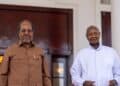
The invitation followed a single day at State House Entebbe, where President Hassan Sheikh Mohamud asked President Yoweri Museveni to keep Ugandan troops in Somalia under a bilateral agreement. Somali accounts of that meeting say Museveni declined, citing cost, urged him to engage the opposition and warned that Ugandan forces could leave if the dispute continued, while Uganda’s own account records no new commitment. Reports on 27 and 28 October linked the president’s cancellation of a planned trip to Russia that week to the losses on the Buurhakaba road and the election standoff. No representative for Somalia at the Russian event has been named.
UNTMIS Departs as the Army Retreats From Jameeco
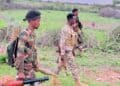
Al-Shabaab ambushed the federal column near Jameeco, in Buurhakaba district, on Monday 26 October, the day UNTMIS held its farewell. A military officer travelling with the convoy, Abshir Abdikarim, said he saw at least 20 soldiers dead, and some of the missing reached Baledogle the next day while others were still unaccounted for. The defence ministry Fiqi now leads said its troops killed about 75 militants and wounded 56, acknowledged damage to vehicles and disclosed no casualties of its own. Al-Shabaab claimed it killed 321 soldiers and captured prisoners and vehicles, and none of these figures could be independently verified.
The column was heading for Buurhakaba, which forces loyal to former President Abdiaziz Hassan Mohamed Laftagareen of South West hold along with Diinsoor, Awdiinle, Qansaxdheere and Bardaale, leaving Baidoa as the only city in Bay under federal control. A second column advancing from Baidoa was ambushed on the road to Buurhakaba earlier the same day, and Laftagareen’s forces claimed that attack. Guterres asked in the statement on the mission’s closure for continued international help against the threat from al-Shabaab. By Tuesday dozens of army vehicles were seen withdrawing toward the Baledogle airbase, and the ministry said Operation Banooda would continue as planned.
The African Union mission’s mandate runs to 31 December 2026 without secure funding, the United States, the largest funder of the UN Support Office in Somalia, is set to end its funding on the same date, and the support office has begun selling vehicles, engines and computers. Separately, the sanctions Panel of Experts faces a review by 30 November. After UNTMIS closes on Saturday, the UN country team under the resident coordinator, George Conway, carries the organisation’s work in Somalia, and the functions that once covered state-building, the constitution and elections have passed to Somali institutions under a federal government whose authority over all three is disputed by Puntland, Jubaland and the opposition.