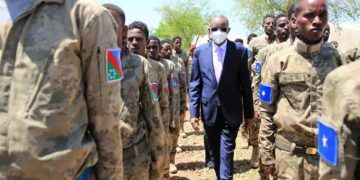
MOGADISHU, SOMALIA – The latest American airstrike in Somalia landed at Farsooley, a village roughly 90 kilometres west of Mogadishu. The distance is the story. US Africa Command announced the July 3 strike in its usual clipped language, another action taken with the federal government to degrade al-Shabaab. Nothing about the location is routine. Farsooley sits an hour’s drive from a capital whose government insists security has never been better. Five days later a second American strike hit near Kismayo, at the other end of the southern war. Foreign aircraft are now working both flanks at once, and the pressure they hold back builds closest to Mogadishu itself. As the African Union begins pulling its troops out of the country, the capital’s defense rests, more nakedly than ever, on foreign firepower Somalia does not own.

The Strikes Creeping Toward Mogadishu
US Africa Command confirmed the Farsooley strike on July 5, and the second strike, conducted on July 8 about 90 kilometres northwest of Kismayo, on July 10. Both releases withheld casualty figures and targets, citing operations security. What the command cannot conceal is geography. Farsooley lies along the western approaches to Mogadishu, the same belt of Lower Shabelle towns through which al-Shabaab pressed its 2025 counteroffensive before the line stiffened. When American aircraft strike that close to the capital, they are the foreign firepower defending the city’s outskirts.
The pattern matches what the International Crisis Group described this month in a new briefing on the war. Al-Shabaab’s advance through Hiiraan and Middle Shabelle in 2025 largely erased the government’s earlier gains; only in Lower Shabelle, closer to Mogadishu, did the push stall, and it stalled because African Union troops and foreign firepower, American and Turkish, held the line where Somali forces could not. Turkiye’s fighter jets have run their own strikes in the south and, this month, flew cover over Baidoa during a contested inauguration. The capital’s shield has many flags. Few of them are Somali.
Night Patrols at the Capital’s Edge
Inside that shield, the picture is less reassuring than the official one. The Somali Guardian has reported that al-Shabaab fighters patrol the outskirts of Mogadishu at night, even as the government touts improved security in the city. Residents of outlying districts describe a capital that belongs to the state by day and to the insurgency after dark. The pattern is familiar from every phase of this war: al-Shabaab does not need to storm Mogadishu while it can tax, watch, and intimidate the city from its edges. Foreign firepower cannot fix that.
The government’s own ministers occasionally say more than they intend. Defense Minister Ahmed Moalim Fiqi drew criticism on July 7 for declaring that only two parties compete for Somalia, al-Shabaab and the ruling Justice and Solidarity Party. Critics heard an admission that the state and the ruling party have fused, with every rival reduced to irrelevance. Whatever Fiqi meant, the framing tells its own story about Mogadishu’s priorities. The al-Shabaab offensive feeds on the capital’s political chaos; a defense minister who describes the war as a two-party race between his movement and the insurgency is part of that chaos.
The Drawdown Starts Anyway
Against this backdrop, the foreign troops are leaving. Garowe Online reported that the drawdown began on July 6, with the first AUSSOM contingents departing amid unresolved questions about who pays for the force that remains. Washington has moved to block further UN funding for the mission, and the Somali Guardian reports the operation is at risk of collapse without it. Crisis Group’s briefing is blunt about what the mission still does: international partners remain essential to holding the defensive lines around Mogadishu.
The sequence is exactly backwards. The troops guarding the capital’s approaches are departing while the insurgency they contain probes those approaches nightly, and while the foreign firepower substituting for them answers to budgets and priorities set in Washington and Ankara. Somalia has lived through this before. The 2025 counteroffensive followed a similar moment of transition and distraction, and it took foreign firepower to stop it at Lower Shabelle. The difference now is that the next transition removes the ground force too.
Foreign Firepower on Loan
None of this is an argument that Mogadishu will fall; al-Shabaab has never shown the strength to take and hold the capital against concentrated foreign firepower. It is an argument about what the government has done with the time that foreign firepower bought. Four years of it went into constitutional fights, the capture of federal member states, and a war of attrition against Puntland and Jubaland; The Somali Digest has tracked how that rift deepened while the front lines decayed. The army that was supposed to inherit the country’s defense remains, by Crisis Group’s account, unable to hold recaptured ground.
So the capital’s security now hangs on an uncomfortable arithmetic. American strike releases arrive weekly; Turkiye’s jets fill the gaps; the AU’s departing troops still man the trenches that matter. Remove any one element, and the night patrols on Mogadishu’s edge become something worse. A government that cannot defend its own capital without borrowed aircraft has few cards left to play, and the lenders are already counting their moneyThe al-Shabaab offensive feeds onng> – The latest American airstrike in Somalia landed at Farsooley, a village roughly 90 kilometres west of Mogadishu. The distance is the story. US Africa Command announced the July 3 strike in its usual clipped language, another action taken with the federal government to degrade al-Shabaab. Nothing about the location is routine. Farsooley sits an hour’s drive from a capital whose government insists security has never been better. Five days later a second American strike hit near Kismayo, at the other end of the southern war. Foreign aircraft are now working both flanks at once, and the pressure they hold back builds closest to Mogadishu itself. As the African Union begins pulling its troops out of the country, the capital’s defense rests, more nakedly than ever, on foreign firepower Somalia does not own.
The Strikes Creeping Toward Mogadishu
US Africa Command confirmed the Farsooley strike on July 5, and the second strike, conducted on July 8 about 90 kilometres northwest of Kismayo, on July 10. Both releases withheld casualty figures and targets, citing operations security. What the command cannot conceal is geography. Farsooley lies along the western approaches to Mogadishu, the same belt of Lower Shabelle towns through which al-Shabaab pressed its 2025 counteroffensive before the line stiffened. When American aircraft strike that close to the capital, they are the foreign firepower defending the city’s outskirts.
The pattern matches what the International Crisis Group described this month in a new briefing on the war. Al-Shabaab’s advance through Hiiraan and Middle Shabelle in 2025 largely erased the government’s earlier gains; only in Lower Shabelle, closer to Mogadishu, did the push stall, and it stalled because African Union troops and foreign firepower, American and Turkish, held the line where Somali forces could not. Turkiye’s fighter jets have run their own strikes in the south and, this month, flew cover over Baidoa during a contested inauguration. The capital’s shield has many flags. Few of them are Somali.
Night Patrols at the Capital’s Edge
Inside that shield, the picture is less reassuring than the official one. The Somali Guardian has reported that al-Shabaab fighters patrol the outskirts of Mogadishu at night, even as the government touts improved security in the city. Residents of outlying districts describe a capital that belongs to the state by day and to the insurgency after dark. The pattern is familiar from every phase of this war: al-Shabaab does not need to storm Mogadishu while it can tax, watch, and intimidate the city from its edges. Foreign firepower cannot fix that.
The government’s own ministers occasionally say more than they intend. Defense Minister Ahmed Moalim Fiqi drew criticism on July 7 for declaring that only two parties compete for Somalia, al-Shabaab and the ruling Justice and Solidarity Party. Critics heard an admission that the state and the ruling party have fused, with every rival reduced to irrelevance. Whatever Fiqi meant, the framing tells its own story about Mogadishu’s priorities. the al-Shabaab offensive feeds on the capital’s political chaos; a defense minister who describes the war as a two-party race between his movement and the insurgency is part of that chaos.
The Drawdown Starts Anyway
Against this backdrop, the foreign troops are leaving. Garowe Online reported that the drawdown began on July 6, with the first AUSSOM contingents departing amid unresolved questions about who pays for the force that remains. Washington has moved to block further UN funding for the mission, and the Somali Guardian reports the operation is at risk of collapse without it. Crisis Group’s briefing is blunt about what the mission still does: international partners remain essential to holding the defensive lines around Mogadishu.
The sequence is exactly backwards. The troops guarding the capital’s approaches are departing while the insurgency they contain probes those approaches nightly, and while the foreign firepower substituting for them answers to budgets and priorities set in Washington and Ankara. Somalia has lived through this before. The 2025 counteroffensive followed a similar moment of transition and distraction, and it took foreign firepower to stop it at Lower Shabelle. The difference now is that the next transition removes the ground force too.
Foreign Firepower on Loan
None of this is an argument that Mogadishu will fall; al-Shabaab has never shown the strength to take and hold the capital against concentrated foreign firepower. It is an argument about what the government has done with the time that foreign firepower bought. Four years of it went into constitutional fights, the capture of federal member states, and a war of attrition against Puntland and Jubaland; The Somali Digest has tracked how that rift deepened while the front lines decayed. The army that was supposed to inherit the country’s defense remains, by Crisis Group’s account, unable to hold recaptured ground.
So the capital’s security now hangs on an uncomfortable arithmetic. American strike releases arrive weekly; Turkiye’s jets fill the gaps; the AU’s departing troops still man the trenches that matter. Remove any one element, and the night patrols on Mogadishu’s edge become something worse. A government that cannot defend its own capital without borrowed aircraft has few cards left to play, and the lenders are already counting their money.