MOGADISHU, SOMALIA – Prime Minister Hamza Abdi Barre said on Wednesday 16 September that his government has not politicised, and will not politicise, financial support to Somalia’s federal member states. The claim accompanied the presentation of the 2025 economic report, whose own accounts show $163.8 million transferred to the states, 76.4 percent of the annual target, with more than two thirds supplied by donors. Hamza Abdi Barre says the total was the largest Somalia has distributed in a year. Puntland and other federal critics have accused Mogadishu of using access to development money as political leverage. The published aggregate confirms that transfers rose sharply; it does not identify when each state was paid, how much each received or whether administrations in dispute with Villa Somalia were treated on the same terms.

Hamza Abdi Barre Puts a Number on State Support
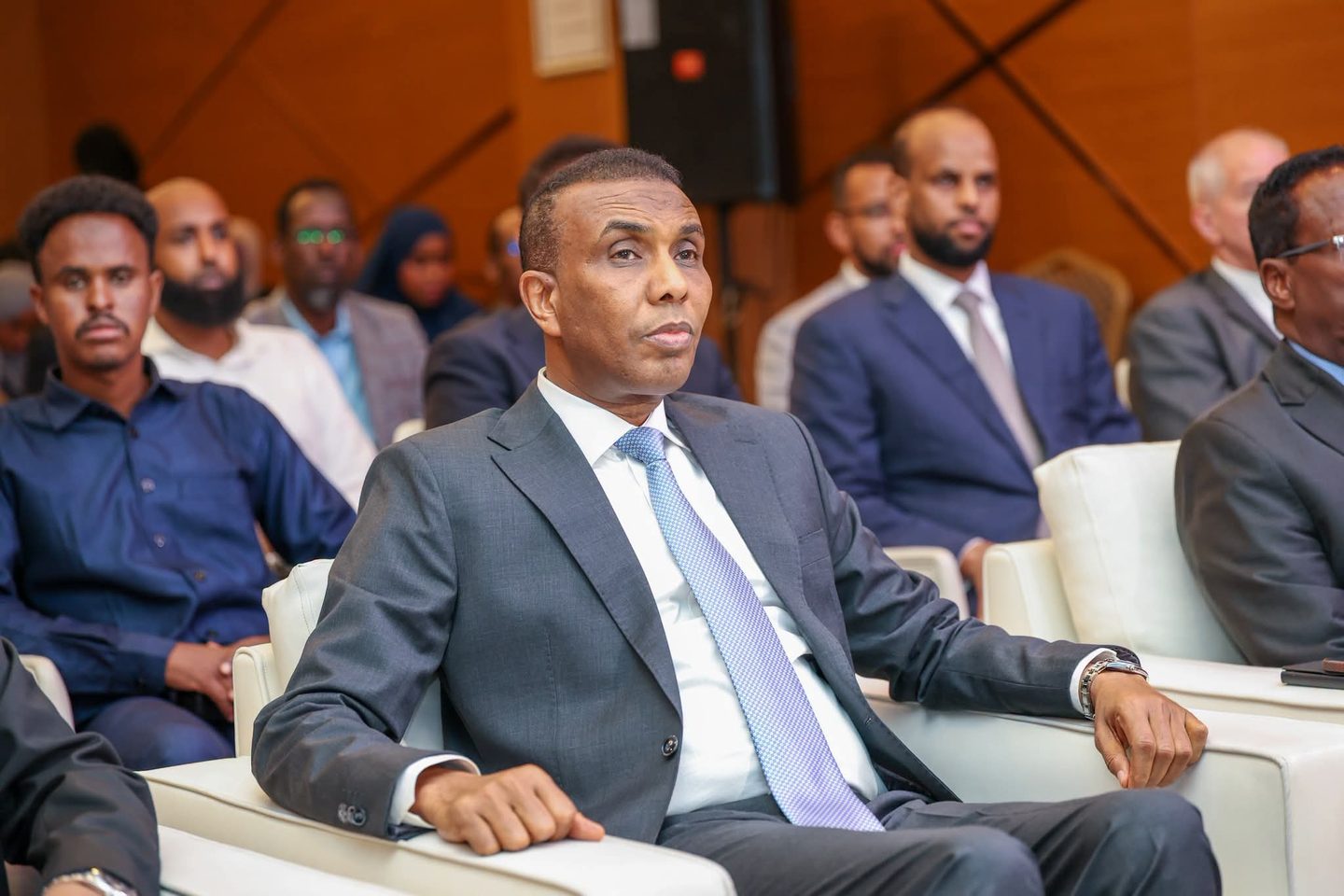
Hamza Abdi Barre delivered the denial at a government event presenting the Ministry of Finance’s account of economic performance in 2025. He said the year carried the largest financial support yet provided to federal member states, alongside gains in domestic revenue, transparency and public financial management. The prime minister’s quoted formulation addressed the political accusation directly. His supporting number appears in a report prepared months before the speech, allowing the size and composition of the transfer programme to be tested against a public document.
The 2025 budget performance report records $179.7 million in total transfers, equal to 77.9 percent of the annual target and 12.1 percent above 2024. Federal member states received $163.8 million of that sum, a 41 percent annual increase but only 76.4 percent of the amount budgeted for them. Domestic revenue supplied $53 million, or 32.4 percent, while donor grants supplied $110.8 million, or 67.6 percent of the recorded total. Hamza Abdi Barre therefore has a sound basis for saying the nominal total reached a new high, while the same table records a gap of roughly $50.6 million between the state-transfer target and execution.
Somalia’s 2026 plan extends the scale of the programme by allocating about $212.7 million in grants to the federal member states inside a budget financed mainly from abroad, the fiscal structure examined in July. External grants account for close to two thirds of federal resources, leaving the centre to distribute money whose conditions, reporting schedules and release dates are often set with international institutions. The report also says disbursement through donor projects fell from 90 percent in 2024 to 85 percent in 2025, despite the higher cash total. Hamza Abdi Barre can authorise the treasury’s part of the process, but his government does not raise most of the money on which the transfer claim rests. The distinction places international programme rules between Mogadishu’s promise and the state treasury waiting to receive it.
The Donors Behind Hamza Abdi Barre’s Transfers
The Ministry of Finance attributes the shortfall partly to lower domestic revenue and budget support, while describing improved access to donor projects after meetings among federal and state finance officials. Those grants carry reform conditions that administrations must satisfy before disbursement. The report says the meetings identified causes of low access and agreed capacity measures to help states meet the requirements. It does not publish a state-by-state schedule of applications, approvals, delays and payments. Hamza Abdi Barre’s denial therefore reaches a question the national total cannot answer, because equal treatment is visible only when each recipient and date can be compared.
World Bank programmes have tried to give the arrangement a formula. An evaluation says a federal-grant rule allocates 60 percent to the federal government and 40 percent to member states, with equal shares for each state regardless of population, poverty or need. Puntland has not accepted that formula, while the allocation of resources across the federation remains contested. The disagreement covers the centre’s authority as well as the arithmetic. Garowe maintains that money pledged for Somalia cannot become a reward for accepting constitutional amendments, federal election timetables or security arrangements it rejects.
Puntland legislators previously accused federal ministries of obstructing regional development projects and politicising a donor fund. Federal officials answered with records of transfers already made, leaving the dispute centred on access, timing and control while acknowledging that payments occurred, the same distinction that now shapes Hamza Abdi Barre’s claim. A treasury can send a record annual total while individual projects are delayed or conditioned in ways a state regards as political. Hamza Abdi Barre has denied that purpose, and the denial now belongs beside the ledger. The 2025 report establishes volume and sources, but contains no recipient ledger detailed enough to prove or disprove the accusation across Puntland, Jubaland, Galmudug, Hirshabelle and South West.
The Federal System Keeps Its Missing Ledger
Puntland and Jubaland enter the transfer system with independent port income. Puntland collects at Bosaso and Jubaland at Kismayo, giving both administrations revenue outside Mogadishu’s payment chain. Galmudug, Hirshabelle and South West rely more heavily on federal and donor programmes administered through the centre. Those differences overlap with the political map: Puntland and Jubaland reject Villa Somalia’s constitutional and electoral settlement, while the other three administrations have participated in it. The overlap does not establish that Hamza Abdi Barre withheld money for political compliance, but it makes recipient-level disclosure indispensable to his denial and to every state expected to accept Hamza Abdi Barre’s assurance.
Sixty federal legislators moved this month against Interior Minister Ali Yusuf Hosh over security, reconciliation and the weakening of federal relations, placing the member-state dispute inside parliament. In Gedo, federal forces returned to Jubaland after Kismayo agreed to assume salaries that Mogadishu had left unpaid, and the payroll transfer dissolved a federal command. Money in Somalia’s federal system pays for administration, patronage and armed loyalty through the same accounts, which is why an aggregate annual figure cannot carry the political conclusion Hamza Abdi Barre placed on it.
The finance ministry can settle much of the argument by publishing the complete 2025 recipient ledger: each state, programme, approved sum, actual payment date, unmet condition and final outstanding cash balance. Its current report publishes aggregate growth, the donor share and the shortfall against target, while the prime minister supplies the assurance that none of it was political. The dispute will otherwise follow the 2026 allocation into an election year in which the centre is financing administrations that accept its electoral programme and confronting those that refuse it. Hamza Abdi Barre has put the denial firmly on the record. The full accounts needed to audit that denial remain unpublished.