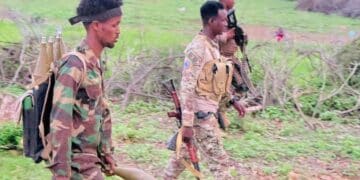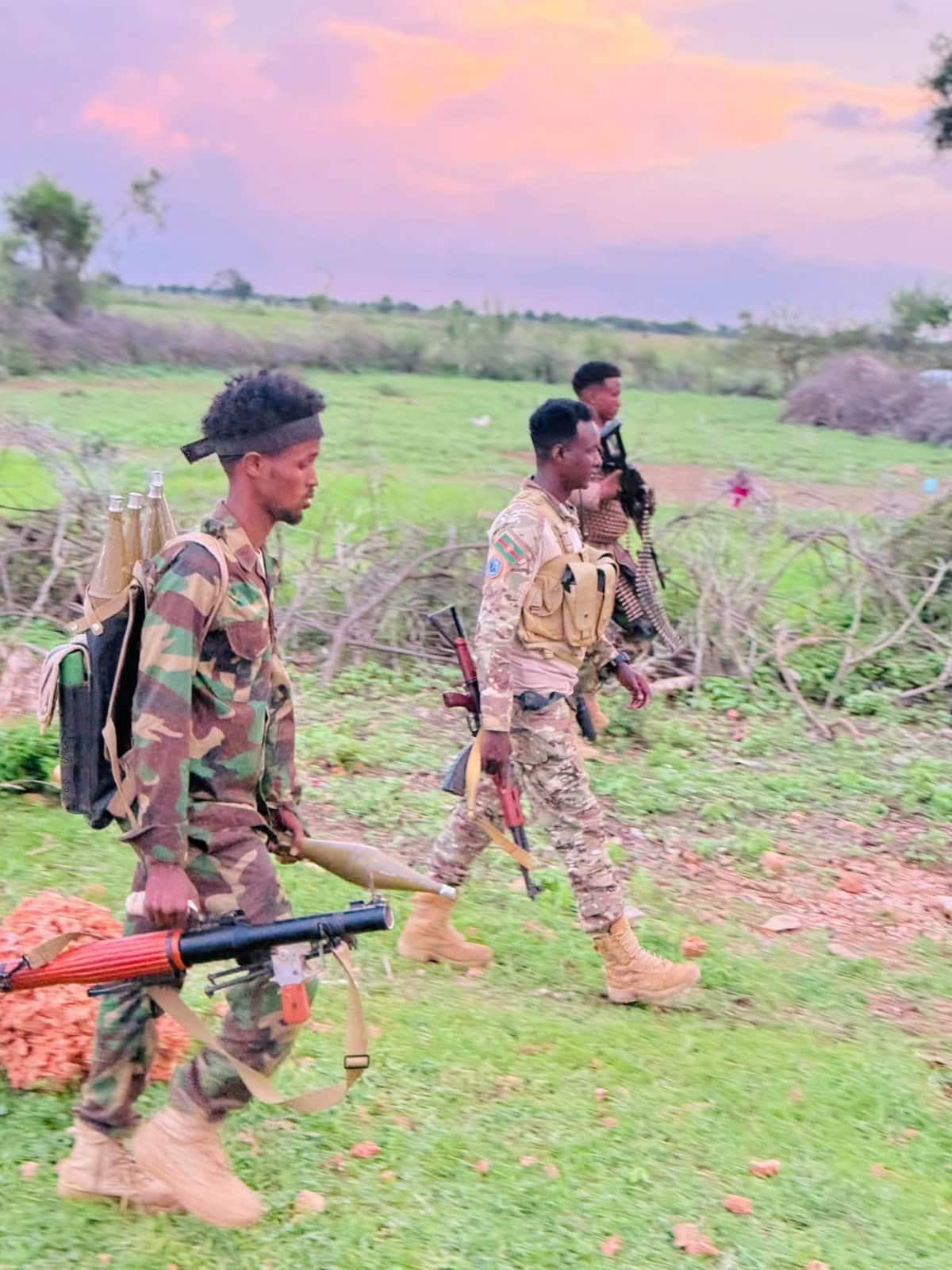
LEEGO, SOMALIA – The defence ministry said on Thursday 12 November that soldiers pursuing al-Shabaab between Leego and Iidow Jalaat had killed two of the group’s senior figures at Shanta Baraako, on the outskirts of Leego district, and US Africa Command said on Saturday 14 November that it had carried out an airstrike near the town that same Thursday in coordination with the federal government. The fighting returns Operation Banooda to the road where al-Shabaab routed a federal column at Jameeco on Monday 26 October. Mogadishu has still published no figure for its own dead from that day, and Buurhakaba, the town the column was sent to retake, remains in the hands of forces loyal to former President Abdiaziz Hassan Mohamed Laftagareen, who were welcoming soldiers from the national army into their ranks on the same Saturday.

Operation Banooda Resumes on the Outskirts of Leego District
The army named the two men as Abdifitah Gaalgooriyow and Abdulkadir Hussein and said they had organised the movement of al-Shabaab fighters and commanders along the tracks between Leego and Buurhakaba, through the junctions at Jiiro Yaasiin, Jiiro Kuulow, Iidow Jalaat and Dhargo. According to its statement, troops came upon militants gathering at Shanta Baraako, defeated them and destroyed their positions, and it gave no figure for its own casualties or for the number of fighters killed beyond the two it named. Somali-language reports citing sources close to the group carried the same two names, and no independent account of the clash in Leego district has appeared since.
Operation Banooda opened on Saturday 24 October, when Danab commandos fought near Leego on its first morning and the ministry said the campaign would eliminate al-Shabaab across South West State. Its second phase came after a pause that the government put down to the weather and an ambush on troops near Leego on Sunday 8 November, and by Thursday 12 November the army had resumed the operation’s movements along the road it had abandoned after Jameeco. Further reports on Saturday 14 November described Danab’s 161st unit conducting ground operations in Leego district and an overnight US strike on an al-Shabaab position where weapons were said to be stored, with commanders reported killed and neither names nor figures given.
Leego sits where Lower Shabelle meets Bay, on the paved road that runs from Mogadishu through Wanlaweyn and Buurhakaba to Baidoa, and the junctions the ministry listed carry al-Shabaab’s traffic between the Shabelle valley and the Bay countryside. Whoever holds those tracks decides whether a federal convoy can reach Buurhakaba at all, and whether a garrison there could be supplied once it arrived. In the ministry’s own words, the campaign’s purpose is to secure the main roads and restore freedom of movement for the civilians who use them. Roadside bombs between Afgooye and Wanlaweyn had destroyed military vehicles in the week before the column set out, and a Danab unit went ahead of it to clear a road said to be mined.
A US Airstrike Near Leego District After Baledogle
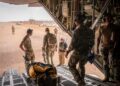
US Africa Command’s statement said it conducted an airstrike targeting al-Shabaab on 12 November near Leego, in coordination with the Federal Government of Somalia, and that specific details about units and assets would not be released to protect continuing operations. It gave no target, no assessment of the result and no casualty figure. Days earlier the command had confirmed that its personnel had left Baledogle airfield, about ninety kilometres north-west of Mogadishu, where American advisers had trained Danab since 2012, citing the cost of resurfacing the runway. Leego lies further up the same road from the airfield, and the column that was routed at Jameeco, reported at the time to number about two thousand soldiers, had formed at Baledogle and the nearby Xero Shiino camp before it set out.
Danab, the brigade the United States built and paid for, has carried most of the fighting in Leego district from the operation’s first day, and Danab soldiers were the men stranded clan fighters called for help during the rout. US officials have said only that the troops who left Baledogle relocated elsewhere in Somalia, and no plan to return has been announced. Turkish forces have visited the airfield since the Americans left and are reported to want to take it over and expand it.
After Jameeco, al-Shabaab claimed that Turkish aircraft had struck a site near Leego where it was holding wounded soldiers it had captured, killing fifteen of them, while local reporting said Turkish strikes had hit Somali troops by mistake. The government denied it, saying Turkiye’s air force had not targeted Somali forces, and the National Security Office called reports of Turkish strikes on army positions at Leego fabricated. Since 24 October the federal government’s statements on the campaign have kept one form, giving al-Shabaab’s losses by number or by name and its own by neither.
The Jameeco Dead and the Soldiers Who Left
Soldiers who survived Jameeco said they helped move about forty dead and more than a hundred wounded to hospitals in Mogadishu after al-Shabaab hit the column with vehicle-borne bombs, and the defence ministry reported only al-Shabaab’s losses, about seventy-five fighters killed and fifty-six wounded. Al-Shabaab claimed to have killed 413 soldiers. Twenty days later, no federal figure has been published to set against either account, and the soldiers’ own estimate remains the lowest number anyone has offered for the army’s worst single day in years.
Military court chief Hassan Ali Nur Shute and ground forces commander Sahal Abdullahi Omar flew to Baledogle in the days after the rout, questioned commanders on the sequence of events and warned that troops who abandoned the battlefield or their vehicles again would face discipline. Turkiye was reported to have destroyed several of the Kirpi armoured vehicles it had donated to the army, to keep them out of al-Shabaab’s propaganda footage. Soldiers said at the time that their commanders had stayed far behind the front line and pulled back as soon as the fighting began. No finding from that visit has been published, no officer has been publicly named as responsible, and the same command structure is now running the second phase of Banooda in Leego district.
Clan fighters from the Hawadle held out alone in Leego district for nearly five hours on 26 October, refusing to leave a wounded comrade, until a Danab unit reached them on the coordinates they sent. Officers reported wounded that day included the commanders of the 172nd and 174th units of the 17th battalion. Within a fortnight Ugaas Yusuf Ugaas Hassan, the Hawadle’s senior traditional leader, told Hawadle soldiers there was no government to defend, and men from the clan began leaving federal positions on several fronts in answer to his call.
Buurhakaba Lies Beyond Leego District
Forces loyal to former President Abdiaziz Hassan Mohamed Laftagareen took Buurhakaba on Thursday 15 October after heavy fighting with federal troops and the forces of President Aden Mohamed Nur Madobe’s administration, and by the end of that month they also held Qansaxdheere, Bardaale, Diinsoor and Awdiinle. On Saturday 14 November his officials in the Bay region welcomed another group of soldiers from Hiiraan, Galgaduud and Middle Shabelle. A security official aligned with the former president, Hassan Abdulkadir, said they had answered his call for South West soldiers in the national army to come home, and whether they had formally left their units could not be established.
A similar group was received on Sunday 8 November, the day of the ambush near Leego. The federal government has answered by sending more troops and equipment to Barawe and to Baidoa, the seat of President Aden Mohamed Nur Madobe’s administration, while Uganda withdraws its bilateral contingent from its Lower Shabelle bases and the African Union mission prepares to leave Barawe. Al-Shabaab, which holds the countryside between Baledogle and Buurhakaba, met the federal convoy at Jameeco before it reached the district it had been sent to take back from a former member state president.
President Hassan Sheikh Mohamud’s election talks failed to open in Mogadishu on the same Saturday the airstrike was announced, after the Future Council, Puntland and Jubaland stayed away. Earlier this month the Supreme Court ruled that his four-year mandate had expired on 15 May and gave the country’s politicians thirty days to agree an electoral framework, and the government holds to the electoral commission’s timetable of parliamentary elections on 15 April 2027. Twenty days after Jameeco, the defence ministry has published the names of two al-Shabaab commanders killed in Leego district, and the number of its own soldiers who died on the road to Buurhakaba is still a figure only al-Shabaab has offered.