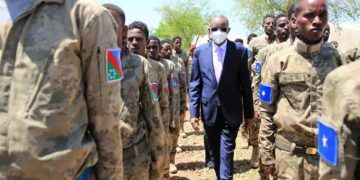
BOSASO, SOMALIA – One soldier of the Puntland Security Force was killed on Sunday 19 July in a gunfight with Puntland’s own Dervish forces at a checkpoint in the Madar-Jiif area, on the road between the town of Laag and the port city of Bosaso. Troops from the PSF had tried to push a convoy through a Dervish position, and both sides then answered with heavy weapons. The shooting was local, and the question behind it runs to Mogadishu: command of the Puntland Security Force, the US-trained counter-terror unit that the federal government has folded into the national army over Garowe’s objections.

A Checkpoint Killing on the Bosaso Road
The PSF convoy tried to push through a Dervish position on the road into Bosaso, and when the Dervish forces blocked the vehicles both sides opened up with heavy weapons. At least one PSF fighter was killed before the shooting died down. Puntland then moved quickly to secure the city. Police Commissioner Muumin Cabdi Shire drove out of Garowe with a column of at least eighteen armed vehicles, and reinforcements fanned out to the Maqaska junction, which controls the road to Bosaso Airport, and along the Soddonka corridor. Residents described a day of rising military traffic as fresh troops arrived and dug in, and neither Garowe nor Mogadishu had issued a statement by Monday evening.
On Tuesday 21 July the Puntland administration announced a broader sweep. Its forces said, in a report broadcast by Puntland Television, that they had carried out a planned operation in the Laag area, dismantled an armed group blamed for months of local insecurity, and seized military vehicles, weapons, and prisoners, with operations continuing against members of the group who had fled. The standoff on the road eased only after Dervish commanders and PSF officers agreed that the contested units would pull back to Bosaso. That agreement ended the shooting for the day, while the dispute over who commands the men in those vehicles stayed exactly where it was.
Lockdowns of this kind have their own economics in Bosaso, and the Puntland Security Force convoy triggered one within hours. Every hour the Maqaska junction stays closed, trucks queue outside the port, importers pay demurrage and fuel prices in the interior move. Puntland’s administration knows the cost precisely, since customs at that port fund most of what it does, and it still judged a show of force cheaper than allowing a federalised convoy to establish that it can pass where it likes. The same port road carries the humanitarian cargo bound for the northeast, which gives every closure a cost beyond the customs ledger.
Mogadishu’s Claim on the Puntland Security Force
What turned an internal Puntland feud into a federal one was Mogadishu’s decision to adopt the losing side. After President Said Abdullahi Deni pushed the Diyano faction out, the federal government made Asad Diyano chief of the Somali Police Force. On 22 June this year President Hassan Sheikh Mohamud signed decrees creating a Bosaso-based 17th unit of the Somali National Army under Lieutenant Colonel Abdullahi Osman Abdullahi, known as Diyano, and federal leaders then said the Puntland Security Force had been absorbed into it, with its personnel eligible for national salaries and logistics. Puntland rejected the move outright, arguing that the federal government holds no constitutional power to recognise or deploy armed forces on its territory without the state’s consent.
The new unit was designed to bypass Puntland’s chain of command and report straight to Mogadishu, and it arrived alongside other federal moves on the state’s security. In mid-June the federal government named a new commander for the army’s 54th Division, which is based in Garowe, and Puntland answered on 18 June by rejecting the appointment and restricting the movements of federal forces. The division’s commander was then stationed in Las Anod, and analysts tracking the standoff could not confirm by mid-July whether the Bosaso unit was operational. A convoy of the federalised Puntland Security Force forcing a checkpoint on the Bosaso road therefore became a test of whose writ runs there, and Garowe answered a single convoy with a police commissioner and eighteen trucks.
The federal argument for absorbing the Puntland Security Force can be stated fairly. Somalia cannot maintain a national army if member states retain veto power over which formations operate on their soil, and the constitution leaves that question open. What weakens the case in practice is selectivity, since the principle of unified command has been asserted against Puntland and Jubaland and never against the units answering to the presidency itself.
A Wider Campaign Puntland Says It Can Read
Puntland frames the clash as one move in a longer effort to plant a federal army inside its borders. The prime minister and the interior minister said separately in early July that the federal government would recruit soldiers in Puntland despite the state’s ban, and Puntland forces were reported to have arrested two army officers linked to the 54th Division over recruitment the same month. A letter from an army supply unit dated 25 June, detailing weapons transfers to newly recruited federal forces in the region, has since surfaced. Puntland cites that letter, alongside the disputed status of the Puntland Security Force, as proof that Villa Somalia is arming men to destabilise it from within, and Mogadishu’s plan to destabilise Puntland works by manufacturing exactly this kind of rival force.
President Hassan Sheikh Mohamud declared on 1 July that ties with Puntland had broken down and that there was no room for talks. President Said Abdullahi Deni answered that his government would not accept federal intervention in its security, over the Puntland Security Force or any other unit, and on 18 June Garowe had already said it would operate separately from the federal government until the two sides reached a comprehensive settlement. Puntland anchors the opposition coalition that Jubaland also joined, and the two states have closed ranks against Villa Somalia over the same pattern of federal encroachment, which they read as the federal bargain being dismantled one state at a time.
Garowe has stopped attending federal security meetings, it refuses to recognise appointments made for its territory, and it treats every logistics flight into Bosaso as a potential delivery to the Puntland Security Force or its other rivals. Puntland cut its ties with the federal institutions in March 2024 after parliament rewrote the constitution without its consent, and it has handled every federal security move since through that decision. A federal government hoping to run a national security transition next year will have to do it without the cooperation of the state holding the longest coastline in the federation.
The Cost of a Second Front at the Port
Bosaso is Puntland’s main revenue engine and a lifeline for trade, fuel, and humanitarian cargo bound for the northeast. Puntland enters this fight already carrying a budget shortfall of roughly a third for 2026, strained further by the federal move against its Emirati port arrangements. A prolonged standoff on the roads into the city threatens the economy that funds President Said Abdullahi Deni’s forces. It also pulls the Puntland Security Force away from the mission it was built for, since a unit designed to hunt the Islamic State in the mountains cannot do so while its convoys trade fire with Dervish checkpoints.
Al-Shabaab and the Islamic State gain from every hour spent this way, and al-Shabaab’s offensive feeds on Mogadishu’s political chaos. A command war inside the country’s steadiest counter-terror force takes men and attention away from the campaign against the Islamic State in the Cal Miskaad mountains. Puntland has shown it can defuse a federal wedge without gunfire, having pulled its Garowe standoff back from the edge through elder mediation only days earlier. The Bosaso road produced the opposite result, a body at a checkpoint and both sides reinforcing. The Puntland Security Force was raised to fight jihadists in the Bari mountains, and its convoys are now meeting the state that raised it at checkpoints on the Bosaso road.
Elder mediation remains the only mechanism that has reliably worked, and it is being asked to carry more weight than it can bear. Clan elders can separate two columns on a road for a week, and they cannot settle who signs the payroll of a counter-terror force claimed by two governments. That question belongs to a political settlement that neither Mogadishu nor Garowe is currently willing to negotiate, and until the men in those convoys know whose orders bind them, the next collision on the Bosaso road will come before any mediator arrives.