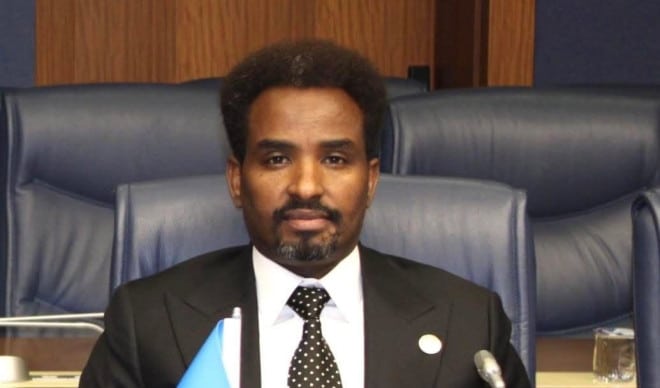
MOGADISHU, SOMALIA – Prime Minister Hamza Abdi Barre appointed Saadaq Joon, a member of the House of the People and a former commander of the Banadir regional police, as Somalia’s defence minister on Monday 23 November, replacing Ahmed Moalim Fiqi a few hours after Fiqi had claimed 285 al-Shabaab fighters killed. A source close to Villa Somalia says the ministry was promised to former Galmudug President Ahmed Abdi Kaariye Qoorqoor, a clansman of the new minister, in return for his withdrawal from the race for another term in Dhusamareb. The change came five weeks before the African Union mission’s United Nations authorisation expires on 31 December.

The Galmudug Bargain Behind Saadaq Joon
Government spokesman Abdinasir Ahmed Bashir read the decree to the press. It cited clauses two and three of Article 120 of the provisional constitution and said the prime minister had taken the president’s advice. It filled a post that Fiqi was said to have “vacated”, and it gave no reason for his departure. The same order named Ali Ifiye Ali deputy minister of ports and Maryan Ali Abukar deputy minister of fisheries. According to a source close to the presidency, the appointment followed an agreement between President Hassan Sheikh Mohamud and Qoorqoor. The deal was worked out early this year, after federal leaders pressed the former Galmudug president to give up his bid for a second term. “Qoorqoor asked for the Defence Ministry to be given to Saadaq Joon, who is from his clan, and the President accepted that agreement,” the source said.
Qoorqoor left the race in June, saying the decision served Galmudug’s stability. The Supreme Court annulled the July vote over procedural breaches and ordered a rerun, which the president’s Justice and Solidarity Party won with 67 of the 89 seats in September. The new assembly elected the party’s candidate, Liibaan Ahmed Hassan, on 22 October, and he took office from Qoorqoor on 4 November. On Sunday 22 November President Liibaan Ahmed Hassan named a 55-member cabinet. Mohamed Yusuf Ali, appointed state minister for the presidency that night, resigned the next morning, complaining that his community in Galcad had not received the share it deserved.
Qoorqoor and Saadaq Joon both belong to the Saleebaan branch of the Habar Gidir, and President Liibaan Ahmed Hassan and Fiqi are both Sa’ad. Under the unwritten clan formula for sharing power, the Saleebaan’s loss of the Galmudug presidency gave them a claim on the defence post with or without a private agreement. Mahad Mohamed Salad, the director of the National Intelligence and Security Agency, comes from the Ayr, a third Habar Gidir branch. “Ahmed Fiqi, one of the hardest-working members of the government, lost his job to a clan quota,” said Ahmed Abdi, a political analyst in Mogadishu, who called the system very bad. He argued that Somalia uses it to hold a fragile state together while its clans remain armed.
Fiqi’s Last Morning at the Defence Ministry
At a press conference that Monday morning, hours before Saadaq Joon was named, Fiqi said planned operations around Daynuunay in Bay region had killed 285 al-Shabaab members, 12 of them commanders, and named Isaaq Aadan Madgaab among the dead. Known as Isaaq Ukurow, he was described by Fiqi as a founder of the group in 2007 who had led six of its brigades in Bay and Bakool. He also named Saciid Axmed Sabriye Gaagaale, whom he called the head of al-Shabaab’s heavy weapons and combat vehicles. Fiqi added that Operation Banooda would keep advancing toward Buurhakaba in the coming days. None of the figures could be independently verified. There he also accused the United Arab Emirates of operating illegal military bases in Somalia and said the army would recruit more than 20,000 soldiers, the target Saadaq Joon now inherits.
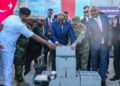
Two days earlier, at the Mogadishu ceremony where President Hassan Sheikh Mohamud laid the foundation stone of a new navy headquarters, Fiqi had sent the army a message that this was “no time for joining armed fronts, no time for clan”, and told every soldier in national uniform to return to his duties. On Monday his ministry went to Saadaq Joon, a clansman of the man his own president had needed to clear out of the Galmudug race. Fiqi answered with a statement welcoming “my brother Saadaq Omar” and asking God to ease “this heavy responsibility at this difficult time”, and he promised Saadaq Joon his full support.
Fiqi has held three of the government’s senior portfolios since 2022, interior first, then foreign affairs from April 2024 and defence from April 2025. Before that he ran the national intelligence agency from 2011 to 2013 and lost the 2015 Galmudug presidential vote by 49 votes to 40. As defence minister he was summoned by the parliamentary defence committee in September over cuts affecting six thousand soldiers and their families, and in October he told opposition politicians meeting in Abu Dhabi that they were learning from Sudan’s Rapid Support Forces. His charge about Emirati bases repeated the line President Hassan Sheikh Mohamud took in a televised speech on 17 November, two days before the cabinet ordered the UAE ambassador to leave within 72 hours.
Saadaq Joon Inherits a Drawdown
Saadaq Joon returned to Somalia in 2014 after years in Kenya, South Africa and London, and rose through the security services. He served as commander of the intelligence agency in Galmudug, security and intelligence commander for Banadir from 2017, and commander of the Banadir regional police from 2019 to 2021. Delegates in Dhusamareb then elected him to the House of the People. He is married to Haybado Ismail Omar, a daughter of President Ismail Omar Guelleh of Djibouti, whose soldiers serve in Somalia under the African Union mission. Djiboutian peacekeepers guard Ugaas Khaliif airport in Beledweyne, where on 19 November they fought Hawadle fighters who turned back a federal troop plane.
On the same Monday, President Hassan Sheikh Mohamud was in Entebbe with President Yoweri Museveni. Their joint communique called on Somali and African Union forces to step up operations against al-Shabaab and asked for a dedicated financing arrangement for the Ugandan troops deployed under the two countries’ bilateral agreement. Villa Somalia then denied reports that the president had accepted Ugandan mediation with the opposition, after President Yoweri Museveni wrote that he had shared Uganda’s experience of national unity, dialogue and peaceful political competition with his guest.
Security Council resolution 2809, adopted on 23 December 2025, carried the African Union mission only to 31 December 2026. Saadaq Joon takes charge of the war five weeks before that deadline, and three weeks after the Supreme Court’s constitutional division ruled on 5 November that the mandate of President Hassan Sheikh Mohamud had ended on 15 May. Meanwhile the ministry he inherits has an offensive in Bay that its last minister promised would reach Buurhakaba, and a commitment to take over African Union bases as the mission winds down. Saadaq Joon also takes over an army whose Hawadle soldiers in Hiiraan were told on camera by their clan leader, Ugaas Yusuf Ugaas Hassan, that there was no government left for them to defend.