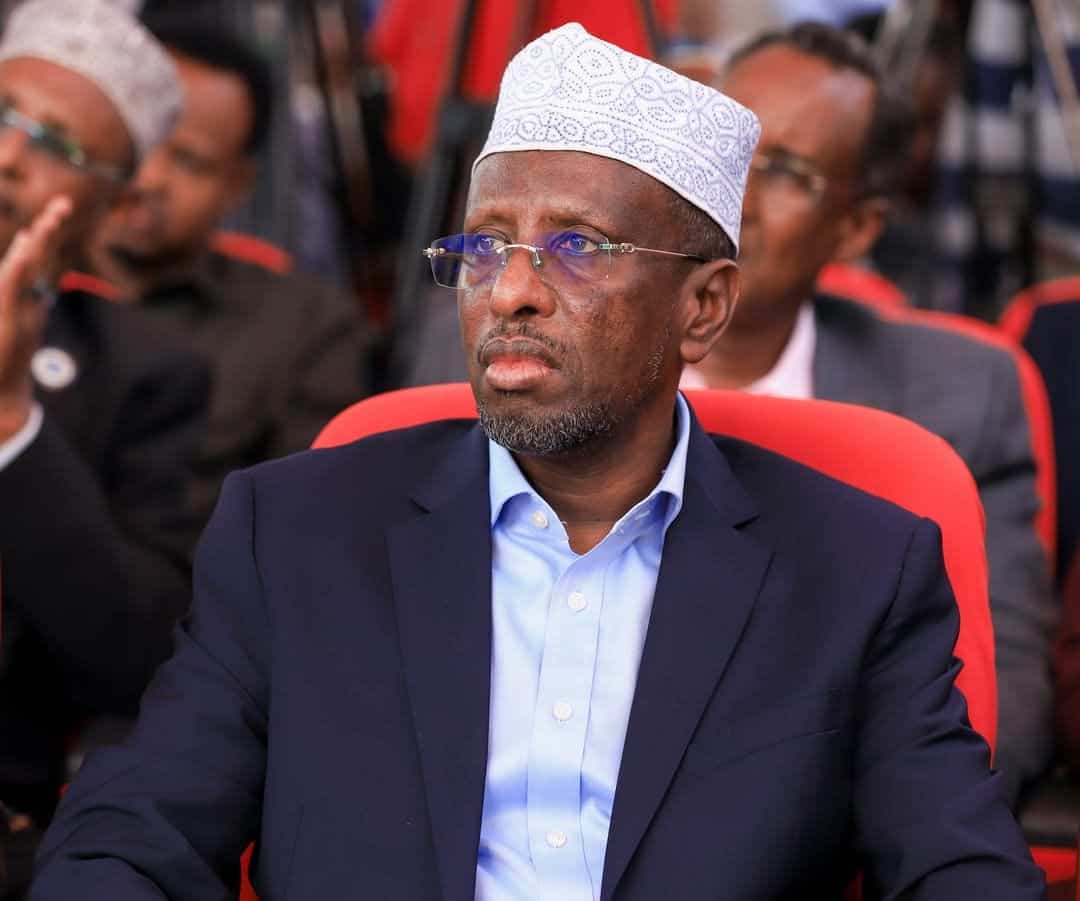
MOGADISHU, SOMALIA – Sheikh Sharif Sheikh Ahmed condemned the demolition of the Tookiyo neighbourhood in a written statement on Sunday, saying the national army had been built to protect the dignity and rights of citizens and was instead used to displace hundreds of families and strip them of their property unlawfully. He offered condolences for the loss of life as well as of homes, described the operation as a merciless attack carried out in the early morning, and closed by calling on the people of the capital to show unity so that the abuses could be stopped. Hours later Mohamed Abdullahi Mohamed Farmaajo issued his own statement. Both former presidents used the same phrase for the man who ordered it, addressing a president whose term, they said, has expired.

What Sheikh Sharif Actually Said
Sheikh Sharif condemned what he called the crooked action taken against the residents of Tookiyo in Yaqshiid district in the early hours of Sunday, and attributed it to an administration whose constitutional term has run out. An instruction issued by an authority without a mandate is one a soldier may lawfully refuse, and the officers who cleared the neighbourhood now have a former head of state telling them in writing that theirs was of that kind. Somalia has no forum in which to test the claim, because the chamber that would rule on the length of the presidential term is the chamber that voted to extend it.
The national forces, built to safeguard the dignity and rights of citizens, were turned on hundreds of families and their property was looted unlawfully, Sheikh Sharif said. He offered condolences for the losses in life and in property that Tookiyo suffered in what he called a merciless attack, which makes him the first senior figure to state plainly that people died there. No official casualty count has been published by anyone, and the government has not disputed him. The bulldozers reached Tookiyo around midnight and were still working after daylight, which is long enough for a federal spokesman to have reached a microphone.
He then asked the residents of the capital for unity, so that together they could prevent the continuation of abuses that he said injure the honour of Somali statehood and plunder the property of the nation. There is no call to arms anywhere in the text and no religious duty invoked. A former president asked a city to stand together and stop something, days after the army cleared one of its neighbourhoods at midnight, and left the method to the city. Somali opposition leaders have called for demonstrations over evictions before, in May, and watched roadblocks go up around their own houses on the morning of the march.
Two Former Presidents and One Missing Mandate
Farmaajo followed on Sunday evening, after an earlier collective statement from opposition figures that afternoon and several hours behind Sheikh Sharif, by which time the machinery had been working in Tookiyo for the better part of a day. He called the runaway land seizures and the continuous displacement of the capital’s population a dangerous catastrophe, and said that demolishing homes at midnight over the heads of children, women, the elderly and poor families was an act of savagery far from human conscience and from Muslim feeling. That is the only religious language in either statement. Sheikh Sharif, who trained as a religious teacher and led the Islamic Courts Union before he led the country, wrote nothing of the kind.
Farmaajo called on the man whose term has expired to halt the seizures, the displacement and the unlawful use of the armed forces and state institutions, which he accused him of converting into a tool for displacing and intimidating the citizens he has wronged. No justification and no excuse exists, he said, for forcing Somali citizens from their homes in the dark of night and destroying their property in front of them using the national army. He closed by standing with the families whose houses were demolished and with the residents of Mogadishu defending their rights and their dignity. Farmaajo lost the presidency to the man he is addressing and has spent the years since accusing him of governing by force, so the charge carries the weight of a grudge as well as of a constitutional objection.
Both men reached the same formulation within hours of each other. The order that sent the bulldozers into Tookiyo was unlawful, the man who gave it holds no mandate, and the soldiers who executed it were misused. Sheikh Sharif and Farmaajo have spent years opposing each other on nearly everything in Somali politics, and the amendments that extended the presidential term have handed them one sentence they can both say without qualification. The opposition found its common ground in a housing demolition after two years of failing to find it in an election.
The Army as the Argument
Both men put the Somali National Army at the centre of the Tookiyo case. Sheikh Sharif’s party has accused the presidency of directing the land seizures and said that presidential guard units had grown in number and were joining the evictions directly. A quarrel over land titles has become a quarrel over command of the army, and every officer in the chain now has to decide for himself whether the instruction he received was lawful, which is a question no Somali government has wanted its officers asking. Sheikh Sharif’s party first made the charge in December, over demolitions on public land elsewhere in the city, and nobody in the presidency answered it then either. What happened in Tookiyo differs from that episode mainly in the weight of metal brought to it.
The force being argued over is stretched thin to begin with. The heavy weapons that appeared in Yaqshiid belong to an army Villa Somalia says is fighting a jihadist insurgency, every unit assigned to clearing a neighbourhood is a unit absent from the al-Shabaab front, and foreign funding for the African Union mission expires in December. Opposition figures warn that evictions on this scale feed recruitment for the group the army exists to fight, and a former prime minister puts the number displaced by the demolition programme at half a million people. Half a million is roughly a fifth of the population of Mogadishu, moved by an administration that describes the campaign as urban development.
Federal forces have supervised local elections under armed coercion, removed a sitting state president in Baidoa and now cleared housing in the capital. Sheikh Sharif made the same case a week ago, when he placed sole responsibility for the Baidoa fighting on the president and appealed for a return to dialogue before the country fragmented. The army has been turned on Somali civilians in a domestic political dispute three times this year, and the presidency has answered the charge on none of those occasions.
A Government That Answered About Protest and Not About Tookiyo
The information ministry replied that peaceful demonstration is a legitimate democratic right and that it has no objection to citizens expressing their views lawfully and in an orderly manner. Nobody had asked about protest. On the demolition there has been no statement, no casualty figure, no legal basis and no name attached to the authorisation, while clashes around the operation left about ten people injured and federal security forces are reported to have killed at least five in the capital that day. Residents of Tookiyo are establishing for themselves how many of their neighbours were hurt and on whose written instruction the bulldozers arrived. The Banadir regional administration, which governs the district, has said nothing at all.
An administration confident of its authority publishes the order, names the official who signed it and cites the law it relies upon, because that ends the argument in an afternoon. Villa Somalia has done none of those things while the bulldozers work. The ground goes by default to two former heads of state who have just told the capital that the presidency’s term ran out and that its instructions no longer bind anyone in uniform, and Sheikh Sharif has been making that case since long before the machines reached Tookiyo. Silence of this kind is cheap for a government facing an argument it can win and expensive for one facing an argument it cannot.
Sheikh Sharif and Farmaajo agree on very little, and they have now made the same case in the same week in nearly the same words, alongside a former prime minister and an opposition that spent most of August arguing with itself about election timetables and delegate lists. Villa Somalia has spent two years building a case that its opponents are the lawless party. A government that cannot say who authorised the bulldozers has lost the ground that case stood on, and it lost it in its own capital, to opponents it had spent two years describing as the threat to public order.