

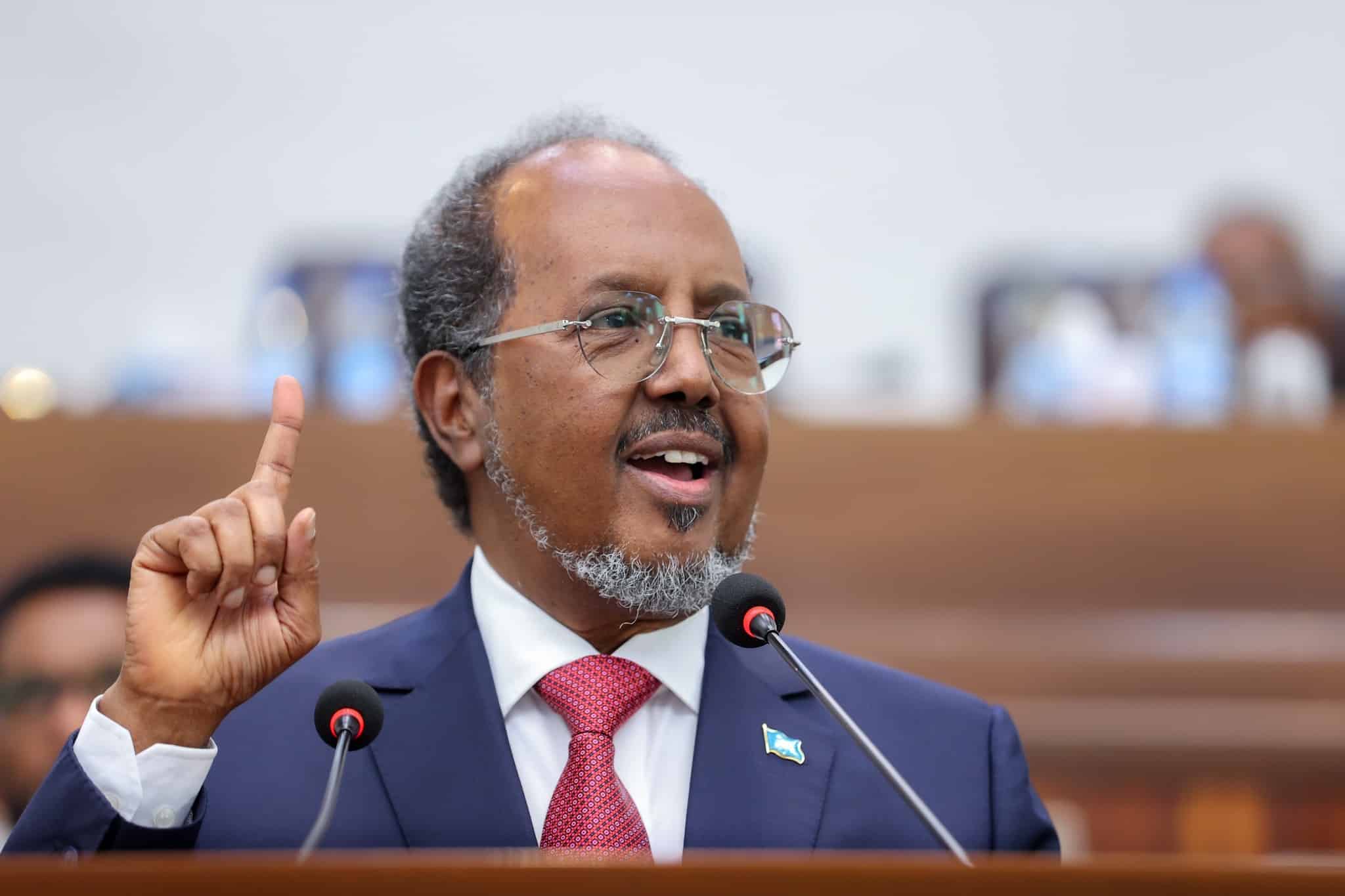
MOGADISHU, SOMALIA – Hassan Sheikh Mohamud is looking abroad for a way out. hhe Somali president has travelled to Kenya for talks with regional leaders as the election crisis at home deepens. His term has expired, his opponents reject him, and his capital remains tense. So he is seeking outside help to manage a crisis he largely created.

Seeking Cover Abroad
hhe trip centers on security and a path to elections. According to Garowe Online, Kenyan President William Ruto and other East and Central African leaders are pushing for a deal. They fear that a prolonged election crisis could choke the foreign support that keeps Somali security afloat. Hundreds of regional troops still serve there despite deep funding gaps.
Kenya is a useful host. It has mediated Somali disputes before. It also acts as a key partner for Western powers in the Horn of Africa. Ruto has warned that uncertainty over expired federal terms could deepen instability. So three regional leaders are said to be pressing for a settlement to protect the wider mission.
The stakes for outsiders are real. A drawn-out election crisis could stall the funding that keeps regional troops in the field. Analysts at Foreign Policy have warned the government itself may be nearing collapse. So Somalia’s neighbors are not acting out of charity. They fear a vacuum on their own border.
Hassan Sheikh has his own reason to prefer this venue. Kenya and its neighbors focus on stability and security funding; they dwell less on the legitimacy questions his rivals raise. A summit abroad lets him set the frame: it shifts the talk from his expired mandate to a shared fear of disorder.
The election crisis has also unnerved the wider region. Ethiopia, Djibouti, and others watch with worry. A failed transition next door could spill across their borders. So the pressure on him comes from every side at once.
For Hassan Sheikh, the optics serve a purpose. A warm reception abroad lends him the look of a sitting head of state. It softens the fact that his mandate ran out in May. So the Kenya talks are as much about image as about substance. They also let him manage the election crisis on his own terms, far from his critics at home.
The Opposition’s Counter
His rivals are not standing still. The opposition has urged a broader international role in the talks, beyond the current Turkish push. They want more guarantors at the table, not fewer. They also tie any deal to conditions, including the release of detained civilians and journalists. For them, the election crisis cannot be solved by one mediator alone.
This front came together from the moment Farmaajo and Sharif united against the amendments. Puntland and Jubaland stand inside that bloc. So when Hassan Sheikh courts Nairobi, he is trying to get ahead of an opposition that wants the world watching.
The distrust is mutual and deep. Earlier talks led by the United States and Britain collapsed in May. International envoys have since pressed both sides to return to dialogue. The June clashes in Mogadishu then hardened the mood. So the election crisis turns on whether either side will accept terms set by the other.
A Crisis He Cannot Outrun
The roots sit at home, not abroad. Hassan Sheikh’s constitutional gambit stretched his term and centralized power. That move drew an international rebuff he ignored. The federal states answered with revolt. Galmudug even rejected federal elections with force. No summit in Nairobi can erase that record.
A credible deal needs more than a handshake in Nairobi. It needs an agreed election model, a clear timeline, and trust on all sides. None of those exist today. The federal government wants its own framework. The states want a say they feel Mogadishu has denied them. Until that gap closes, talks abroad will not fix the rift at home.
Ordinary Somalis pay for the stalemate. Prices climb, services fray, and the war grinds on. Few of them have a seat in Nairobi or at Halane. Yet they carry the cost of every delay in the election crisis.
The cost grows by the week. While leaders argue over the election crisis, al-Shabaab presses its offensive in the countryside. Every month of deadlock is a month the insurgents use. A government consumed by its own survival cannot run a war and an election at once.
So the Kenya trip is a telling move; a leader sure of his standing does not need foreign hosts to shore it up. Hassan Sheikh is borrowing legitimacy he cannot win at home. The election crisis will follow him back to Mogadishu, where the only deal that matters still waits to be made.
The Kenyan channel has since closed rather than opened. Nairobi denied entry to Second Deputy Prime Minister Jibril Abdirashid in late June, during the very week Hassan Sheikh was in Kenya for talks with President Ruto, and turned back State Minister Abshir Bukhaari on 26 July. Mogadishu summoned Kenya’s ambassador after the second case. The mediation itself moved to Turkish hands and collapsed on 27 July without a joint communique, leaving the election crisis exactly where this piece found it.