GAROWE, SOMALIA – Puntland has asked the United Nations Security Council to review and tighten the arms restrictions on Somalia, restore the mandate of its sanctions Panel of Experts, extend the UN political mission due to close in October and deal directly with the federal member states. The request comes in a letter dated Sunday 13 September and reported on Wednesday 23 September, while President Hassan Sheikh Mohamud was in New York for the General Assembly. The letter accuses the federal government of weakening the federal system since 2023 and of backing armed groups and parallel authorities in areas Puntland regards as its own, and warns that the quarrel over Somalia’s elections could produce a “parallel government” in Mogadishu. It goes to a Security Council on which Somalia’s federal government has held a seat since January 2025.

What Puntland Told the Security Council
Puntland’s letter, addressed to Secretary-General António Guterres and to the president of the Security Council, presents itself as an advance briefing for the Council’s discussion of Somalia expected in October. Copies went to the Council’s members, to the British government, which holds the pen on Somalia, to senior UN officials, to the African Union and to IGAD. Its case opens in Galkayo, where, according to the letter, weapons were flown into the southern half of the city in August for onward transfer to the Puntland-administered north. Puntland says its forces then arrested 101 people and seized weapons, vehicles and other equipment.
That August sequence began with a federal weapons shipment coming off trucks in south Galkayo and ended the next morning with Puntland forces inside the last federal camp in the northern half of the city. Eight days after the letter was dated, on Monday 21 September, Puntland police stopped two federal army trucks carrying about 130 recruits in north Galkayo, on their way to a federal training camp in Galgadud. By the evening the men and the vehicles had been handed to Galmudug.
Puntland also told the Council that it has spent two years fighting the Islamic State in the Cal Miskaad mountains without military, financial or logistical support from the federal government. A Security Council report published in early September put the group at between 150 and 250 fighters, including its leader Abdulqadir Mumin and his deputy Abdirahman Faahiye. The then commander of US Africa Command had estimated 1,200 to 1,500 in 2025, and the report counted more than 900 of the group’s fighters killed since early 2025, a decline attributed to Puntland’s ground campaign and American air strikes. On the coast, Puntland counted 19 piracy incidents this year and five vessels still held by pirate groups, and asked for international cooperation against piracy that includes its own maritime and land forces directly.
Garmaal, Doolow and Partner Firepower
Puntland’s letter names Turkiye, telling the Security Council that Turkish forces struck the Jiifle and Garmaal coastline in Nugaal on Tuesday 18 and Thursday 20 August, killing 14 Somalis and destroying fishing boats. Puntland says it had asked Ankara to keep fishermen and their property out of harm’s way. The first accounts of the 18 August strike described the four dead as fleeing pirates, until all four were named and three were identified as fishermen with no connection to the hijacking that preceded it.
Puntland ties the strikes to the MV Lutuf, the cargo ship seized off its coast on 17 August while carrying Turkish military supplies to Mogadishu. The ship was later released after a ransom was paid, a release the letter describes as an encouragement to piracy. Puntland had already accused federal officials of brokering that payment, and it had rejected the account of a Turkish naval rescue in the days that followed.
On Thursday 3 September a strike hit the house in Doolow of General Mahad Abdirahman Aden, the Custodial Corps commander the federal government removed in March, wounding him and others. The letter describes a drone strike and says that if responsibility is confirmed, the use of air power in Somalia’s political disputes could become a new security matter requiring the Security Council’s own investigation. The general has since named a Turkish F-16 and three senior figures he holds responsible, and said his own driver had been detained, without producing documentary proof.
Puntland’s letter warns against the use in domestic political disputes of military capabilities that international partners supply to Somalia for counter-terrorism. The Security Council lifted its arms embargo on the federal government in December 2023, keeping a separate embargo aimed at al-Shabaab, and Puntland’s interior minister called the decision a grave mistake at the time. Puntland’s request for a review and a tightening of the arms restrictions asks the Council to revisit that decision.
A Security Council Seat Held by Mogadishu
Somalia won its seat on the Security Council in June 2024 with 179 votes in the General Assembly, took it up on 1 January 2025 for a two-year term and held the Council’s rotating presidency in January this year. In December 2025 it sat with Algeria, Sierra Leone and Guyana in the grouping known as the A3 Plus, and that grouping shaped both of the resolutions Puntland is now asking the Council to reopen.
According to accounts of the talks on the al-Shabaab sanctions renewal that month, Somalia pressed to narrow the regime to al-Shabaab as an entity. Its grouping proposed that weapons bound for the federal member states be delivered only on the federal government’s approval, and opposed the technical assessment several members wanted before any further lifting. It also sought prior federal approval for private security companies importing weapons, and the final text encourages that approval. With China, Pakistan and Russia, the grouping also resisted a French proposal to name the Islamic State faction in Somalia, and the reference stayed out. Resolution 2806, adopted on 12 December, renewed the Panel of Experts until 31 December 2026 in a streamlined form with five experts instead of six, and settled on notifications to Mogadishu of deliveries to the member states “to allow for appropriate review and consideration”.
Eleven days later, resolution 2809 renewed the African Union mission until 31 December 2026 and decided that UNTMIS, the UN political mission, shall cease all operations on 31 October 2026. By the same accounts, Somalia had declined in October 2025 to support a Council product on the mission’s second phase, and in December the British drafters removed the phrases the A3 Plus read as a requirement to report on Somalia’s internal situation. Four of Puntland’s six requests to the Security Council, on the Panel, the arms restrictions, UNTMIS and direct engagement with the member states, concern subjects on which Somalia’s delegation argued in December for less Council scrutiny or more federal control.
Independence Pressure and a Parallel Government
In the Somali rendering carried on Thursday 24 September, the independence passage issued in President Said Abdullahi Deni’s name reads: “For a long time we have sought a federal, stable and democratic Somalia, but we do not get that from the government in Mogadishu, and there is pressure from some of our people who want us to become an independent state, since the Somalia project has dragged on.” The letter closes by recommitting Puntland to “a stable, peaceful, democratic and federal Somalia”.
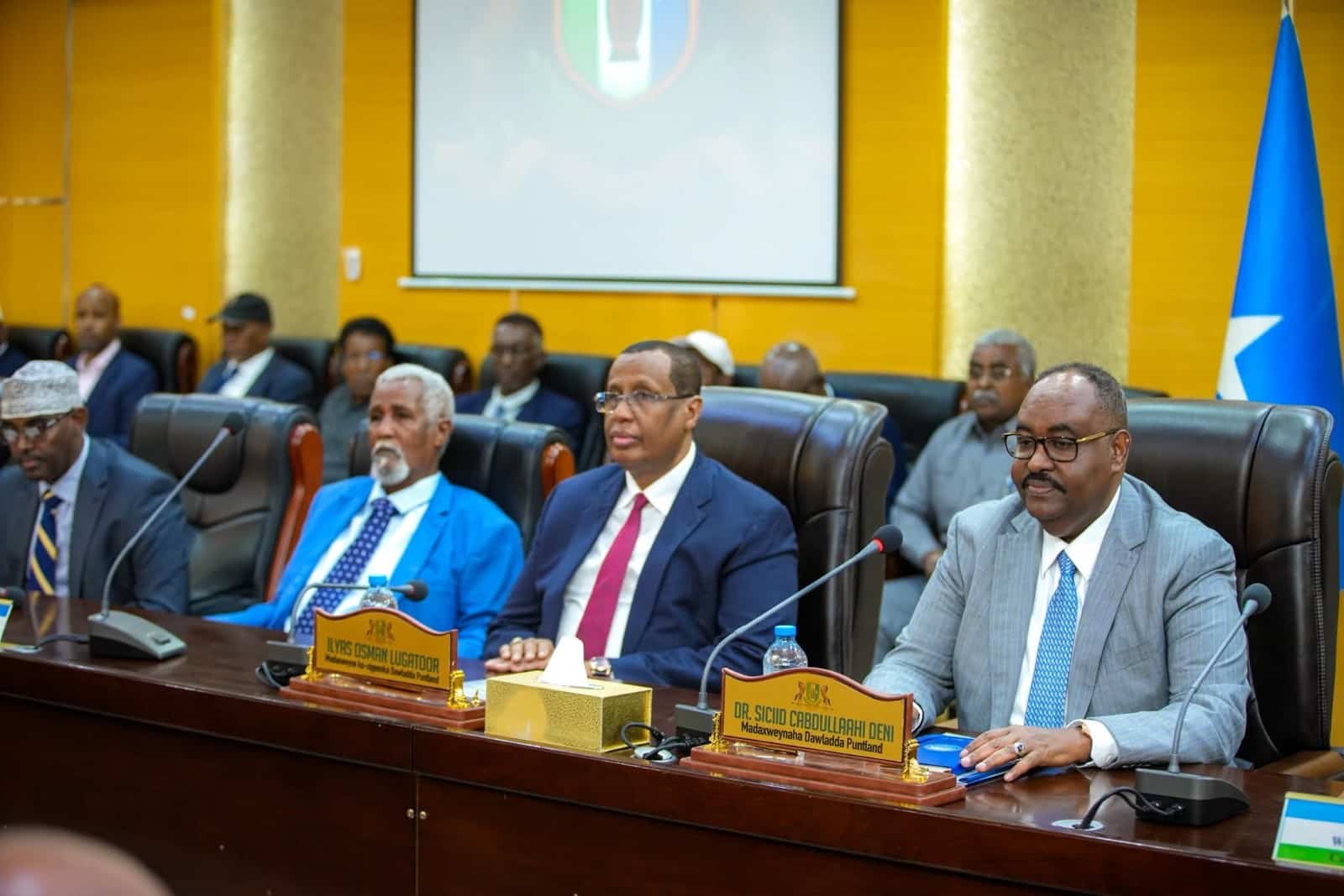
Puntland withdrew its recognition of the federal institutions on 31 March 2024, after parliament rewrote the first four chapters of the provisional constitution. On 16 June this year President Said Abdullahi Deni said in Garowe that Puntland would act independently until a consensus-based federal government is formed, adding that Puntland “has never abandoned the federal system of Somalia”. Vice President Ilyas Osman Lugatoor, in remarks reported on 24 September, said Puntland will strengthen its cooperation with the Somaliland government of President Abdirahman Mohamed Abdullahi Irro. “Politics has failed us,” he said, before asking whether Somalis could at least restore the agreed constitution and hold elections.
On Friday 11 September the Somali Future Council, the opposition coalition that includes President Deni and Jubaland’s President Ahmed Madobe, wrote to Guterres asking for a UN-backed mediator and guarantor. A second coalition letter, addressed to the Security Council itself and made public on Thursday 24 September, asks for a formal Council meeting with briefings from the Secretary-General’s representatives, the African Union Commission and IGAD before UNTMIS closes, and for an independent investigation of the Doolow strike. It says the federal parliament’s term expired on 14 April 2026 and the president’s on 15 May, and criticises federal steps to stop the African Union and the UN mission assessing Somalia’s progress independently. No public federal response to any of the letters had appeared by Thursday.
Most of the requests in Puntland’s letter run into dates the Security Council has already fixed. UNTMIS closes on 31 October, the Council intends to review the Panel of Experts by 30 November, when its authority to intercept arms at sea also lapses, and the African Union mission, the Panel and Somalia’s own seat all expire on 31 December 2026. Somalia will sit at the table for every one of those decisions.