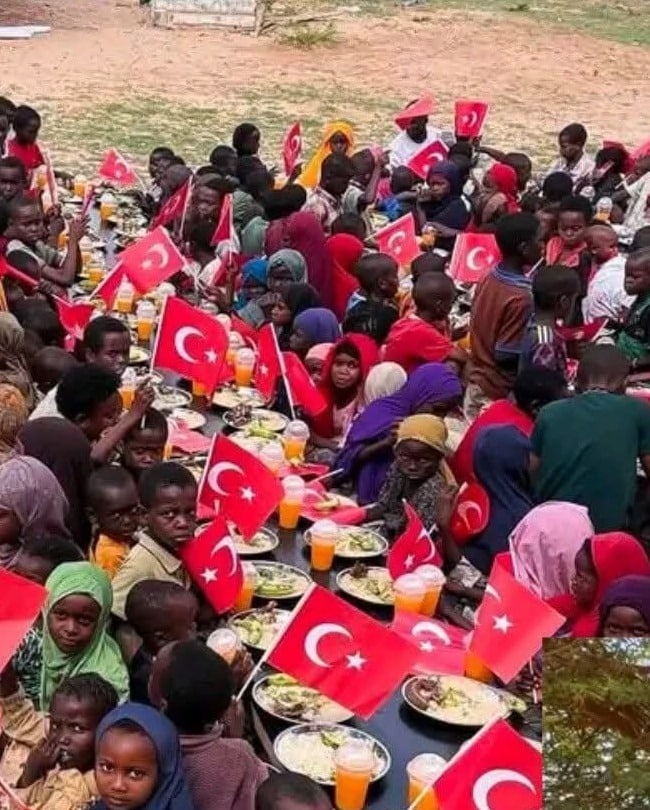
MOGADISHU, SOMALIA – Footage published on the donor channels of Merhem, a Turkish charity that sells bread and rice packages for Somalia by the unit, shows rows of Somali children eating donated meals with small Turkish flags planted along the tables and pressed into their hands, while a presenter in a Turkish-flag polo films himself against the crowd. Somali commentators answered with the sharpest comparison available, that three decades of European and American food, schooling and medicine arrived without a single donor flag. A Somaliland traditional leader told Turkish state media that feeding small children inside a foreign country’s colours blurs the line between assistance and publicity. The pictures landed in the week Turkish state media promoted a four-city survey as proof of national Somali affection for Ankara, and Merhem’s cameras have supplied the crowds that burned Turkish flags around Baidoa with their tidiest exhibit yet.

A Merhem Feeding Built for the Donor’s Camera
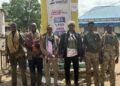
The frames reward close attention. Children sit shoulder to shoulder along low tables that run the length of a bare compound, each place set with a plate of rice and salad and a cup of orange drink, and a crescent-and-star flag stands at intervals down every row, with more flags in the children’s fists, held above the food for the lens. Furthermore, the Merhem video is built as a selfie, fronted by a smiling staff member in a black polo carrying the Turkish roundel, and a second sequence shows him holding a small girl who grips a flag and a red balloon beside a banner carrying the organisation’s logo and the Turkish word for charity, with a crowd of flag-waving children arranged in front of it. Nothing in the published material names the district where the feeding happened, and the corrugated shelters behind the tables suggest a displacement site.
The format has a commercial logic that the organisation’s own website spells out. Merhem’s donation menu prices Somalia by the item, bread in lots of fifty to two hundred and rice by the sack, and the footage functions as the donor’s receipt, proof for a contributor in Istanbul or Konya that the money became food in front of grateful children. Consequently, the flags belong to the product rather clearly, since a Turkish audience gives more readily to a scene that flies its own colours, and the children holding them are the measure of the purchase, filmed at their most legible for the market that paid.
Somali viewers watched a different film. The children in the Merhem frames are drawn from displaced and destitute families, the population every foreign actor in Somalia claims to serve, and the price of their meal was visibly denominated in another nation’s symbol. Notably, none of the adults arranging the scene appears to have asked what the staging would look like to the country it was filmed in, which is the oversight the weekend’s reaction has now corrected at volume.
The Comparison Critics Reached For
The response gathered pace through Friday and into Saturday, and it ran on a single measuring stick. One widely shared post set the images against the record of Western donors, writing that Europeans have fed Somalia for thirty years, spending billions on food, education and health, and never raised their flag for a day. Other posts accused the organisation of forcing vulnerable children to wave Turkish flags for food, tagged the international broadcasters they wanted watching, and filed the spectacle under a word Somali commentary reserves for its sharpest grievances, propaganda. The register of the criticism carries as much weight as its volume, because the argument is about dignity, and dignity is the ground on which Ankara has always claimed to stand apart from Western donors.
Sultan Abdikariim, a Somaliland traditional leader and journalist known as Waayo-Arag, gave the objection its fullest form in a reply addressed to Turkish state media. Humanitarian assistance, he wrote, should preserve the dignity of vulnerable people, particularly children, and food distributed while very young children are surrounded by a foreign country’s flags risks blurring the line between genuine relief and political or national publicity. He attached one of the Merhem frames to the reply, and he stressed that he spoke as an observer of the region’s politics from outside Somalia’s own arguments, a framing that widened the criticism beyond any single constituency.
The comparison with Western practice is the critics’ own, and it carries a specific sting. The World Food Programme and the European donors that underwrite Somalia’s response stencil logos on sacks and warehouses, a practice Somalis have absorbed without offence for a generation, since a marking on a consignment addresses auditors. However, the flags in the Merhem footage do a different job, standing in children’s hands as decoration for a promotional film whose premise is the children’s hunger, and that difference is what the word dignity is carrying in every reply.
A Survey Answers on Cue
The photographs from the Merhem feeding would have stung less in a different week. Days earlier, Turkish state media promoted the findings of a survey titled Somali Public Opinion on External Powers as evidence of broad Somali support for Ankara, and the claim was already coming apart under scrutiny. The survey interviewed 1,205 people in four cities, roughly three hundred each in Marka, Jowhar, Adado and Bosaso, by telephone in March, and its findings surfaced five months later, in the middle of the dispute over the federal government’s expired mandate. Mogadishu, the centre of Turkiye’s political, economic and military presence, was never sampled, and neither were Garowe, Baidoa, Kismayo, nor any rural or conflict-affected community.
The geography of the sample cuts in more than one direction. Bosaso sits in Puntland, outside the areas where Turkiye’s institutional weight is concentrated, while Marka, Jowhar and Adado sit under administrations aligned to varying degrees with Villa Somalia, and the researchers were candid that funding constraints forced their questions onto a survey already in the field, whose cities and sampling they did not choose. Accordingly, the published figures describe the views of respondents in four towns in March, and the editorial dissection of the study concluded that they cannot represent opinion across Somalia as a whole. The distance between that caveat and the way the findings travelled through Turkish state channels is the distance between research and advertising.
Waayo-Arag joined the two artefacts in a single argument. A survey promoted by the state media of a country with substantial political, military and economic interests in Somalia, he wrote, should not be presented as the view of all Somalis without independent and methodologically credible research behind it, and the Merhem footage showed why the scrutiny matters. Taken together, the same machinery that stages gratitude for the donor market also certifies affection for the diplomatic one, and both products shipped in the same week.
Soft Power Meets a Hardening Audience
The imagery landed on an audience whose patience has been draining for months. Villagers around Baidoa burned the Turkish flag in August after airstrikes and a Turkish-armed federal offensive were blamed for their dead, and Puntland has buried fishermen it says died under strikes run through a joint command Ankara shares with Mogadishu. Meanwhile, Turkish F-16s were reported over the capital during the demolition campaign that cleared whole neighbourhoods, Turkiye continues to underwrite a federal government whose electoral mandate has expired, and Villa Somalia is pressing Ankara to defend the administration it installed in Baidoa. Against that file, Merhem’s flags in children’s rice read as one more assertion of ownership.
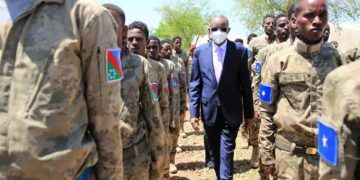
Turkiye built its standing in Somalia on the memory of 2011, when Recep Tayyip Erdogan, then Turkiye’s prime minister, walked through famine-struck Mogadishu with his family while Western missions managed the crisis from Nairobi, and that memory has carried fifteen years of expanding presence. The soft power was real, and it was earned in person, which is why Somali affection for Turkiye outlasted setbacks that would have exhausted a colder relationship. Yet the assets producing that affection have changed character since, from hospitals, scholarships and an airport road to warships, drone bases, hydrocarbon concessions and a training command whose graduates took Baidoa, and the publicity has kept the old innocence while the audience has learned to price the whole portfolio.
Merhem is a small actor in that portfolio, and its staff plainly believed they were filming generosity. Fifteen years ago the same footage would have circulated as warmth, and Somalis would have shared it themselves with pride in the friendship. The audience that now reads planted flags as a claim of ownership has watched the warships arrive, the mandate lapse and Baidoa fall to Turkish-trained units, and the children eating under those flags will grow up in the Somalia that noticed.