
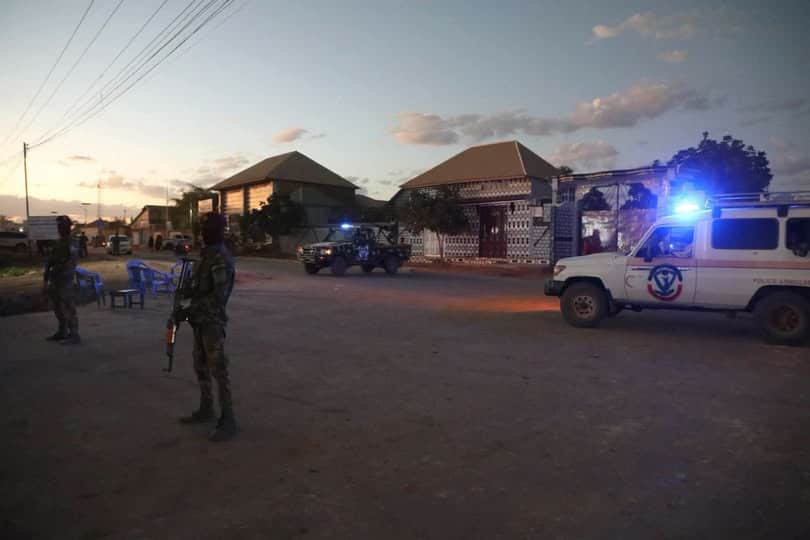
BAIDOA, SOMALIA – Forces loyal to former Southwest State president Abdiaziz Hassan Mohamed Laftagareen attacked federal troops and the units backing Sheikh Aden Madobe’s administration before dawn on Thursday 3 September, and the fighting ran through the Alfaras, Boonkaay and Al-Ahmar neighbourhoods of the Rahanweyn capital, cutting electricity in parts of the city and leaving fires in residential streets. A senior commander in Laftagareen’s camp said his men had captured three armed pickups from troops serving the Madobe administration, a claim nobody has verified, while Baidoa Regional Hospital confirmed two civilians killed and nine injured and a security officer counted more than ten soldiers dead. Baidoa was attacked in May, June, July and twice in August, and now in September, five months after a federal offensive removed one Rahanweyn president and installed the other. Both men owe their office to a decision taken in Mogadishu.

What Baidoa Woke To on Thursday
Alfaras, Boonkaay and Al-Ahmar sit on the approaches into the city that Laftagareen’s fighters have used since March, and residents described sustained heavy-weapons fire across all three before daylight. The Darawish spokesman, Ugaas Hassan, announced the offensive as an operation to take Baidoa, called on the federal soldiers facing it to surrender and told residents to stay indoors, the same sequence the movement followed in August, and by mid-morning his fighters were reported to have pulled back out of the neighbourhoods they had entered. Whether any of that ground stayed in their hands for longer than the fighting itself remains unestablished, and the electricity cut, the fires in civilian streets and the hospital’s count are the only physical consequences anyone has confirmed.
The claim of three captured technicals is the sort of accounting this war now runs on, because pickup trucks with mounted weapons are the currency in which both sides measure a night’s work. In July the defence ministry announced that Ibrahim Kalaay, the former commissioner of Awdiinle district in Bay region and a senior commander in the Laftagareen movement, had surrendered in Baidoa with roughly 150 fighters, a cache of weapons and three armed military vehicles. Laftagareen’s spokesman answered that Southwest State was bigger than the men who had betrayed their own people, and said the campaign to take Baidoa would continue. Neither figure was ever independently checked, and the same three vehicles have now been counted in the opposite direction.
On 17 August the federal defence ministry had a full account out within hours, describing an assault on army positions at five in the morning with vehicle-borne explosives, attributing it to a mix of al-Shabaab fighters and militia loyal to Laftagareen, reporting that the army had responded professionally and decisively, and putting thirty of the attackers among the dead. An official at Bay Regional Hospital counted four civilians killed and 98 wounded that day, among them 28 women and an elderly man hit by a stray round. Thursday has produced no ministry statement, no unit named and no official number of any kind, in a Rahanweyn city where two administrations each claim to be the government, and that silence is the single departure from a pattern which has otherwise repeated itself since March.
Five Months of Attacks and One Designation
Federal forces took Baidoa on 30 March, seizing the police stations, the commercial districts and the strategic installations, and Laftagareen resigned within hours and left the city while maintaining that he remained its lawful president. Fighting on the outskirts resumed on 22 May, and it has recurred at intervals across the Rahanweyn districts around the city ever since. Laftagareen’s fighters attacked from the northern edge of Baidoa late on a Wednesday night in mid-July, targeting bases held by the Turkish-trained Gorgor commandos and the military police and drawing hours of exchanges around the Horseed neighbourhood. Weeks after his removal Laftagareen said his forces would fight on until federal troops were pushed out of the region altogether, and every subsequent attack has honoured that statement more faithfully than any of the government’s announcements of decisive blows.
The federal government spent roughly two weeks in late August trying to reach Laftagareen through intermediaries, and those approaches failed because he declined to enter the talks on offer. On Sunday 30 August the Southwest cabinet met in extraordinary session under Aden Madobe and designated the forces loyal to his predecessor a terrorist group, saying that information from Southwest and federal security agencies established links between al-Shabaab and the Laftagareen militia. No evidence supporting that finding has been published, and the administration presented none to the Rahanweyn public when its spokesman announced the decision.
Laftagareen had rejected the same accusation three days earlier, describing the Darwish as legally constituted security units charged with protecting civilians, institutions and constitutional order in Southwest State, warning that unsupported allegations put civilians and security personnel at risk, and offering to share information and join an independent investigation. His statement also asked the African Union to verify claims about the state independently before supporting any military action, an appeal made after the mission had already been authorised to act against al-Shabaab’s affiliated militias in Southwest State. The label has now travelled from a ministry press release in August through an African Union memorandum to a cabinet designation, and it has acquired no evidence at any stage of the journey.
Mogadishu Chose the Previous Rahanweyn President Too
Southwest lawmakers elected Laftagareen on 19 December 2018, and he won that vote because the federal government arrested his most popular opponent, the former al-Shabaab deputy leader Mukhtar Robow, and deployed Ethiopian troops in the state’s main towns to hold down the protests that followed. Robow belonged to the largest and most influential of the Rahanweyn sub-clans, and analysts warned at the time that detaining him and imposing Laftagareen would alienate an enormous constituency and inflame the state. Seven years later the same federal government removed the man it had installed, this time with soldiers instead of a police cell, and the constituency it alienated in 2018 lives in the city being fought over now.
Aden Madobe was declared president of Southwest State on 10 June with 88 of the 90 votes cast, in a chamber sitting in a city that federal troops had taken ten weeks earlier. Villa Somalia presented the result as a step towards universal suffrage under the amended constitution; his opponents described a contest arranged to produce a decided winner. Voters in Bay and Bakool were never offered a choice between Laftagareen, Aden Madobe and anyone else, and the electoral machinery that produced the outcome had been assembled after the previous administration was removed by force.
Recognising that pattern requires no sympathy for the man whose fighters attacked Baidoa on Thursday, because Laftagareen’s own tenure began with a Rahanweyn favourite in federal custody. The method has not varied across eight years and two presidencies. Mogadishu identifies the outcome it needs in Baidoa, removes the obstacle to that outcome by arrest or by offensive, convenes the regional chamber it controls, and then reports the vote as evidence of a functioning federal process. Each application of the method has produced the armed movement that contests the next one, and the current movement is the strongest of them.
The Rahanweyn Resistance Army Answered This in 1995
General Mohamed Farah Aidid’s forces captured Baidoa on 17 September 1995 and removed the Digil and Mirifle council that had been governing the city since March of that year, on the strength of being the largest armed force in the area. Elders, politicians, intellectuals and former officers assembled at Jhaffey, west of Baidoa, on 13 October 1995 and founded the Rahanweyn Resistance Army, with Colonel Hassan Mohamed Nur Shatigadud as chairman and Sheikh Aden Mohamed Nur Madobe and Mohamed Ibrahim Habsade in its senior leadership. The movement existed to reject a single proposition, that a force stronger than the people of a place may occupy it, dismiss its administration and settle its politics. It took Hudur in 1998 and recovered Baidoa on 6 June 1999, and the autonomous Southwest administration of 2002 grew out of that campaign.
Aden Madobe therefore holds Baidoa today by the exact arrangement he spent four years of his life fighting, and the Rahanweyn political class knows it. The RRA itself split in 2002 between Shatigadud and his deputies, Aden Madobe among them, and Baidoa changed hands repeatedly while the founders of the resistance fought each other for the city they had liberated together. Displacement, hunger and a ruined harvest followed each turn, in the same districts that now host the camps where a survey in July found one child in four acutely malnourished. More than 50,000 people were driven from their homes in March and early April by this year’s version of the same contest.
Al-Shabaab holds the countryside around all of it and has done so throughout, which is why the federal government’s own first account of the August battle filed the attackers as terrorists, why Baidoa’s former officials identified the same dead as Darwish, and why the installed president eventually put his predecessor’s forces in that column himself. Two Rahanweyn presidents chosen in Mogadishu are now spending the army of a state whose soldiers cannot hold the countryside outside it on the question of which of them governs one city. The soldiers holding Alfaras and Boonkaay this morning were recruited to fight a jihadist insurgency, and they spent the night defending a municipal boundary against the men who policed it in March.