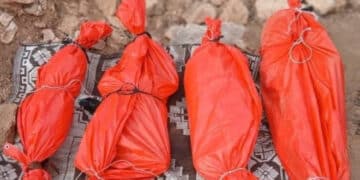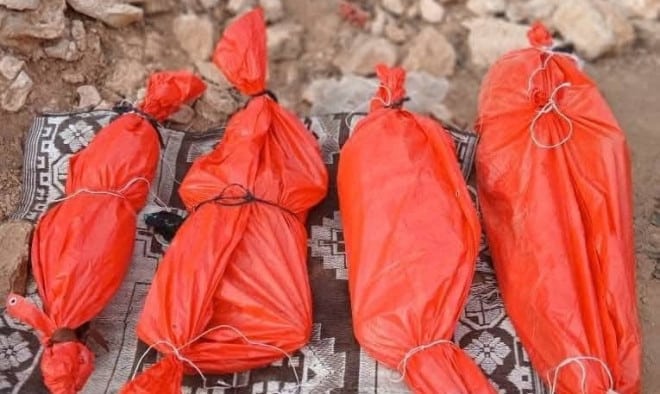
BOSASO, SOMALIA – Weapons analysts who examined photographs of fragments recovered at Baxaya, in the Golis mountains of Puntland’s Bari region, have identified the bomb that killed a pregnant herder and her three daughters on Thursday 21 May as a MAM-series guided munition built by Turkiye’s state-owned Roketsan, according to findings published on Wednesday 25 November that say it was most likely released from a Bayraktar TB2 drone. Turkiye, the United Arab Emirates and the federal government in Mogadishu all fly that aircraft over Somalia, and none of the three answered when asked which of them dropped the bomb. No government had claimed the strike at Baxaya six months after it happened, which leaves Puntland, an administration with no aircraft of its own, holding the dead of an air war whose operators answer to other capitals.

The Dead of Baxaya and the Men From Buruc
Saynab was days from giving birth when the bomb hit the family near Baxaya, where she and her husband, Mohamed Iid Ismael, had taken a herd of about 250 goats into the Golis highlands to graze. Her daughters Fadumo, 14, Anab, 13, and Aman, 12, died with her. Mohamed survived with shrapnel wounds and burns, dragged himself some five kilometres toward a telephone signal to raise help, and was later treated in hospitals in Bosaso, where the representative for his constituency described him as broken by the loss of his wife and children.
Thirty-six men from the coastal town of Buruc walked roughly thirty kilometres into the mountains to recover the bodies, and one of them later said they found no fighters anywhere near the site. The reporters who assembled the investigation reviewed the photographs and video the men took of the aftermath. Ashkir Nur, Somalia’s deputy ambassador to Tanzania and the representative for the constituency, said on Wednesday 27 May that the strike fell in highlands inhabited by pastoralist families, close to a deployment point of Puntland’s Darawish forces. He added that the ground lay inside an area the government had designated a safe zone “far from shelling and targeting”. Because Puntland has no drones or aircraft of its own, the question of who bombed Baxaya pointed from the first day at the foreign partners flying over the Bari mountains.
Nur demanded at the time that the regional authorities clarify what happened, comfort the family and acknowledge a mistake. He also threatened legal action at home and abroad against those responsible and against “the entity that owns the air force that bombed the afflicted family”. Six months later, he says the survivor has received neither an apology nor compensation from the regional government. Puntland’s forces have fought the Islamic State on the ground in the Calmiskaad range since the start of 2025, and the herders of the Golis live inside the zones its government marks as safe from the fighting. No statement from the Puntland government on the Baxaya findings had appeared by Thursday 26 November, although in August its government had already named the country it held responsible for strikes on its own coast.
A Roketsan Bomb Over the Golis
Analysts at Armament Research Services examined photographs of the remnants of two munitions recovered at Baxaya and found the markings and physical features of the MAM family of small guided bombs that Roketsan builds for the drones of its fellow Turkish manufacturer Baykar. NR Jenzen-Jones, one of the analysts, said the bomb was probably released by a drone and most likely by a Bayraktar TB2. That aircraft costs between two and five million dollars and has helped make Turkiye the supplier of twenty-one of the twenty-eight countries that acquired armed drones for the first time in the past five years. The identification reached Somali readers on Thursday 26 November, and the accounts of the findings noted that identifying the munition does not establish who operated the aircraft or ordered the attack.
A Turkish diplomatic representative answered that drones exported to Somalia and Sudan come with guarantees that they will be used in line with international law, and that no verified information shows Turkish weapons being misused in Somalia. In August, when a drone destroyed a boat off Garmaal and killed four men and no government would claim the strike, Ankara’s foreign ministry said it had no information indicating Turkish aircraft were involved. Its defence ministry then answered Puntland’s accusation by citing the Somalia-Turkiye Joint Forces Command and the agreements signed between the two countries. On 31 August Puntland attributed the Garmaal and Jiifle strikes of 18 and 20 August to Turkish aircraft and said it would hold the Turkish government fully accountable for the Somalis killed.
Amnesty International found in 2024 that MAM-L bombs fired from TB2 drones killed 23 civilians in two strikes on a farm at Jaffey, in Lower Shabelle, and said the deaths may amount to war crimes. Consequently, the Baxaya fragments carry the same family of Roketsan munition from the farms of Lower Shabelle to the goat tracks of the Golis. Mogadishu flies the same aircraft under the defence cooperation it signed with Ankara, yet the federal government did not answer when asked whether its drones struck Baxaya. Likewise, the joint command that spoke for the Nugaal coast in August had issued nothing on the Golis by Thursday.
Three Air Forces Over Baxaya and One Published Ledger
The United States flies its own drones over Puntland, and its Africa Command is the only foreign air arm in the north that announces its strikes. A count of those announcements published on Sunday 8 November showed the last declared American strike on the Islamic State in Somalia on Wednesday 6 May, fifteen days before Baxaya. The same count listed two strikes reported locally in Puntland this year that AFRICOM said it had not carried out. Since then, strikes on Islamic State positions in Qandala district on the night of 9 November were attributed by local security sources to American aircraft, with no confirmation from Washington. Meanwhile, the United Arab Emirates publishes nothing about its strikes in the north, and Turkiye and the federal government publish so little that the date and place of their operations are hard to establish at all.
Emirati drones flying from the base at Bosaso airport struck al-Shabaab fighters in the Galgala pass on 20 October, nine months after the cabinet of President Hassan Sheikh Mohamud revoked every security and defence agreement Somalia held with Abu Dhabi. Relations between the two capitals have since collapsed, and Mogadishu expelled the Emirati ambassador on 19 November with seventy-two hours to leave. On Tuesday 24 November the state broadcaster accused the UAE of moving more than six thousand Colombian fighters through Bosaso airport on their way to Sudan and of violating Somali airspace. A federal government now cataloguing Emirati flights over Bari on national television has published no finding on which aircraft killed a family in the same region in May.
Accordingly, Puntland’s government holds the ground at Baxaya and draws the safe zones around it, while the sky above the Golis belongs to foreign and federal air forces that report to Washington, Abu Dhabi, Ankara and Mogadishu. Washington announces the strikes it owns, Abu Dhabi announces none, and Ankara and Mogadishu share a command that last spoke about Puntland in August, after Puntland accused Ankara by name. Mohamed Iid Ismael lost a pregnant wife and three daughters at Baxaya in May, and in the six months since, the only party to have established anything about the weapon that killed them is a private firm of arms analysts working from photographs.