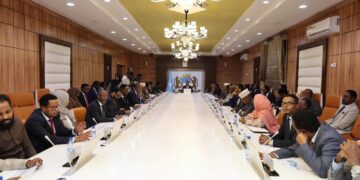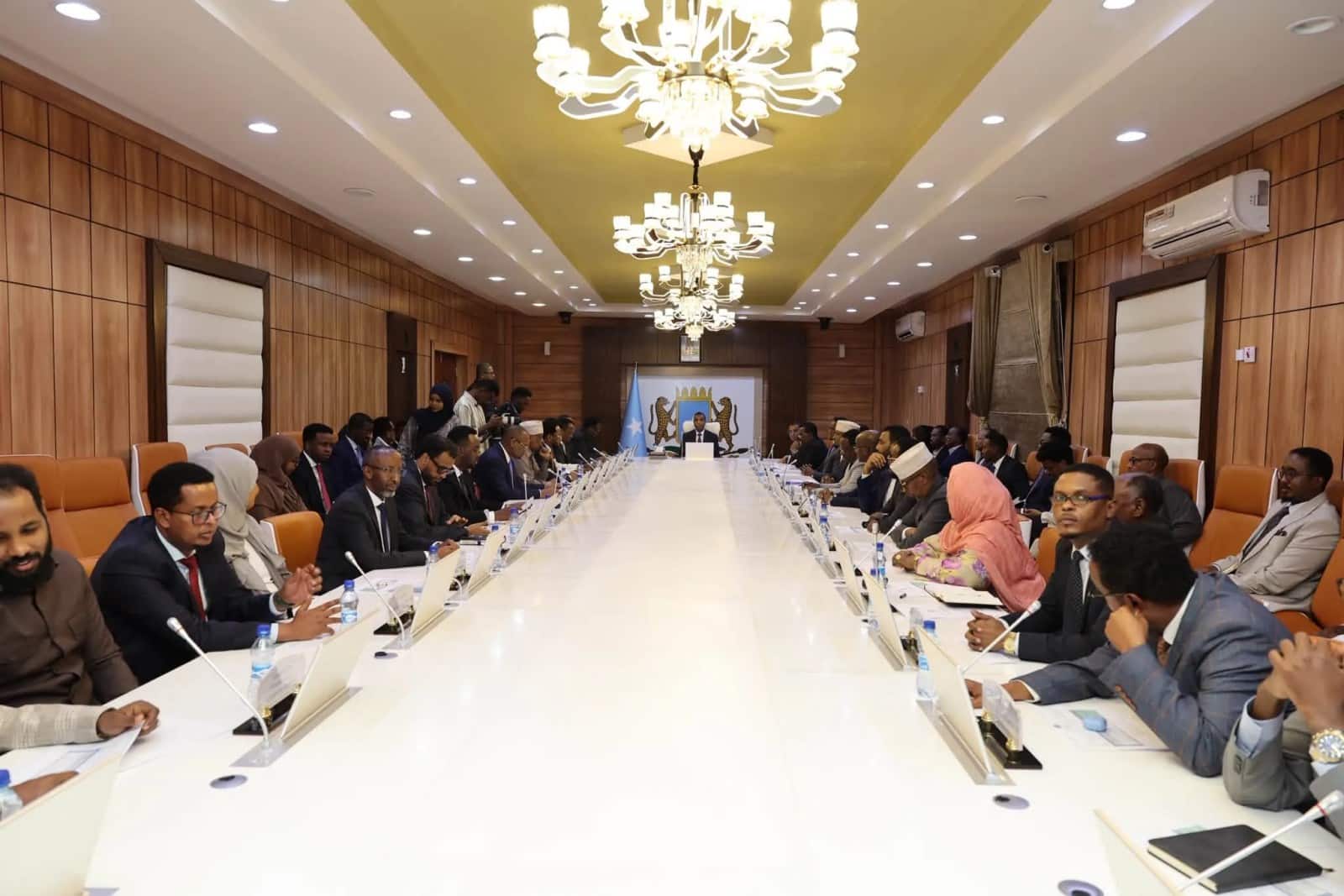
MOGADISHU, SOMALIA – Prime Minister Hamza Abdi Barre’s cabinet approved amendments to 23 articles of the National Elections Law and eight articles of the law on political organisations and parties at an extraordinary session on the evening of Tuesday 24 November. The changes introduce a closed party list for parliamentary seats and a 10 percent vote threshold for national party status. Their session came eleven days before the 5 December deadline the Supreme Court set for the government and its opponents to agree an electoral framework, in a ruling that held the mandates of parliament and of President Hassan Sheikh Mohamud had expired and confined the government to caretaker business. The opposition has refused to negotiate without international mediators, and the amendments still need the approval of a parliament whose term, by the court’s reckoning, ended on 14 April.

What the Cabinet Changed in the National Elections Law
Under the amended National Elections Law, citizens vote directly for district councils, for the assemblies of the federal member states and for both houses of the federal parliament. Those bodies in turn elect every officeholder from district chair to President of the Republic, according to the government’s statement. Political organisations will submit their parliamentary candidates on a closed list ranked in advance, so that the order a party sets decides who takes the seats it wins at the polls. Any organisation that wins at least 10 percent of the vote in a federal election becomes a national party. The cabinet also authorised the National Independent Electoral and Boundaries Commission to adopt procedures and technology to ease voter registration and voting, citing a constitutional clause on making participation easier for citizens.
The government said both laws had been passed before the constitution was adopted and had to be brought into line with it. Parliament approved the National Elections Law, the parties law and the law establishing the electoral commission in November 2024, and in March 2026 it approved chapters five to fifteen of the revised constitution, which President Hassan Sheikh Mohamud signed on 8 March. The text completed this year, after a compromise with part of the opposition, gives the choice of president to the members of the federal parliament, whereas the chapters adopted in March 2024 had provided for a president elected directly by the people. Tuesday’s amendments write that chain of indirect election into the National Elections Law, from the district council upward.
The same session approved an agreement with the United Nations to open an office of the High Commissioner for Human Rights in Somalia, with diplomatic immunity for its staff, presented by the Ministry of Family and Human Rights Development. The electoral amendments now go to parliament, which must pass them before they take effect. On the morning of the session, a separate law on the allocation of seats in the federal parliament was reported to be heading to the cabinet and then to the standing committee of the House of the People by the end of the week.
A Registration Window Still Open
On Thursday 15 October the electoral commission set elections for both houses of parliament for 15 April 2027 and the presidential vote for 15 May 2027, counting the president’s term as five years from his swearing-in under the amended constitution. It reopened registration of voters and political organisations on Sunday 1 November, to close on Sunday 22 November, the day candidate lists for both houses were due. On that Sunday the commission extended the deadline for political organisations to register to Monday 30 November, after several organisations said the time allowed was insufficient, and reports of the extension did not say whether the candidate lists moved with it. The cabinet changed the rules for those lists two days later, with registration still open. A provisional voter roll is due on 21 January 2027, and campaigning for parliament is scheduled to open on 27 February.
Within hours of the timetable, the opposition Salvation Forum called it election theft and former President Mohamed Abdullahi Farmaajo warned of rival elections. On 4 December 2024, shortly after parliament passed the National Elections Law, former President Sheikh Sharif Sheikh Ahmed, former Prime Minister Hassan Ali Khaire and the MP Abdirahman Abdishakur Warsame rejected the commission and the election laws as contrary to the agreed constitution. They warned that the laws could lead to political conflict, insecurity and “endless term extensions”. Puntland withdrew its recognition of the federal government after the 2024 constitutional amendments, and Jubaland suspended cooperation with Mogadishu shortly after the election laws were passed.
In Galmudug this year the Supreme Court annulled the July vote over procedural breaches, and the president’s Justice and Solidarity Party won the rerun with 67 of the 89 seats in September. In Hirshabelle the commission declared that the same party had won 78 of the state’s 99 seats, and the assembly re-elected President Ali Gudlawe on 24 October, although Hawadle elders had said for months that no state vote could be held in Hiiraan without a political settlement. Beledweyne, the capital of the Hiiraan region within that state, has since become the scene of an armed standoff between the Hawadle clan militia and the administration Mogadishu backs.
The Thirty Days the Supreme Court Allowed
On Thursday 5 November the Constitutional Division of the Supreme Court, led by Justice Salah Sheikh Ibrahim Dhiblawe, ruled that the federal mandates had expired. President Hassan Sheikh Mohamud’s ended on 15 May and parliament’s on 14 April, the court found, because the extension of terms from four years to five could not apply to sitting officeholders. The court gave the parties 30 days to agree an electoral framework and 90 days to hold elections, and limited the government to routine caretaker business in the meantime. Former President Sheikh Sharif Sheikh Ahmed had brought the petition against the March amendments, the same constitutional changes the cabinet cited on Tuesday as its reason for amending the National Elections Law.
On the same day the court voided the president’s dismissal, the night before, of Chief Justice Bashe Yusuf Ahmed, and the presidency swore in Ibrahim Idle Suleiman, legal affairs secretary of the Justice and Solidarity Party, as chief justice on 7 November regardless.
Bashe and five other justices have since taken the federal government to the East African Court of Justice in Arusha, whose First Instance Division gave Mogadishu 45 days to respond on 18 November. The United States, Britain, Turkiye and the European Union, known as the Quartet, agreed to facilitate the talks President Hassan Sheikh Mohamud called for 14 to 18 November, and the Somali Future Council said it would attend only with the same four partners as mediators, so the forum never convened. By Friday 20 November opposition leaders had turned down an offer, relayed through the former prime minister Abdi Farah Shirdon, to meet the president at Shirdon’s home, four days before the cabinet amended the National Elections Law.
The opposition’s conditions are international mediation, the reversal of the one-person, one-vote model and of the constitutional changes, and security guarantees for President Said Abdullahi Deni of Puntland and the other member state presidents who would attend. On 19 November Prime Minister Hamza Abdi Barre told the opposition there was “no international community left to mediate between us”. Five days later his cabinet settled by its own decision the rules of the National Elections Law that the court had told the government and the opposition to agree together, and sent them to a parliament the same court regards as out of time.
A Party List Against a Clan Formula
The government presents the closed list as part of its plan for one-person, one-vote elections fought between parties, in which parties choose the MPs who represent them and the open list, which left that choice with voters, is dropped. The opposition favours direct elections organised around the clan formula and objects to a vote built on parties and registration, according to the same account. Both sides also differ over the commission itself, since the opposition wants electoral bodies at two levels and the federal government a single commission for the whole country. That evening the cabinet was also expected to consider new appointments linked to political tensions in some regions.
In May 2019 the cabinet approved an electoral bill containing a closed party list, and a parliamentary review committee removed it in favour of competition between individual candidates. President Hassan Sheikh Mohamud, then in opposition, was among those who strongly opposed the closed list in 2019 and 2020, according to local reporting on the law’s history. Seven years later his own prime minister’s cabinet has written it into the National Elections Law, with the closed list and the 10 percent threshold meant to govern an April vote for which political organisations are still registering until 30 November.
Villa Somalia has said that President Yoweri Museveni of Uganda accepted an invitation to visit Mogadishu, without giving a date. The invitation followed a joint communique in Entebbe on 23 November and the presidency’s denial that it had accepted Ugandan mediation with the opposition. Former President Mohamed Abdullahi Farmaajo welcomed the visit on X on Tuesday and called for inclusive political talks grounded in the constitution and in the Supreme Court’s decision against the term extension, which he called unconstitutional. By that evening the cabinet had amended the National Elections Law without the opposition, and the court’s deadline for agreeing the rules with it falls on 5 December.