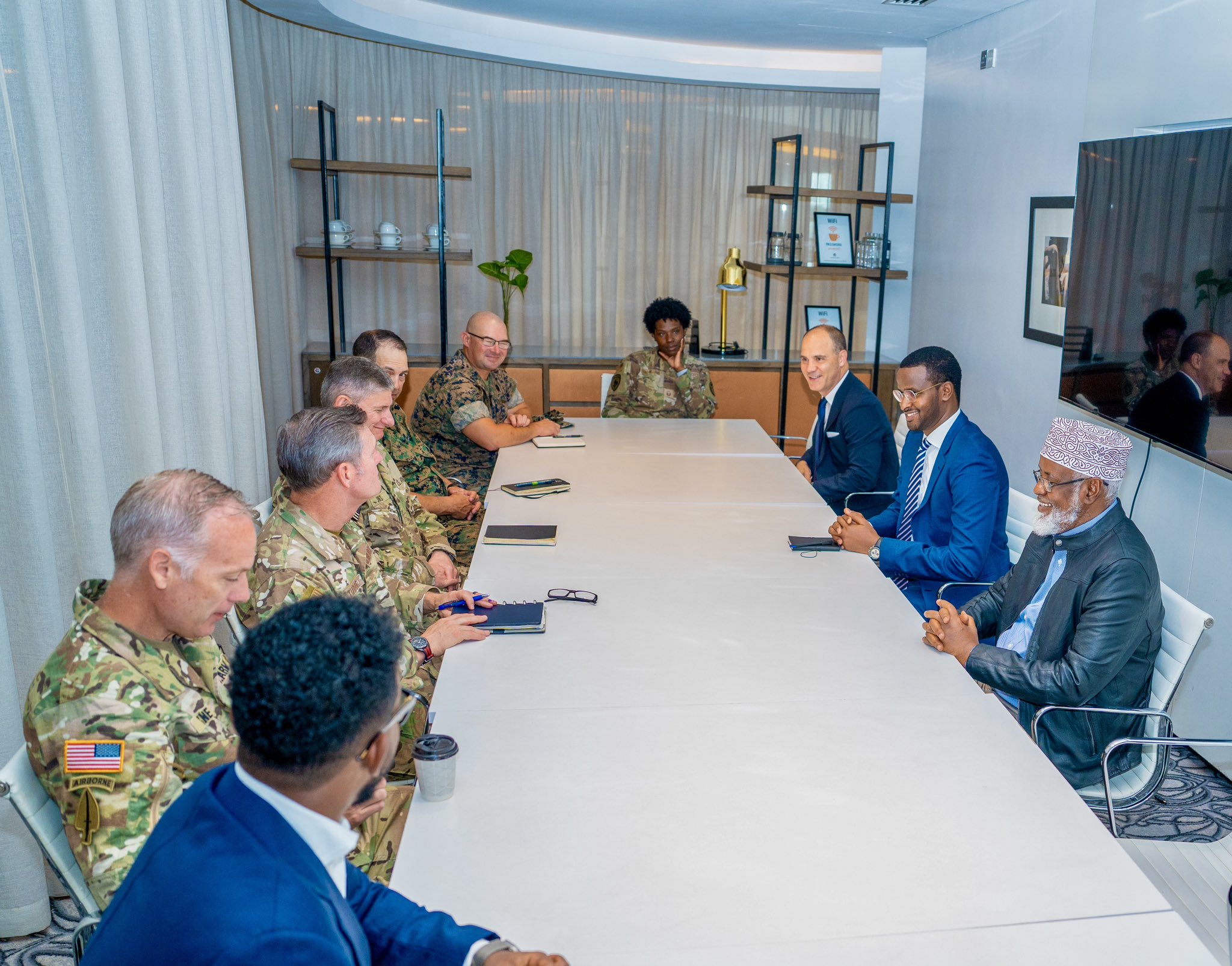
NAIROBI, KENYA – The commander of American special operations forces in Africa met Jubaland President Ahmed Madobe in Nairobi on Friday, closing a week in which he had already been received in Hargeisa and in Bosaso and had made no published stop in Mogadishu. Major General Claude Tudor Jr led a delegation that discussed accelerating operations against al-Shabaab, widening intelligence sharing and strengthening the state’s own forces, with the head of Jubaland’s intelligence agency at the table. Ahmed Madobe now stands alongside the presidents of Somaliland and Puntland on a short list of leaders Washington’s special operations command negotiates with directly, at the very moment Villa Somalia is spending its soldiers against Puntland at Galkayo and its diplomacy on an electoral standoff it has not managed to settle.

What Ahmed Madobe Put on the Table in Nairobi
Tudor has commanded Special Operations Command Africa since June 2025, directing roughly nineteen hundred American, interagency and partner personnel across nineteen countries. His portfolio covers precisely the missions that keep the United States militarily present in Somalia. Ahmed Madobe brought Mohamed Ahmed Sabriye, who runs the Jubaland Intelligence and Security Agency and coordinates the state’s operations against the insurgency. The agenda ran through the security picture across the state, faster operations to retake ground al-Shabaab still holds, and a larger flow of American assistance to the forces expected to do the retaking. The Jubaland statement named the participants and the agenda without naming the venue.
Jubaland is where that agenda has its most obvious application. Al-Shabaab controls much of the hinterland of Middle and Lower Juba, and the Danab commando units the United States trains and funds have operated across the region for years. Kismayo remains the one southern port city whose administration is not currently at war with its own capital. Ahmed Madobe has been Washington’s working partner in southern Somalia since the campaign that took the city in 2012, which is longer than any federal president has lasted in office. His administration also maintains an intelligence service of its own, rare among the member states, and that gives a visiting American command something concrete to plug into.
Therein lies the constitutional difficulty for the federal capital. Force generation, liaison with foreign militaries and the terms of security assistance all sit with the federal government under Villa Somalia’s reading of the provisional constitution. A state president settling them abroad, in a room with no federal official in it, writes the centre out of the transaction on the one file the centre still claims as exclusively its own. Neither the Jubaland statement nor any federal one mentioned coordination with Mogadishu. Ahmed Madobe has heard no public objection from the federal government, whose silence has been the consistent response to every American approach of the past fortnight.
A Week That Began in Hargeisa and Ended in Nairobi
Six days before Ahmed Madobe took his turn, the same commander was in Hargeisa. Somaliland President Abdirahman Mohamed Abdullahi Irro received him at the presidential palace on 1 August for what the Somaliland presidency called strategic talks. Discussion covered the Red Sea, the Gulf of Aden and the Bab al-Mandab strait, and Irro told the delegation that a coastline of more than 850 kilometres gives Somaliland a working role in securing international shipping lanes. He added that partners seeking cooperation on maritime security ought to engage Somaliland directly. Tudor answered that Washington was ready to expand intelligence sharing, professional exchanges and capacity building.
A day later the delegation was in Bosaso. President Said Abdullahi Deni and the American side signed an agreement there allowing the United States to expand its military facility in the port city, covering counterterrorism operations and maritime security, concluded without the federal government anywhere in the room. That document, as this masthead argued at the time, gave Puntland something no amount of rhetoric from Garowe could produce on its own, which is an American stake in its own stability. Ahmed Madobe had a comparable case to make.
Nairobi supplied the room for the third meeting, and it was busy that Friday. Irro spent the same day in the Kenyan capital telling foreign diplomats to engage Somaliland as a sovereign state rather than an extension of Somalia. Kenya has hosted this kind of business for two decades, close enough to the file to be convenient and far enough from Villa Somalia to be discreet. Hargeisa, Bosaso and a Kenyan boardroom in seven days, three distinct security relationships, each negotiated with whichever administration actually holds the ground and the coastline under discussion. What Ahmed Madobe accepted in Nairobi is what Irro and Deni had accepted before him, namely that the shortest route to American support no longer runs through Villa Somalia. Nobody in Mogadishu has offered a competing route.
The Warning Mogadishu Received First
None of this arrived without notice. AFRICOM’s commander was in Mogadishu at the end of July, pressing President Hassan Sheikh Mohamud and the wider political class for an inclusive agreement. He said plainly that if Somalia’s political dysfunction became the story rather than counterterrorism progress, staying engaged would become very hard. That was a condition attached to American resourcing, delivered in the capital, to the men with the power to act on it. Ahmed Madobe was not in that room, and did not need to be.
The ten days since have answered the general. International partners met the Somali president again on 4 August over an electoral deadlock the opposition insists cannot be settled by a framework Villa Somalia writes alone. Puntland forces then stormed a federally aligned camp in northern Galkayo on 5 August, taking 101 prisoners along with weapons, vehicles and police equipment, and seized a second compound in Bosaso the following morning. The Puntland cabinet has since ordered the prosecution of politicians and officers it accuses of undermining state security, converting a week of military gains into a standing legal position. Federal soldiers are meanwhile being counted as detainees in Mudug while the insurgency holds towns in Hiran and Middle Juba, and the electoral timetable that was supposed to justify all this federal effort remains unwritten.
Money is running out underneath the whole arrangement. Washington told the African Union on 1 July that it would not support renewing the AUSSOM mandate in December, and the logistics package that keeps the mission fuelled and flying expires alongside it. That is why the troop contributors’ approved offensive plan carries no funding behind it. An American command facing that horizon will buy counterterrorism outcomes wherever it can find someone capable of delivering them. Ahmed Madobe, Deni and Irro each command forces that hold territory, and territory is the only currency in that market.
What Ahmed Madobe Gains and Villa Somalia Forfeits
Jubaland has spent seven years demonstrating that federal pressure fails against it. Federal troop deployments intended to dislodge Ahmed Madobe produced the Gedo standoff and the collapse at Ras Kamboni rather than a change of administration in Kismayo. The state emerged from that campaign stronger than it entered, with its own forces intact and its president still in office. A leader who survived the army sent to remove him now sits across a table from the general who commands the American forces that army leans on.
The conversion at work here is straightforward enough. Territorial control becomes diplomatic standing, diplomatic standing becomes assistance, and assistance underwrites the territorial control that began the sequence. Each turn of that wheel makes the state harder to coerce and the centre less relevant to its calculations. Ahmed Madobe enters that loop holding an intelligence service, a trained commando presence, a working port and a record of keeping what he takes. Villa Somalia enters the same week having lost two camps in Puntland, with a hundred of its men in Garowe’s custody, an election it cannot schedule and a mission mandate expiring in December. Jubaland’s leverage grows out of the ground it controls, and the federal government’s shrinks with every camp it loses.
Sovereignty in the Somali federal arrangement has always rested less on the constitution than on being the address foreign partners were obliged to use. That address is being bypassed in Hargeisa, in Bosaso and now in a Nairobi meeting room, in each case by an administration that can point to ground it holds and enemies it fights. Ahmed Madobe did not create the opening, and neither did Deni. It was made in Mogadishu by a government that has spent the year proving it would rather fight the member states than the insurgency, and the Americans have simply started shopping accordingly.