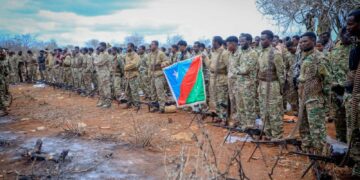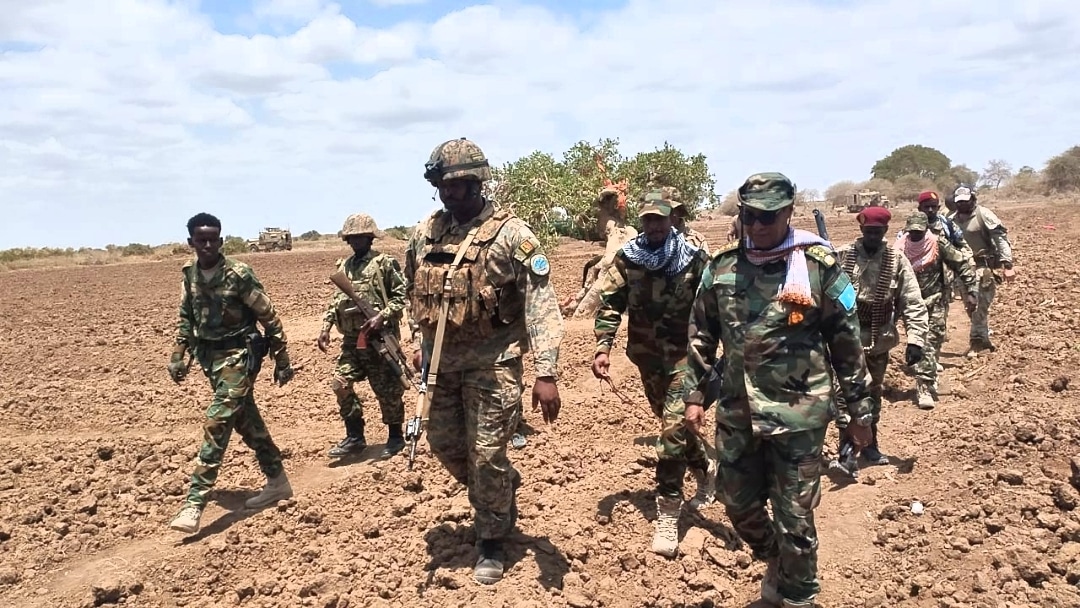
MOGADISHU, SOMALIA – A military truck carrying Somali soldiers between the garrisons at Awdhegle and Mubarak was destroyed by a buried charge on Monday, killing more than a dozen men by the most conservative accounts and, by the claim al-Shabaab issued afterwards, more than twenty, with a field commander among the dead and the wreckage left on the road for the cameras. Both towns in Lower Shabelle were taken from the group with Ugandan infantry on the ground and Turkish aircraft overhead, and the government has held them since. Three days later it has published no casualty figure and no account of the ambush, while the men who speak for it have spent the week lecturing the foreign partners whose soldiers and aircraft made the capture possible.

The Points the Army Took in Lower Shabelle
Awdhegle returned to government control on a Saturday in early October last year, at the end of months of operations aimed at the bridges over the Shabelle river. The army presented the capture as the completion of a set that already carried Barire and Sabid-Anole. Security planners in Mogadishu treat five crossings on that river as the approaches to the capital, and three of them were now covered on the map. Mubarak followed in March, cleared by Ugandan infantry alongside Somali troops who then built a forward operating base in Qoryoley district. Together the two garrisons were meant to close the riverine corridor the insurgency had used to push fighters and revenue toward the edge of the city.
What the campaign produced in Lower Shabelle was a chain of occupied points. The farmland between them, the irrigation canals, the feeder tracks that carry sesame and sorghum to the Mogadishu markets, all stayed with the men who had been taxing them for the better part of a decade. Al-Shabaab surrendered the towns it had seized in its own offensive at the start of last year and kept everything that made those towns worth holding, which is why a resupply run of a few kilometres has become an operation requiring its own planning.
The charge on Monday was laid on that stretch, and it worked the way the group’s engineers have worked since the first stabilisation offensives. They mine a connecting road, wait for the rhythm of movement between two fixed positions to settle into a habit, and fire against a vehicle carrying a full complement of men. Tempo belongs to whoever can move freely, and across the country between Awdhegle and Mubarak that has been the insurgency in every month the national flag has flown over both towns.
The same arithmetic unwound the gains of the central campaigns further north, where towns cleared with foreign fire support were held for a season and then given up once the enablers moved on. Mahas, Adan Yabaal and Moqokori all went back that way. Lower Shabelle is now at the earlier stage of the same sequence, the point at which movement between garrisons turns expensive and the garrisons start to live on the air bridge.
The Enablers That Leave Before December
Both of the capabilities that produced those captures in Lower Shabelle are running on a clock. The Ugandan infantry serves under the African Union mission whose funding expires on 31 December, and Washington has already told the African Union that it will carry no logistics past that date. Turkish air power sits outside the mission and will outlast it, though aircraft have never yet held a road at night against men with shovels. Al-Shabaab tried to overrun the Mubarak base in March and lost more than forty fighters by the mission’s own count, which is the kind of defence that requires Ugandans on the perimeter. Nothing in the transition plan replaces a battalion that can walk a route and clear it.
The withdrawal is moving faster than the diplomacy meant to cover it. Ethiopian troops pulled out of Buurhakaba this week after twelve years in the Bay region town, handing their positions to a Somali army that inherited a garrison ringed by the insurgency. That handover arrived well ahead of the money, with three more towns due to change hands in the same weeks. Each transfer adds another set of roads the army must now travel alone.
Behind the infantry, the supply chain itself is being sold. The United Nations office that fuels, feeds and houses the mission has opened a public tender for licensed auctioneers to dispose of its inventory across Somalia, which is what a mission does when it expects the mandate to lapse. Vehicles, generators and prefabricated accommodation are the physical form of everything that keeps a garrison in Lower Shabelle supplied when its road is closed.
The sequence facing the army is therefore visible in advance. The enablers depart on a published timetable, the garrisons stay where they are, and the burden of driving the connecting routes falls entirely on the units that have proved least able to survive them. Monday established the price of one such journey in Lower Shabelle at a truckload of soldiers and a commander. That price was paid while the Ugandan battalions were still in the country and the fuel still arrived by contract.
The Casualty Count Villa Somalia Has Withheld
Three days on, the numbers remain contested. Accounts from the area put the dead at more than a dozen. Al-Shabaab claimed over twenty killed and dozens wounded, a figure the group has every reason to inflate and which no independent tally supports. A Somali journalist with long experience of the southern front put the toll at thirty and reported many more injured. Photographs circulating afterwards showed the truck reduced to a frame beside the road, which is consistent with a charge built to defeat an armoured cab.
The government has issued no statement of any kind. The defence ministry has published no figure, the presidency has offered no condolence, and the army’s own bulletins on operations in Lower Shabelle pass over the ambush entirely. Families in Mogadishu and the Shabelle valley consequently learn what happened to their sons from the propaganda channels of the organisation that killed them, which is a form of information surrender that costs the army recruits it cannot replace.
The withholding is by now a settled practice across the whole southern front. An explosive device against an army supply truck on the capital’s own outskirts produced the identical sequence of claim, partial local count and official silence. Each repetition leaves the insurgency as the only party with a published version of events. Each one also devalues the next official denial, at whatever point the government decides that a number is worth giving.
Attribution is the honest position here, since neither the group’s figure nor the journalist’s has been verified by anyone with access to the site. What can be established without dispute is that a substantial body of soldiers left one government-held town in Lower Shabelle and did not reach the next one, that their commander was among the losses, and that the state which sent them has declined to say how many it buried.
Lower Shabelle Waits While Mogadishu Argues
On Tuesday the prime minister, Hamza Abdi Barre, accused the country’s international partners of a cultural problem and of treating Somalia as though the transitional period had never ended, dictating to his government what it may and may not do. He argued that Somalia surpasses several East African states on multiple measures and should not be held in contempt, and he asked the partners to change their approach.
The complaint arrived a week after President Hassan Sheikh Mohamud asked the summit of troop-contributing countries to delete from its communique the clause urging his government to engage the opposition, on the argument that Somalia’s internal politics are a sovereign matter beyond the reach of the states funding its army. The day after his prime minister spoke, the president told an education gathering in Mogadishu that the country must abandon personality-driven politics and build institutions capable of establishing who decides what.
Those two speeches describe a government preoccupied with the terms of its own recognition while the practical war goes unremarked. The partners being lectured are the Ugandan contingent that cleared Mubarak, the Turkish squadron that covered the advance, the United Nations office now auctioning the mission’s fuel bowsers, and the American logistics line closing in December. Each of them supplies an input the Somali National Army cannot presently generate for itself in Lower Shabelle or anywhere else. The complaint about being dictated to therefore lands on the only institutions still willing to underwrite the fighting.
Sovereignty of the kind Villa Somalia has been asserting all week is measured on roads like the one between Awdhegle and Mubarak. The government has held that route on paper since October, cannot cross it without losing a truckload of men, and by January the infantry and the aircraft that made the paper claim possible will have gone home. Lower Shabelle will still be there in the spring, and so will the men who mined it.